On Rights Politics and Migrant Workers


These notes were prepared for a discussion in Delhi on a report on the condition of migrant workers in Delhi, Uttarakhand and Tamil Nadu (October 6 2017).

REFORMS & REVOLUTION

1. The two significant aspects of demand and right politics are – firstly, they are grounded in the immediate social needs that are framed within a structure. Secondly, they are attempts to establish a discourse with the state machinery – hence they are discursively circumscribed within the field of social relations. Thus, they are necessarily reform oriented, but they need not be reformist. The questions of rights, reforms and demands are unavoidable guerrilla struggles, which build the capacity of workers to organise larger movements. But do these struggles mean deferring the final movement that targets the very structural and superstructural setup that give language to those social needs? No, because they also test the vulnerabilities of the system and can become endeavours to burrow through it the final escape or emancipation. Every moment is a moment for both reform and revolution, and also reaction. When a movement is able to transcend its initial demands, to go on to attack the present social relations and to reorganise them then it becomes revolutionary. When the movement attempts to take the leap, but fails, then reaction happens. When the movement is not ready to take any leap beyond or reneges at the last moment, reform and/or reaction can happen, depending on the level of crisis in the system.

2. However, because the rights politics in itself is concerned with achievements of the rights and demands, at its own level will be geared towards negotiations and bargains, and impressing upon the state machinery, rather than changing the social relations themselves. Even the trade union politics is embedded in this kind of relationship. There is nothing in these forms that makes them question the structure of that relationship between workers and capitalists, or in the former case between workers and the state. The danger of reformism comes from this. But once again, as a conscious part of the larger movement against the structure of present social relations they play a crucial role of waging guerrilla struggles. But what does this signify? Then how do we define the working class politics? Also what will be the organisational question which balances between reform and revolution?

3. When we talk about workers’ politics, it is grounded in the dialectic of competition and collectivity. Marx captured this very aptly, when he said: “Wage-labour rests exclusively on competition between the labourers. The advance of industry, replaces the isolation of the labourers, due to competition, by their revolutionary combination, due to association.” The politics that is premised upon the segmentation of the workers vs the politics of ever-expanding combination and association, that is grounded in the everyday interaction among workers. The latter is not a mechanical aggregation or unity of isolated workers with similar grievances or demands, but a combination or network that is built in their daily conflict with state and capital. Only an expansion of this network has the capacity to refuse to be subsumed by capital and its network. In this, demands are definitely raised but are incidental. In this framework, demands and rights play the role of testing the system’s vulnerabilities and the organisational strength of the expanding combination.

ON MIGRATION

4. Migration is not just a fact, but also an act. It is not fully incidental that a word for migration in Hindi is पलायन (the more formal word is प्रवास). The former is very rich, often used as a stigma – one of its meaning being running away or an escapist act. In my view, it is this sense that renders the act of migration politically rich. Migration is not just a spatial fix, a response of the weak to the immediate contingencies of life. It is also a rebellious withdrawal, an escape, a long march against “the current state of affairs.” It is an act of refusal, non-acceptance of the lot. As an immediate spatial fix it demonstrates the weak agency of the migrant – a weakness in mastering the system. But it also has a utopian element that makes any human agency restless, that may come one time as an escape, another time as an emancipation, especially when individual weakness becomes a ground for collective subjectivity. Wasn’t this Ambedkar’s intention when he advised dalits to escape villages?

5. Legal Unionism is bound to consider migrant and mobile workers unreliable for their purpose – it simply cannot rely on them. On the other hand, social unionism which seeks to overcome the limits of traditional unionism is caught up in the discourse of non-conflictuality and negotiations with state (which in turn is problematically conceptualised). Hence for this school too it is always about accommodation – creating space for the migrants, not about problematising the whole space itself which is the etatised field of labour-capital relations. Therefore the vagrancy and mobility of proletarians are something to be shed off, not to be made a ground to imagine an overhauling of social relations and ideologies. Hence migrants as migrants are suspects, to be always put in the peripheries of organised politics. But different revolutions have shown how it was mostly settled workers’ organisations, afraid of losing their accumulated privileges, developed petty bourgeois tendencies and were unable to go beyond the legal fights when required, unless workers revolted and autonomously organised themselves.

6. Right from Karl Marx, Marxists have understood the relationship of workers mobility and their political consciousness. Lenin provides an insight into the poltical meaning of migration and demonstrates how to think about workers beyond their victimhood and our philanthropist vanguardism:

“There can be no doubt that dire poverty alone compels people to abandon their native land, and that the capitalists exploit the immigrant workers in the most shameless manner. But only reactionaries can shut their eyes to the progressive significance of this modern migration of nations. Emancipation from the yoke of capital is impossible without the further development of capitalism, and without the class struggle that is based on it. And it is into this struggle that capitalism is drawing the masses of the working people of the whole world, breaking down the musty, fusty habits of local life, breaking down national barriers and prejudices, uniting workers from all countries in huge factories and mines in America, Germany, and so forth.”

“Thus, Russia is punished everywhere and in everything for her backwardness. But compared with the rest of the population, it is the workers of Russia who are more than any others bursting out of this state of backwardness and barbarism, more than any others combating these “delightful” features of their native land, and more closely than any others uniting with the workers of all countries into a single international force for emancipation.

“The bourgeoisie incites the workers of one nation against those of another in the endeavour to keep them disunited. Class-conscious workers, realising that the breakdown of all the national barriers by capitalism is inevitable and progressive, are trying to help to enlighten and organise their fellow-workers from the backward countries.”

7. In recent years, Negri (and Hardt) repeats the same in the language of our times:

“Traditionally the various kinds of migrant workers, including permanent immigrants, seasonal laborers, and hobos, were excluded from the primary conception and political organization of the working class. Their cultural differences and mobility divided them from the stable, core figures of labor. In the contemporary economy, however, and with the labor relations of post-Fordism, mobility increasingly defines the labor market as a whole, and all categories of labor are tending toward the condition of mobility and cultural mixture common to the migrant. Not only are workers are forced to change jobs several times during a career, they are also required to move geographically for extended periods or even commute long distances on a daily basis. Migrants may often travel empty-handed in conditions of extreme poverty, but even then they are full of knowledges, languages, skills, and creative capacities: each migrant brings with him or her an entire world, Whereas the great European migrations of the past were generally directed toward some space “outside,” toward what were conceived as empty spaces, today many great migrations move instead toward fullness, toward the most wealthy and privileged areas of the globe…

“Part of the wealth of migrants is their desire for something more, their refusal to accept the way things are. Certainly most migrations are driven by the need to escape conditions of violence, starvation, or depravation, but together with that negative condition there is also the positive desire for wealth, peace and freedom. This combined act of refusal and expression of desire is enormously powerful…. Ironically, the great global centers of wealth that call on migrants to fill a lack in their economies get more than they bargained for, since the immigrants invest the entire society with their subversive desires. The experience of flights is something like a training of the desire for freedom.

“Migrations, furthermore, teach us about the geographical division and hierarchies of the global system of command. Migrants understand and illuminate the gradients of danger and security, poverty and wealth, the markets of higher and lower wages, and the situations of more and less free forms of life. And with this knowledge of the hierarchies they roll uphill as much as possible, seeking wealth and freedom, power and joy. Migrants recognize the geographical hierarchies of the system and yet treat the globe as one common space, serving as living testimony to the irreversible fact of globalization. Migrants demonstrate (and help construct) the general commonality of the multitude by crossing and thus partially undermining every geographical barrier.”

On Enzensberger’s poem “Will and Representation”


The italicised texts are from Hans Magnus Enzensberger’s poem “Will and Representation” in his collection, “A History of Clouds”. Translated by Martin Chalmers and Esther Kinsky (Seagull Books, 2010)

He thinks he knows what he wants.
The seed of success is exactly in this thinking. Even if in the end what he gets is nowhere near what he wants, or near what he knows what he wants, or near what he thinks he knows what he wants, it is his thinking that he knows what he wants that encourages him, so that
He gives of his best
What else is the meaning of giving his best if not that
He strives He toils
Here it is not just about thinking, or knowing or wanting, but doing with plans to achieve what he thinks he knows what he wants. If he doesn’t do anything he can’t get anything – as great Lucretius said nothing comes out of nothing. But if he does without plans, he might not get what he thinks he knows what he wants. He has to plan, to adjust according to the context, to the forces that he can’t manage, and to the forces that he must manage, so that
He makes it He climbs
When he makes it, he climbs. His surge humbles powers that resisted his making it, his climbing, and they take their
Hats off to his effort
Rags to riches, so much striving and toiling against all oddities – they wonder what use are those multi-generation dynastic lineages. Here is He thinking what he knows what he wants, strives and toils, makes it and climbs. He is the biography of the modern man, he represents each of us – our ideal. Thus,
A breeze bore him
It gives him some solemnity after so much hard work, but in the end he must be on
A Wind
He represents us, he must ride the Wind, which bears whatever has climbed. The system must take over, in other words, he must be on the top of the system representing us, our thinking, our knowing, our wanting, our striving, our toiling. Through his sheer will, he has climbed. But now he takes over the driving seat in the automatic roller coaster, or rather the wind takes him over
Like this maple leaf
We invest our energy, our concrete labour to feed into the abstraction of the system, for a place in the system, which takes us as this maple leaf
Suspended up there
he is at bliss taken over by the wind, which is unaware of what he thinks, what he knows, what he wants. Look at this maple leaf, how
Playfully it gets into a spin, wavers
Exactly like this, he too is playful, and usefully he spins and wavers – demonstrating to aspirants his blissful state, enjoying his abstraction. Lo! He
Rises up once more
a shudder of ecstasy, and now he
Slowly sinks Lies there weak-willed
Quenched, he
Rests awhile Rustles
His body like the maple leaf
Discolours
but he becomes one with the machine, the spirit of the wind, evermore striving and toiling through us, feeding on us.

Russian Revolution and Luxemburg’s Approach


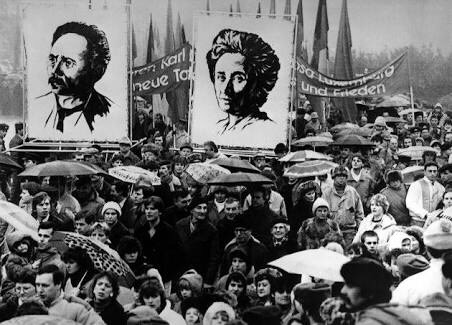
Even being a direct observer of the happenings in Russia and being critical of Bolshevik practice, Rosa Luxemburg could keep a far more objective and materialist understanding of the problems of the Russian Revolution, in comparison to the theo-sectarian polemics around facts and counter-facts that is being exercised today globally during the centenary celebrations. In a letter to Adolf Warski written less than a couple of months before her assassination, Luxemburg comments on the two most crucial problems of the Russian Revolution and Bolshevik practice, refusing to subjectively analyse them. It is this objectivity that generated her revolutionary “optimism of will”. She writes:

The use of terror indicates great weakness, certainly, but it is directed against internal enemies who base their hopes on the existence of capitalism outside of Russia, receiving support and encouragement from it. With the coming of the European revolution, the Russian counter-revolutionaries will lose only support [from abroad] but also – what’s more important- their courage. Thus the Bolshevik use of terror is above all an expression of the weakness of the European proletariat. Certainly, the agrarian relations that have been established are the most dangerous aspect, the worst sore spot of the Russian Revolution. But here too there is a truth that applies – even the greatest revolution can accomplish only that which has ripened as a result of [historical] development. This sore spot also can only be healed by the European revolution. And it is coming!

George Adler, Peter Hudis and Anneliese Laschitza (ed), The Letters of Rosa Luxemburg, Verso (2011), pp 484-85

The Economics of India’s Cow Fetishism


I think what intensified bovine politics in India is achieving is a sort of primitive accumulation in the livestock industry. It goes remarkably well with the concentration and centralisation of money and tax economies through the more formal measures like GST and demonetisation. These measures kill the autonomy of dispersed economic structures and fit them to the suction nodes of the neoliberal net of finance capital. The liberal and Keynesian economists have criticised many of these measures on the ground that they will destroy local economies and federal autonomy. Same well-meaning experts are criticising the way livestock policies have recently been formulated. The fascistic nature of their implementation is quite evident. However, the tangible structural change that is being effected through these measures are lost sight of in the overpowering moralism in these criticisms.

In a recent article in The Mint, some relevant statistics have been brought together. The authors rightly contends,

“It emerges that economics rather than religion drives cattle ownership in India. After adjusting for wealth inequality, cattle ownership shows a similar pattern across religions. Expectation of milk yields is what drives cattle ownership in India.”

They provide pertinent facts about the livestock economy and the negative impacts that the new policies and bovine politics have made on this economy.

“Female animals under two years would be expected to grow into milk-giving cattle. Breeding cows are still in their milk cycle. Everything else apart from these two categories can be described as non-milk animals. Only 15% of households own non-milk animals in India. This is half of the overall cattle ownership figure of 30%. Again, the figures are not very different across religions. One does not need to be a rocket scientist to guess where the non-milk bovines end up. They are the supply for India’s multi-billion dollar beef industry. It has been an unacknowledged but convenient arrangement. Most owners sell their non-milk cattle without asking questions about the end use. This is why the local cattle trade is crucial for India’s livestock economy. A government ban on sale of animals for slaughter in local markets, and vigilante mobs attacking those transporting cattle in the name of gau raksha, can destroy this arrangement. Everybody with stakes in the livestock economy would suffer as costs go up due to a pile-up of non-milk animals.”

However, the destruction of this existing arrangement is bound to proliferate new arrangements in the livestock industry. The unconcentrated dispersed cattle ownership based industry might lead to a greater degree of concentration and centralisation. The “local” cattle trade and meat businesses may give space to a more centralised livestock, meat and milk industry.

Hence, if till now it was economics, not religion that shaped cattle ownership and trade, then we must admit that it continues to be so. The economics behind restrictions, banning and lynchings must be recognised and revealed.

IN THE NAME OF SOCIALISM — “A CHAIN OF HISTORIC DEFEATS”


(Written for a bilingual collection published by Mazdoor Mukti (Kolkata), to commemorate the centenary of the Russian Revolution)

“The whole road of socialism – so far as revolutionary struggles are concerned – is paved with nothing but thunderous defeats. Yet, at the same time, history marches inexorably, step by step, toward final victory! Where would we be today without those “defeats,” from which we draw historical experience, understanding, power and idealism?” — Rosa Luxemburg

I

Many times in their political interventions Marx and Engels used the term socialism to signify any critique of capitalism both in theory and practice. In the Communist Manifesto they showed how this critique had provenance in various class standpoints. They developed a typology of socialisms which demonstrated that actually no class was satisfied within capitalism, not even the bourgeoisie; hence these classes developed their own critiques of capitalism, and therefore socialisms. Marx and Engels assessed the political dimensions and limits of these socialisms. How much they could really question capitalism in concrete terms was dependent on the respective class capacities, the location of these classes in the overall capital relations. These class critiques actually shaped the dynamics of capitalism too — exposing its contradictions and motivating changes. But only communism or the critique of capitalism from the standpoint of the working class has the capacity to present an all round critique — being an immanent critique it could go, not just against, but beyond capitalism. Communism or Proletarian socialism is “the expression of historical necessity”. Since “the proletariat has ‘no ideals to realise'”, the proletarian critique “can only breathe life into the things which the dialectics of history have forced to a crisis; it can never ‘in practice’ ignore the course of history, forcing on it what are no more than its own desires or knowledge. For it is itself nothing but the contradictions of history that have become conscious.”(1)

II

Call them deterministic, if you may, but it is true that Marx and Engels uttered at numerous junctures of their political activism and theoretical reflections that socialism/communism “cannot be ordered by decree”, that “revolutions are not made deliberately and arbitrarily but that everywhere and at all times they are the necessary consequences of circumstances which are not in any way whatever dependent either on the will or on the leadership of individual parties or of whole classes.” (2) But the proof of the pudding is in the eating — whether the circumstances were appropriate or not, whether the revolutions that happened in the twentieth century were postcapitalist/socialist or not, whether the leadership, individual parties etc did or did not rise up to the occasion provided by the circumstances could only be judged retrospectively. As Luxemburg commanded, “The question of why each defeat occurred must be answered. Did it occur because the forward-storming combative energy of the masses collided with the barrier of unripe historical conditions, or was it that indecision, vacillation, and internal frailty crippled the revolutionary impulse itself?” (3) However, even these problems of subjectivity must be explained in terms of their constitutivity — as evolving in the dynamics of the organic social processes that delimit subjectivity formation and freedom.

III

Fataha is an Arabic word meaning to open, to grant, to be victorious etc. It forms the root for Al Fattah, which is one of the names of Allah and means the Opener. What makes this term, fataha, interesting is the combined dialectical sense that its diverse meanings render. The way it celebrates, yet humiliates the victorious is quite fascinating – the victory or triumph is nothing more (and, of course, nothing less) than an opening. I think the heroic tragedies in history are mostly in forgetting this lesson. The so-called “conscious” radical social agencies often are oblivious of the dialectical truth of transience – they as missionaries, which definitely they are, think they have put the society to the desired pathway to the future, when it was just a mere possibility, one of the many possibilities. In fact, they have done nothing but opened Pandora’s box, bringing the society to the brink of possibilities (and uncertainties). What usually happens is that the phenomenality of the victory preoccupies everybody, it is reified.

IV

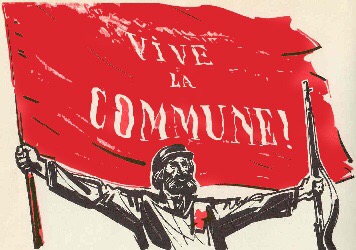
The Paris Commune “inaugurated” the “glorious movement” — “the dawn of the great social revolution which will for ever free the human race from class rule.” It was the concrete beginning of coherent revolutionary politics of the working class that continues to train generations of world revolutionaries, despite recurrent reversals as revolutionary advancements are time and again consolidated in the form of nationalistic successes and gains. Even though locally the Paris Commune was crushed, “the presence of the threatening army of the proletariat of the whole world gathering in the rear of its heroic vanguard crushed by the combined forces of Thiers and William of Prussia” “attest the hollowness of their [the enemies’] successes.” (4)

V

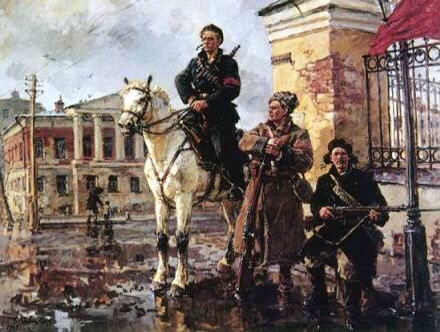
The October Revolution in its initial years was always taken as a mere “opening” for the European Revolution at least, if not the world revolution. It inaugurated a series of working class led revolutionary upsurges throughout Europe. Revolutionaries in Russia were aware of the need for the expansion of the revolution for the deepening of the revolution. Outside Russia, the revolutionary solidarity forces were intensifying their own struggles, which were understood as building upon the successful “opening.” However, as the world revolutionary movement subsided, especially with the defeats of the German Revolution, the “opening” became conscious of its distinction, its own being and endeavoured to survive merely as a state – regimenting internal forces of transformation and manipulating the vestiges of the solidarity forces to ensure its own survival. It became a model state. As the crisis of capitalism deepened, the “Russian Path” emerged as a formidable competitor to welfarist capitalism and techno-social corporatism that evolved to re-regulate national economies. The competition between these political-economic regimes took numerous turns – the Second World War, Cold War, Arms Race, and of course, “peaceful coexistence” that Stalin (not Khrushchev) initiated – “Let us not mutually criticize our systems. Everyone has the right to follow the system he wants to maintain.”(5)

VI

The Chinese Revolution too emerged as an opening for the revolutionary upsurges in various colonial and post-colonial peasant societies that questioned the teleology of market-oriented European capitalism. A planned nationalist transition with a controlled competitive regime, unimpeded by the imperialist politico-economic demands gripped the socialist imagination in these backward societies. We see large revolutionary movements and people’s wars rising in various parts of the world, especially on behalf of the pauperised peasantry and the precarised youth. These movements again saw the Chinese revolution just as an opening. But eventually the crisis of welfarism and statist capitalism, on the one hand, and the Cold War bipolarity, on the other, led to the reduction of various new de-decolonised states into self-hating rentier-bureaucracies, which bargained with the two poles and eventually became the ground for the neoliberal regime of economic restructuring. Ultimately, the Chinese state itself threw away the mantle of the Opener, and entered the fray to attract financialised capital huckstering upon the local institutions, resources and labouring population cheaply available.

VII

On a much smaller scale, the Cuban Revolution too emerged as an opening for the Latin American revolutionaries and in Africa. Most of the time both Cuban and Chinese revolutions combined to inspire peasant revolts. Che Guevara epitomised this opening, lending himself to replicate the Cuban experience across continents – Congo and Bolivia, but to remarkable failures. What he lacked, unlike the Maoist conceptualisation of the protracted war, was the ability to keep politics in command. His guerrilla practices were extreme forms of voluntarism and subjectivism. On the other hand, the Maoist practice internationally suffered from both conceptual and practical overgeneralisation, which came from the legitimate practice of developing “base areas.” The territorial militarist symbolism and existentialism of localised peasant struggles overpowered the political sense of these movements. This led to the subservience of every expansion to secure base areas, which were increasingly surrounded and squeezed by the globalised networks of the capitalist circuit. Hence, the base areas remained central to revolutionary survivalism, while becoming marginal to the overall anti-capitalist movement of the working class. Guerrillas became identities in themselves, rather than “masses in arms”, as Kwame Nkrumah used to define a guerrilla. These movements could never become threats to capitalism, but always remained as actual scapegoats to impose global McCarthyism.

VIII

In fact, it was this marginalisation and deadlock that the movements like Zapatistas in Mexico apprehended in the 1980-90s, and were forced to envisage struggle and solidarity beyond instituted territorialities and state power. It was a recognition of the implausibility of the statist imaginary of post-capitalist transformation in the age of financialised transnational capital regimes. The critique of militarism and vanguardism presented by movements like the Zapatistas was the clarity that “you cannot reconstruct the world or society, or rebuild national states now in ruins, on the basis of a quarrel over who will impose their hegemony on society.” (6) The impetus to recognise and build a world of many worlds was not a simple rhetoric to revert to some united front tactics. It was a result of a deeper critique of relative “human conditions” and a self-critique of revolutionary practice, that was fixated upon the pre-determined goal of capturing state power. The critique of vanguardism that the Zapatistas presented was an affirmation of the vanguard as constantly (re)composed in the diverse levels of struggle – “We do not want to monopolize the vanguard or say that we are the light, the only alternative, or stingily claim the qualification of revolutionary for one or another current. We say, look at what happened. That is what we had to do.” (7) Of course, by relinquishing the aim of state power, they affirm themselves to be only a subset of the protracted global struggle. The Zapatistas provided an opening for the movemental critique of capitalism and capitalist state-formation, but the hypostatisation of the movement form that happened subsequently externalised this critique and reduced it to a dualism of state and civil society, that the process of state formation has always sought to pose. The powerful Zapatista experiment was eventually circumscribed within the NGOised civil society discourse – lobbyist rights, localist self-help politics and difference assertion which suited the neoliberal political economy based upon an infinite discretisation of human capacity and lean politics. The solidarity politics and economy that were envisaged in the Zapatista movement were abandoned in favour of identitarianist assertions, rights discourse and lifestyle autonomy. Instead of negating the state in practice, the state question was left unproblematised, avoided and wished away.

IX

If the post-Keynesian neoliberal counterrevolution professes to minimise the State by proclaiming it out of bounds from economy, it is simply vocalising the given divide between the economic and the political that characterises the capitalist system itself. What this divide means is the politics of depoliticisation of exchange relations – therefore, economy is always political economy, even if it is depoliticised. Whichever state form that has existed in the history of the modern state has come into being to facilitate the reproduction of exchange relations. The function of state in all its forms is to soak away the organic emergence of class struggle in these exchange relations, and limit it to the political superstructure. If the Zapatistas exposed the crisis of valorisation on the margins of exchange relations and they could effectively practice “the idea of simply turning our back on the state,” their practice could not become more than an inspiration for those who found themselves enmeshed in exchange relations. John Holloway notes, “…there is no golden rule, no purity to be sought. Thus, for example, the Zapatistas in Chiapas make an important principle of not accepting any support from the state, whereas many urban pro-Zapatista groups in different parts of the world accept that they cannot survive without some form of state support (be it in the form of unemployment assistance or student grants or – in some cases – legal recognition of their right to occupy a social centre).” (8)

X

It was in the particular conditions of urban and semi-urban locations at the very heart of exchange relations, that the risky in-the-state struggle became once again important. Especially in those countries where extractive industries are at the centre of economy and/or where the stark instrumentalisation of state institutions by (g)local agencies of capital through purported neo-colonial mechanisms scuttled the local capacity to self-determine, the “opening” that Chavez’s Venezuela epitomised was significant. This revived the ground for people-oriented nationalist/statist efforts, but with a difference – there was a strong apprehension toward the statist primacy. Of course, the question of state power was posed by the barrios themselves, but with an evident sense that the state itself can never be transformed, but destroyed. The issue was to rein in state power to unleash a constant drive towards collective self-determination, rather than a pre-determined complete self-determination circumscribed within the instituted territoriality. The situation of dual power must be constantly posed, where popular autonomy is distrustful and vigilant towards the state, while class conflicts continually politicise exchange relations at every level and extend the reach of solidarity economy beyond territorial limits. Any slippage in this regard is an advantage to statism which eventually reduces dual power to the duality of the political and the economic – allowing capital to technicise the political recomposition of the working class to bring back exchange relations and capitalist accumulation on track.

XI

The lessons of the so-called twenty-first century socialisms, including the Bolivarian “revolutions” in South America, are once again very elementary that until and unless successes are taken as mere openings for the revolution to be built upon, they are bound to implode. Rosa Luxemburg, a revolutionary for all seasons, reminded us a long time ago, “Either the revolution must advance at a rapid, stormy, resolute tempo, break down all barriers with an iron hand and place its goals ever farther ahead, or it is quite soon thrown backward behind its feeble point of departure and suppressed by counter-revolution. To stand still, to mark time on one spot, to be contented with the first goal it happens to reach, is never possible in revolution.” (9) In this age of the permanent crisis of capitalism and of generalised precarity, we will face numerous such reversals and can only hope to emerge every time a bit wiser.

References

(1) Georg Lukacs (1968) History and Class Consciousness, Merlin, London, p. 177-78.

(2) Frederick Engels (1847) Draft of a Communist Confession of Faith.

(3) Rosa Luxemburg (Jan, 1919) Order Prevails in Berlin.

(4) Karl Marx [2011 (1872)] “Resolutions of the Meeting held to celebrate the anniversary of the Paris Commune,” in Karl Marx and Frederick Engels, Selected Works, People’s Publishing House, New Delhi, p. 287.

(5) J.V Stalin (1947) Coexistence, American-Soviet Cooperation, Atomic Energy, Europe: Interview with Harold Stassen. In For Peaceful Coexistence: Post War Interviews, International Publishers, New York, 1951.

(6) Marcos quoted in Alex Khasnabish (2010) Zapatistas: Rebellion from the Grassroots to the Global, Zed Books, London, p. 83.

(7) Marcos quoted in Alex Khasnabish (2010), p. 64.

(8) John Holloway (2005) Change the world without taking power, Pluto Press, London, p. 235.

(9) Rosa Luxemburg (1918) The Russian Revolution. Available at marxists.org

Demonetisation: Maturing Capitalism?


Radical Notes

“…it is not a question of the higher or lower degree of development of the social antagonisms that result from the natural laws of capitalist production. It is a question of these laws themselves, of these tendencies working with iron necessity towards inevitable results. The country that is more developed industrially only shows, to the less developed, the image of its own future.” – Karl Marx (1)

“We do not think or plan in piecemeal, but in full-scale design. It is just that we are revealing our cards gradually…” – Narendra Modi (2)

The left-liberal intelligentsia in India is clearly in a quite precarious state, if it finds ex-Prime Minister Manmohan Singh’s criticism of demonetisation as the most competent response to the Modi Government’s move. The daily peddling by left social media activists of the criticisms that mainstream economists are making of demonetisation is a symptom of the Indian left’s lost confidence (if it ever had any). Even those who have come up with more erudite responses are lost in the grammar of the move — its immediate performance and effects — and have concluded that demonetisation is poor, bad and ignorant economics. Coming from a chaiwala, what else can it be!!!

In our view, Modinomics is a legitimate successor to Manmohanomics — it is a continuity entrenched in the dynamic needs of capitalist accumulation. Post 1990, India has seen governments of all colours, but the coherence of the Indian state has rarely faltered on the economic front. The rulers with all their electoral compulsions have succeeded in maintaining, if not accelerating, the neoliberal regime. However, this does not mean the political shade is merely external and cosmetic — politics in an electoral democracy is all about reshuffling social anxieties and interests in a manner that allows the state system to self-reproduce.(3)

Financial Expropriation and the Emergence of a Debtfare State

Demonetisation is a misnomer. It is not an attack on money by demonetising economies. Rather, it is a spectacular yet momentary unravelling and strengthening of the adamantine chain around so-called economic independence and growth in capitalism. In fact, it is a heightened expansion of money as financial and political-economic control. It is an effort to assess and consolidate the expanse of economic activities and transactions and thwart any possibility of parallel economic regimes. Delegitimising particular denominations of currency becomes a means to reclaim those activities, and reassert money as a universal measure of value, not as a means to autonomise particular levels of economy, by treating it as a mere facilitator of exchange or a means of hoarding. Money creates boundaries only to expand and cross them. Money measures the immeasurable, it equalises the most unequal. It institutes hidden connections between phenomena quite remote from one another — the vertical control however is revealed only at particular junctures of economic development through the action of state. In our opinion, demonetisation is an assertion of the universality of “universal equivalence”, i.e., money. This means consolidation of the linkages between layers of social relationships in the economy — strengthening of the neoliberal concentration and centralisation of capital.

There are two chief processes that define the neoliberal regime of capitalist accumulation, and demonetisation is remarkably connected with both of them. These processes are financialisation and informalisation, which in the present heat of the demonetisation debate, have been popularly dubbed as cashlessness and black/parallel economy respectively.

Financialisation has three main features. First, non-financial corporations increasingly financialise themselves, relying on retained profits and open financial markets for investments, rather than on banks. Even their wage bill “is frequently financed through the issuing of commercial paper in open markets.” Second, there is a restructuring of the banking operations by re-orienting them towards mediating “in open markets to earn fees, commissions and profits from trading”, on the one hand, and towards individuals/households “to obtain profits from lending but also from handling savings and financial assets”, on the other. With the active help of state through legislative measures and encouragement, the banks mobilise personal savings for peddling in stock markets.(4)

Lastly, and most importantly, in recent years “the personal revenue of workers and households across social classes” has been increasingly financialised. On the one hand, this specifically signifies that there has been a substantial increase in personal and household debts for various life needs – consumption, housing, health, education, etc. On the other hand, it shows there has been an expansion in the range of financial asset holdings — for medical and life insurance, pension and old-age benefits, various short- and long-term money market investments, etc. This relates obviously to a withdrawal of state-supported public provisions in the form of subsidies and direct benefits, and hence their privatisation. So, we find a tremendous increase in the involvement of banking and other financial institutions in mediating household consumption, while they have obtained a full freedom to channel “household savings to financial markets, thus extracting financial profits”.

Profiteering through financial transactions between banks and households has a predatory character. Profit here is not raised in the sphere of production, but through “the systematic extraction of financial profits out of the revenue of workers and other social layers”. This is what has been termed as “financial expropriation”. (5)

The current demonetisation move is nothing less than a full-scale financial expropriation in operation. The move has in one go forced small and big cash hoarders run to line up in the queue to reveal and officialise their savings. The government is not allowing these savers to exchange and repossess the whole amount of their savings in cash. This is not simply due to any unpreparedness or erratic behaviour on the part of the Indian state and Reserve Bank of India, as many have alleged. In fact, it is a remarkable move to institutionalise a financialised relationship between the banks and households. Of course, it is too early to judge if demonetisation has really succeeded in altering “nation’s conduct”. But its motive is pretty clear, as finance minister Arun Jaitley has time and again pronounced: “This one decision that has ensured that a lot of money has come into the banking system, a lot of informal savings have become formal now, and therefore, the tendency to invest these more formal savings in instruments that you keep an eye on is also increasing.” Demonetisation is a kind of encouragement to “ordinary citizens to channelise their savings into the market which indirectly would then contribute to the process of national development rather than be blocked only in dead assets”.(6)

Demonetisation is clearing the ground for a systematisation of “cannibalistic capitalism” in India by proliferating secondary forms of exploitation which are not directly linked to production but are financial mechanisms to expropriate. The Indian economy is massively based upon underemployed and under-waged surplus population that constitute the unorganised and informal labour relations. This makes it a very fertile ground for cannibalism that marked the US economy, which was based on the proliferation of various financial mechanisms of expropriation — nay, a financial inclusion of the hitherto excluded. In fact, we see in this move of demonetising specific denominations of the currency an emergence of the debtfare state.

Susan Soederberg defines a debtfare state as one that “legitimates, normalizes, depoliticizes and mediates the tensions emerging from cannibalistic capitalism”. It deregulates finance and provides legal machinery to protect and strengthen banks, thus facilitating an intensification and expansion of “forms of predatory practices.” The debtfare state enhances “the social power of money by legally and morally permitting credit card issuers (banks) to generate enormous amounts of income from uncapped interest rates and by continually extending plastic money to those who fall within Marx’s category of the surplus population: the partially employed (underemployed) or wholly unemployed”. The impact on the labour regime is also significant as “surplus workers” are subjected “to the disciplinary requirements of the market, such as compelling them to find and accept any form of work to continue to be “trustworthy” creditors”.(7)

Demonetisation in 2016 might mark a drastic emergence of a full-scale debtfare state by financially including the massive community of unbanked individuals and households through mobile, e-payment and plastic money. However, this has not happened suddenly. The insistence of the subsequent governments to profile Indian citizens through a unique identification system called AADHAAR and linking it with their everyday economic activities, despite the Indian judiciary pronouncing such moves illegitimate, was already an indication towards building a panopticon, which will make everybody useful and watched under the system. The banking and tax institutions had already started utilising this data. With demonetisation, now that the banks have acquired a full command over the finance of Indian households, a grand system of financial discipline and punishment can be effectively generated. With the proliferation of plastic and mobile/e-connections, our consumption and activities will be regulated, and we will pay for our own regulation.

This connects to the second aspect of neoliberalism, i.e. the process of informalisation, or the generalisation of informality destroying its sectoral and transitional character.

Informalisation and Consolidation

“With the junking of the old high-value currency, the parallel economy has become part of the formal system” – Arun Jaitley (8)

Everybody is talking about the impact of demonetisation on the informal sector, which is heavily dependent on cash transactions. But there is scarcely any analysis that shows how it is shaping the location of informality in the whole economy. Is it an end of informality — of the exploitation of cheap labour? Certainly not. It is an increase in the real subsumption of informality — it is a revelation that sectoral dualism sustained through segmented economies, if not fully illusory, is merely at the levels of appearance and form. The indirect exploitation of surplus population as cheap labour by capitalist firms by accepting the relative autonomy or sectoralisation of informality perhaps needs regimentation today to further expand capital accumulation. Through the so-called demonetization move, capital is arguably seeking to consolidate itself by vertically integrating the horizontalised relationship between formal and informal. It exposes the vulnerabilities of particular capitals seeking to hide their localised parallel levels accounted for in the official bookkeeping only as leakages in the system.

Managing money circulation is about networking and facilitating economic activities and transactions — production and circulation. The left-liberal intelligentsia, including many “Marxists”, are only talking about the impact of demonetisation as immediately experienced. At best, they are prognosticating a dampening of activities and demands, which will have adverse effects on growth. They are only remotely touching on the policy’s essential connection with the changing contours of the regime of accumulation. Leftists are right in noting the impact of demonetisation on the informal sector, but they have been unable to account for how it is shaping the regime in which informalisation is central.

It has been frequently noted, and quite rightly, that under neoliberalism the economy moves towards informalisation. The formal sector and employment are not growing, while informality is increasingly being embedded in the supply chains of the economy. That is why the informalisation of work processes is considered among the chief characteristics of the neoliberal economy.

As the informal sector has always thrived on surplus population exploited as cheap labour, “hiring-and-firing” is the norm there. What the pre-neoliberal phase had done was to secure an organised labour force that through its demand stability could sustain the domestic market. In many regions, however, a vast rural and urban informal sector was allowed to develop to reproduce surplus population. But the economic planning was avowedly geared towards formalisation. This vast surplus of labour and an increase in the organic composition of capital led to a crisis of the prolonged interregnum of planned capitalism, and a decline in the profitability rate. Technological transformations found the stable workforce in the so-called formal sector over-skilled and a hindrance to further accumulation. The formal sector was increasingly considered to be exclusionary unable to accommodate the growing surplus population allowing over-exploitative hidden economies to flourish. This led to an ascendancy of neoliberal market fundamentalism, which essentially attacked the formal-informal duality by legitimising informality. The aim was to take advantage of overpopulated living labour and utilise technological innovations that made skills redundant and required equi-skilled cogs in the wheel. Through initial structural adjustment programmes these surplus population-based informal sectors were linked with the formal corporate structures in the supply chain. In this scenario, instruments like the time-tested putting-out system, which capitalised and destroyed the old guild system, started becoming handy once again. It was through these instruments that cheap labour arrangements and regimes that existed locally were subsumed to avoid costlier and inflexible labour regimes that pre-neoliberal planning had generated.

However, despite the obvious hierarchical relationship between transnational corporate structures and local industrial set-ups that mobilised surplus labour, this relationship remained externalised becoming barriers to capitalist consolidation — concentration and centralisation of capital. Local laws that were promulgated to stabilise the labour force in the earlier regime became hurdles for capital mobility and accumulation in labour surplus economies. It was to avoid these hurdles that smaller and informal units were networked, but informalisation now has to be internalised and these units must be incorporated to survive intense competition. The parcellised production and distribution is not permanently beneficial. Also needed is “the concentration of already formed capitals, the destruction of their individual independence, the expropriation of capitalist by capitalist, the transformation of many small capitals into a few large ones”.(9)

Banking and finance that institutionalise the power of money facilitate the concentration and centralisation of capital today by regimenting individual capitals — big and small — and compel them to submit to the general needs of capitalist accumulation. The multiple layers of industrial forms — formal and informal — generate clogs in the real-time mobility of financialised capital. The informal set-up provides many smaller units with legal and trans-legal comparative advantages allowing them a kind of relative autonomy from legitimate competition. Being based on cash transactions they become autonomous from the institutionalised finance and public credit, while fully utilising the currency issued by these institutions. It was only through monetary and banking reforms that these economies could be contained within the structure.

We would do well to remember that one of the major battles capital has had to wage time and again is that of labour reforms. At the present juncture, especially in countries like India, numerous legal “number filters” have been imposed that grant smaller industrial units a freedom to disregard minimal labour standards, which bigger units have to at least legally maintain. Only by coordinating with these smaller units and utilising a labour contractual system the corporate sector could evade the imposition and draw the benefits. There has been a continuous demand to remove these filters, so that the benefits that the informal sector has — to openly exploit surplus population as cheap labour — could be generalised. Only through such generalisation can the processes of concentration and centralisation become effective.

Of course, the formal sector incorporated informal entities and relationships to evade the hazards of regulation. The way cheap labour-power was bought and exploited in the informal sector was an object of envy and is the benchmark for the formal sector entities to model the labour regime and demand for deregulation from the state. The state and the formal industrial regime have been long trying to achieve this. Despite being able to utilise informality to their advantage, the formal sector has been subject to humiliating bargaining tactics of smaller entities in the informal sector. The diverse local industrial regimes in which these entities function create difficulties for formal and bigger players in the value chains. Moreover, the ancillary interests are able to effectively compete with the corporate interests on the basis of their lower technical capabilities and cheap labour, thus leading to difficulties in the consolidation and centralisation of capital.

As labour reforms become more conflictual, with increasing defensive struggles of workers in the formal sector, monetary policies like demonetisation go a long way in regimenting “informal” and “small” capitalist interests. The wages of the unbanked population whom these entities have over exploited are all paid in cash. Demonetisation attempts to mobilise the advantages of these entities, which will now be totally subservient to formal processes. It is self-evident that any monetary tactic that affects cash flows would have an immediate effect on the cash-based informal economy. Amartya Sen is correct when he says, “At one stroke the move declares all Indians — indeed all holders of Indian currency — as possibly crooks, unless they can establish they are not.” (10) However, it is not totally wrong to say that a large section of this economy is always black as transactions and contracts there are not formally accounted for, and a substantial portion of income generated remains untaxed. But does this mean demonetisation will lead towards formality?

The notion of (in)formality is loaded with all kinds of connotations. And it is pretty confusing when we dichotomise formal and informal. In the production and distribution networks that define today’s economy we find this dichotomy resolved very efficiently. If legal systems tend to dampen flexible transactional and contractual relationships, informality (beyond the regulated formal relationships) seeps in to transcend rigidity. As a system, the formal-informal relationships constitute enormous value chains. However, if we discretise these relationships, it is not difficult to find clear examples of dichotomies in them, which actually define an intense competitive regime within the value chains — intra- and inter-sectoral competition. The entities in the informal zones of the value chain compete among themselves and also with entities in the formal zone.

Through demonetisation a process of verticalisation has been effectuated and the formal nodes would now act as concentration and centralisation of informal advantages. The state acting on behalf of capital in general is disciplining the devious and particularising nature of informality. Neoliberalism is a project to look after the general needs of capital in today’s conjuncture. Demonetisation is a decisive step in that direction.

Conclusion: Vulnerabilities

“…the magnitude of the global economic crisis at times is not felt in India because of strong (parallel) economy of black money.” – Akhilesh Yadav (11)

Post-2007-08, countries throughout the globe have been struggling to set their respective houses in order. That the so-called parallel cash-based economies in India cushioned the impact of the global crisis at the national level, acting as clogs that minimised the strains of the impact, is a strange truth. However, in order to sustain a higher growth these economies with their particularities will have to be incorporated into the formal system, and their comparative advantages annulled through their generalisation. What we see today is the neoliberal urge to mainstream and generalise informality and make it a ground for systematic capital accumulation, with concentration and centralisation as its vehicle. Hence, it is in this regard that the moves like demonetisation become effective instruments. But this would destroy the clogging effects of local and parallel economies. Hence, it would eventually minimise their ability to cushion against global vulnerabilities.

Notes and References

(1) Karl Marx, “Preface to the First German Edition,” Capital I, Collected Works, Volume 35, Progress Publishers, Moscow, p. 9.

(2) “Indira Gandhi lacked courage to demonetise, we are paying for it: Modi to his party MPs”, Indian Express (Dec 17, 2016).

(3) The political institutional ascendancy of rightwing jingoistic assertions is not any return to protectionism, rather it mobilises and productivises the general precarity to restrengthen neoliberalisation. By a reactionary generalisation of fear and terror that the mobility of capital and its crisis creates, it helps the system to reconsolidate its base against any radical statism and revolutionary anti-statism. The phenomena of Modi, Brexit, Le Pen and Trump will actually help in the final dismantling of the vestiges of older protectionist labour regimes in the name of making local economies and labour markets competitive, so that capital finds the locality docile for investment.

(4) Costas Lapavitsas (2013), “The financialization of capitalism: ‘Profiting without producing’”, City, Vol. 17 No. 6, pp 792–805.

(5) Ibid.

(6) “Demonetisation is changing nation’s conduct: Jaitley“, The Hindu (Dec 24, 2016).

(7) Susan Soederberg (2013)The US Debtfare State and the Credit Card Industry: Forging Spaces of Dispossession, Antipode Vol. 45 No. 2, pp 493–512.

(8) “Digital payments will help lower fiscal deficit: Arun Jaitley”, LiveMint (Dec 25, 2016).

(9) Karl Marx, op cit, p. 621.

(10) “Interview: Demonetisation move declares all Indians as possible crooks, unless they can establish otherwise, says Amartya Sen”, Indian Express (Nov 26 2016).

(11) “Black money helped Indian economy during global recession: Akhilesh Yadav”, Indian Express (Nov 15 2016).

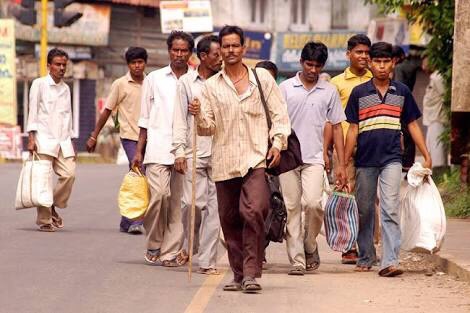
Kashmir beyond the Child Psychology of Partha Chatterjee


The argument that Partha Chatterjee peddles in his latest article in Telegraph on the ongoing Kashmir uprising is quite mainstream. It is of course presented in a subalternist language and with a lot of sympathy. But in its assertion of the autonomy of the subaltern masses, the subalternist sympathy becomes generally like that of those parents who find every action of their children to be revelatory about their uniqueness. And if other children seem to show some unique characteristics, these parents always find them resembling their own children.

Being a Bengali historian, Chatterjee reserves this feeling of empathy only for Bengali subalterns. Obviously this allows him to connect with other parents, sympathise and advise them. This is what Chatterjee is doing in this article – imploring other parents (Indian and Kashmiri) to recognise the crossroads in their children’s lives and help them pass them successfully, without sliding to “worst outcomes.”

Chatterjee finds Kashmiris resembling Bengali mourners at the funeral of Kanailal Datta in 1908, who shot at a renegade in the courtroom, and was hanged by the Britishers. He quotes an official report of the time,

“An extraordinary scene was witnessed at Kalighat at the time of the cremation of Kanai… Crowds thronged the road, people pushing past one another to touch the bier… Many women, to all appearances of a highly respectable class, followed the funeral procession wailing, while men and boys thronged around shouting ‘ Jai Kanai’!””

According to Chatterjee, the Kashmiri act of mourning and rioting for an ‘Islamist terrorist’ similarly “perplexed” the officials and others. A proud father is always ready to dispel people’s perplexities towards other kids, by flaunting his own wisdom of parenthood remembering the childhood of his children.

Thus, continues the wiseman’s argument, where patronising eventually takes a more mainstream turn. Subalterns always perplex non-subalterns. Hence, they need specialised experts to interpret their actions and language. Left to themselves, the innocence of subalterns makes them vulnerable to all kinds of manipulations. Actually, they always look for “figures of love and reverence” and “pure selflessness.” Hence, the Kashmiris themselves are innocent and victims of “bad” manipulations by the two neighbouring states and “routine politicians.” What is happening is now an outrage against these manipulations constituting “the crossroads.”

So, Chatterjee asserts, “Kashmiri nationalism stands at the same crossroads where Indian nationalism stood a hundred years ago.” Pure subalterns wanting to be tended with love, care and self-sacrifice are looking for the figures that epitomise them. If “democratic nationalism” is not “given a genuine chance”, there will be a slide –

“Given the bankruptcy of the politics that has tried so far to accommodate Kashmir’s national aspirations within the Indian federal system, there is a tendency now for the young to adopt an Islamist idiom to vent their demands. If this trend gets stronger, the best result might be a new popular movement, Islamist in temper but with deep roots in local communities…The worst outcome would be the burgeoning of jihadi groups that no one will be able to control.”

Hence, as subalterns are bound to be instrumentalised or domesticated, why not channelise their energy for some good cause, which protects them and mobilises them in the interest of progress and democratic nationalism, thus saving them from an uncontrollable jihadi sectarianism?

But that leaves the story twisted – not just in Kashmir, but also that of the early twentieth century Bengal. Chatterjee does not tell us what happened to Indian/Bengali nationalism “beyond the crossroads”, at least not in this piece. In fact, he does not clear the ambience at “the crossroads” too. He talks about outcomes without talking about the processes. And outcomes are explicitly seen as sliding to worse, if they are not short circuited by “democratic nationalism”. “The bankruptcy of the politics” leads “to a tendency …to adopt an Islamist idiom”, which if not saved through “democratic nationalism” would result into “the worst outcome.”

Actually, the Bengali bhadralok has never been able to cope with the partition of his Bengali nation. The year 1971 soothed him but the scar that 1947 gave runs very deep. Historians like Chatterjee do understand it, but dil hai ki maanta nahin. How could the Islamic enticement to integrate with Pakistan ever be stronger than the Bengali brotherhood?

Hence, azadi is fine as it can be variedly interpreted, and one clever interpretation is that of the Indian left, which Chatterjee articulates so well:

“Azaadi is not the name for a blueprint of Kashmir’s future political state. Rather it is a rejection of India’s armed occupation and the declaration of the right of the Kashmiri people to decide its own future.”

It is all due to the intransigence of India and Pakistan that no breakthrough is happening. They see Kashmir as a site for their competition. Chatterjee goes ahead and talks about progressive constitutional options as tried in Canada to resolve the Quebec question. All these must be tried or things will slide to “the worst outcome.”

“To stop that slide, democratic nationalism in Kashmir must be given a genuine chance.”

It is the same Bengali hangover that seems to play its role here – pitting “democratic nationalism” of Sheikh Abdullah against Islamism/Pakistan. Chatterjee seems to judge everything according to tangible historical outcomes and options, rather than in terms of the processes that might lead to multiple outcomes and options. Azaadi is of course “not the name of a blueprint”, but a movement that houses many contesting blueprints.

Why not? It could also be about the redefinition of South Asia – a movement against thinking in terms of established states and institutions. It could be a signal to subsumed nationalities in the region to revolt against internal segmentation of politico-economic agencies, against differential surplusing and inclusion/exclusion of populations. It could be a struggle against the evolving framework of regional political economy that hierarchises peoples, while including some and reserving/surplusing many, to keep the structure under control and “human resources” competitive.

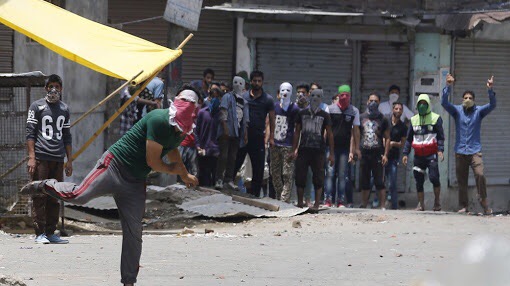
But most importantly, why are we not considering the stone throwing and infinitely resilient, yet defiant Kashmiri youth a sign of the times – the evolution of a popular subjectivity of the precariat leading a real movement that abolishes the present state of things? Why is Chatterjee bringing an example from the Bengali history that seemingly demonstrates innocence and malleability of the masses? Crossroads are about the opening of new horizons too. And definitely, the people’s history of early twentieth century Bengal is extremely rich in this regard. It is unbelievable that Partha Chatterjee is unaware of the complexity of those times. But perhaps the subalternist notion of subalternity doesn’t allow him to render any overt political agency to subalterns except as fodder for the two sides in the Manichaeism of mainstream institutional politics.

There, were far more interesting things happening than a funeral march, which was just a symptom, a temporal spectacle. Beyond spectacularity, while Bengali bhadralok radicals were mired in the voluntarist and masochistic interpretation of Bhagavad Gita, a new Islam was rising in Bengal that gave radical meaning to the everyday struggle of people providing a ground to the evolution of popular subjectivity. In this regard, let me extensively quote from a recent article on MN Roy written by a very astute historian of communism in Bengal, Suchetna Chattopadhyaya, published in the first volume of Communist Histories (Left Word, 2016, pp 45-46), edited by Vijay Prashad:

“The ‘new’ Islam of the early 1910s, in its populist political form, took shape in the backdrop of the ‘new’ plan to sharply alter the physiognomy of the city, the Balkan Wars as a ‘prelude’ to the First World War, and the emergence of a new set of preacher- leaders known for their radical rejection of loyalist positions. One of the aims of pan-Islamist campaigners was to protect Islamic shrines and monuments in the Ottoman Empire, under jeopardy in the climate of Balkan Wars. These efforts by a segment of the intelligentsia resonated, stirring empathetic response among the masses. The immediate material context of this identification was the aggressive and invasive implementation of colonial construction plans that had disturbed conurbations from Kanpur to Calcutta. Though public protests in Calcutta revolved around the issue of mosque demolitions by the authorities, the submerged feelings at a popular level reflected social anxieties and anger over looming evictions. The anti-demolition meetings, including those directed against the Port Trust authorities in Khidirpur, saw large participation of cooks, waiters and small traders. The protestors experienced and envisaged uprooted neighbourhoods, destroyed settlements and forcible expulsions from their dwellings. In the backdrop of such a large-scale offensive from the top, pan-Islam, and popular protests interacted and forged political combinations. With the coming of a major conflict, and British declaration of war against Turkey, the pan-Islamist support for the Ottoman Caliphate came to be echoed in mosques and bazaars, in prayers and conversations and in the texture of everyday life.”

Whatever the limits of historical languages and institutions inherited by the people be, the organic political process (not necessarily around formal state apparatuses) grounded in popular everydayness renews the subjectivity of the multitude, always exploring and exploding the limits that temporally bind it. Subalternisation should be seen as procrustean endeavours of the State apparatuses to depoliticise the everydayness and alienate this subjectivity. However, pure subalternity is never achieved, the multitude accepts new bondages only to master and destroy them. Hence, assuming any innocence on the part of the “subalterns” in Bengal and Kashmir in the process of the “slide” that Chatterjee talks about is not only factually wrong, but politically meaningless and even dangerous. Such assumption autonomises political practices and ideologies from the real political ground and reduces them to mere objects of the elitist and statist operation of naming and shaming.

What “Fataha” means in Anti-Capitalist Politics


[O]ur army is very different from others,
because its proposal is to cease being an army.
– Subcomandante Marcos

1. SYRIZA’s initial electoral victory in Greece generated much hope among the European left and elsewhere too. The Europeans did not need to look zealously and jealously at the advancements in Latin America and elsewhere now. They suddenly found themselves advancing. But much of optimism, and also scepticism, looked at this political event as a phenomenon in itself which either had to be toasted for or condemned outrightly. They were either waiting for the SYRIZA experiment to be successful or defeated. Such sentiments have much to do with the way political formations are taken as voluntary forces judged in terms of their open or hidden programmes and agendas. They transcend and replace the movemental and other societal processes of which they are mere moments or symptoms. Political formations like SYRIZA in Greece and Podemos in Spain in this way are autonomised from the specific grounds of global class struggle.

2. Reactions to SYRIZA’s ‘success’ replayed the reactions to Latin American struggles and incidents of state empowerment in the last decade. Similar was the nature of remorse later. Such reactions I think rely too much on statism and less on its critique. They judge every success in the political field not as a beginning, but as a victory. Subsequently, the whole analyses that were being peddled were about what would SYRIZA do to sustain itself in state power, the task which we all know essentially is nothing but the state’s mode of reproducing itself through such agencies. It was good that SYRIZA’s every move was watched and debated, but to what purpose – just to wait for its success or defeat, not to generalise what its initial ‘success’ represented – the crisis of the old. You can’t wait for the barriers to become limits – this transformation requires not waiting, but hoping. As Ernst Bloch once said, “Against waiting, only hoping helps, which one must not only drink, but cook somewhat too.” (1)

3. Thankfully, in SYRIZA’s case there was a spoiler from the very beginning – it was SYRIZA’s alliance with ANEL, a rightist political formation which too stood against austerity, but for its own nationalist petty bourgeois reasons. The much-tested old wisdom is justified to consider such an alliance evil in its very constitution – it has a social corporatist nature, and any commitment around it must have a reactionary character seeking not to sharpen but obliterate the contradictions that might lead to the progressive transformation of the national and European political economy. Of course, at least, a critical mass of the polemicists were always online trying to dissuade people from considering electoral victories and state activism more than what they were. But even then the question remained – could SYRIZA have done better? So the object of analysis stayed – what SYRIZA did or didn’t do. And, hence, the conclusion: it was their opportunity, and they messed with it. But in reality, SYRIZA-like formations are definitely locally limited, yet globally linked. It is generally forgotten that their survival as radical forces depends on this balance. And this indicates at the responsibilities of both insiders and outsiders – who are equally located inside the structure of the global class struggle of which the Greek experience is an intrinsic part.

4. Similar was the euphoria, both positive and negative, when the Maoists in Nepal triggered a republican transformation, an overthrow of the royalty in the landlocked country, heavily dependent on Indian capital and its demands. A party-power struggle ensued in which even the revolutionaries were caught – every political party in Nepal has become a medium to pose different permutations and combinations of political groups to acquire or bargain power. The only stable political element that exists in Nepal is India trying to be the regional puppeteer using every political, social and cultural mechanism to fine-tune Nepalese politics to the advantage of the regional capitalist accumulation under its protection. Obviously, the presence of China is an irritant that Nepalese politicians utilise to claim some manoeuvrability. But what is interesting to see how all the blame for the failure of Nepalese communists/Maoists to mobilise republicanism under their leadership is put on them and their corruption. This blaming business is a reflection of the same voluntarist understanding of politics and state power that we see in the discourse over SYRIZA. It is not understood how within the dichotomised political/economic frame their failure was sealed from the very beginning. They definitely intensified the vocalisation of divided interests in the Nepalese society, which the royalty had suppressed in the name of unity. But limited to a national-state understanding of the Nepalese society they were evermore mired in the stagism of bourgeois-democracy. They on their own could not transform the political economy of the region of which Nepal was a mere part. Any local statist motivation in the Indian neighbourhood will not be very different from winning a few seats within the Indian Parliament. It is the benevolent nationalism of Indian communists that never allows the envisaging of a realistic transformation in the region. In fact, it scuttles any revolutionary potential in the local challenges like in Nepal or Kashmir. It is the big brotherly Indian radicals who are blind to any opening or opportunity in regional ripples.

5. The Nepalese movement was never simply to establish what they call “a modern state.” Reducing the many decades of the Nepalese movement to the unique and static question of state formation (which again is reduced to the royalty-or-republic frame) is the hegemonic mode of subsuming and dissipating the protracted struggle of the Nepalese toiling masses against the network of political economic power which India presides. Even republicanism must be understood as a concentrated, yet temporal reflection of the everyday struggle of the Nepalese people.

6. Fataha is an Arabic word meaning to open, to grant, to be victorious etc. It forms the root for Al Fattah, which is one of the names of Allah and means the Opener. What makes this term, fataha, interesting is the combined dialectical sense that its diverse meanings render. The way it celebrates, yet humiliates the victorious is quite fascinating – the victory or triumph is nothing more (and nothing less) than an opening. I think the heroic tragedies in history are mostly in forgetting this lesson. The so-called conscious social agencies often are oblivious of the dialectical truth of transience – they as missionaries, which definitely they are, think they have put the society to the desired pathway to the future, when it was just a mere possibility, one of the many possibilities. In fact, they have done nothing but opened Pandora’s box, bringing the society to the brink of possibilities (and uncertainties). What usually happens is that the phenomenality of the victory preoccupies everybody, it is reified.

7. The Paris Commune “inaugurated” the “glorious movement”, “the dawn of the great social revolution which will for ever free the human race from class rule.” It was the concrete beginning of coherent revolutionary politics of the working class that continues to train generations of world revolutionaries, despite recurrent reversals as revolutionary advancements are time and again consolidated in the form of nationalistic successes and gains. Even though locally the Paris Commune was crushed, “the presence of the threatening army of the proletariat of the whole world gathering in the rear of its heroic vanguard crushed by the combined forces of Thiers and William of Prussia” “attest the hollowness of their [the enemies’] successes.” (2, italics mine)

8. The October Revolution in its initial years was always taken as a mere “opening” for the European Revolution at least, if not the world revolution. Revolutionaries in Russia were aware of the need for the expansion of the revolution for the deepening of the revolution. And outside Russia, the revolutionary solidarity forces were intensifying their own struggles, which were understood as building upon the successful “opening.” It was when the world revolutionary movement subsided with alternative statist capitalism and techno-social corporatism competing with it that the “opening” became conscious of its distinction, its own being and endeavoured to survive as a government and a state. The Great Depression and the subsequent New Deal economics sealed the peaceful coexistence and competition between the two political-economic systems – the Cold War.

9. The Chinese Revolution too emerged as an opening for the revolutionary upsurges in various colonial and post-colonial peasant societies that questioned the teleology of market-oriented European capitalism. A planned nationalist transition with a controlled competitive regime, unimpeded by the imperialist politico-economic demands gripped the socialist imagination in these backward societies. We see large revolutionary movements and people’s wars rising in various parts of the world, especially on behalf of the pauperised peasantry and the precarised youth. These movements again saw the Chinese revolution just as an opening. But eventually the crisis of welfarism and statist capitalism, on the one hand, and the Cold War bipolarity, on the other, led to the reduction of various new de-decolonised states into self-hating rentier-bureaucracies, which bargained with the two poles and eventually became the ground for the neoliberal regime of economic restructuring. Ultimately, the Chinese state itself threw away the mantle of the Opener, and entered the fray to attract financialised capital huckstering upon the local institutions, resources and labouring population cheaply available.

10. On a much smaller scale, the Cuban Revolution too emerged as an opening for the Latin American revolutionaries and in Africa. Most of the time both Cuban and Chinese revolutions combined to inspire peasant revolts. Che Guevara epitomised this opening, lending himself to replicate the Cuban experience across continents – Congo and Bolivia, but to remarkable failures. What he lacked, unlike the Maoist conceptualisation of the protracted war, was the ability to keep politics in command. His guerrilla practices were extreme forms of voluntarism and subjectivism. On the other hand, the Maoist practice internationally suffered from both conceptual and practical overgeneralisation, which came from the legitimate practice of developing “base areas.” The territorial militarist symbolism and existentialism of localised peasant struggles overpowered the political sense of these movements. This led to the subservience of every expansion to secure base areas, which were increasingly surrounded and squeezed by the globalised networks of the capitalist circuit. Hence, the base areas remained central to revolutionary survivalism, while becoming marginal to the overall anti-capitalist movement of the working class. Guerrillas became identities in themselves, rather than “masses in arms”, as Kwame Nkrumah used to define a guerrilla. These movements could never become threats to capitalism, but always remained as actual scapegoats to impose global McCarthyism.

11. In fact, it was this marginalisation and deadlock that the movements like Zapatistas in Mexico apprehended in the 1980-90s, and were forced to envisage struggle and solidarity beyond instituted territorialities and state power. It was a recognition of the implausibility of the statist imaginary of post-capitalist transformation in the age of financialised transnational capital regimes. The critique of militarism and vanguardism presented by movements like the Zapatistas was the clarity that “you cannot reconstruct the world or society, or rebuild national states now in ruins, on the basis of a quarrel over who will impose their hegemony on society.” (3) The impetus to recognise and build a world of many worlds was not a simple rhetoric to revert to some united front tactics. It was a result of a deeper critique of relative “human conditions” and a self-critique of revolutionary practice, that was fixated upon the pre-determined goal of capturing state power. The critique of vanguardism that the Zapatistas presented was an affirmation of the vanguard as constantly (re)composed in the diverse levels of struggle – “We do not want to monopolize the vanguard or say that we are the light, the only alternative, or stingily claim the qualification of revolutionary for one or another current. We say, look at what happened. That is what we had to do.” (4) Of course, by relinquishing the aim of state power, they affirm themselves to be only a subset of the protracted global struggle. The Zapatistas provided an opening for the movemental critique of capitalism and capitalist state-formation, but the hypostatisation of the movement form that happened subsequently externalised this critique and reduced it to a dualism of state and civil society, that the process of state formation has always sought to pose. The powerful Zapatista experiment was eventually circumscribed within the NGOised civil society discourse – lobbyist rights, localist self-help politics and difference assertion which suited the neoliberal political economy based upon an infinite discretisation of human capacity and lean politics. The solidarity politics and economy that was envisaged in the Zapatista movement was abandoned in favour of identitarianist assertions, rights discourse and lifestyle autonomy. Leave aside its negation in practice, the state question itself was avoided.

12. If the post-Keynesian neoliberal counterrevolution professes to minimise the State by proclaiming it out of bounds from economy, it is simply vocalising the given divide between the economic and the political that characterises the capitalist system itself. What this divide means is the politics of depoliticisation of exchange relations – therefore, economy is always political economy, even if it is depoliticised. Whichever state form that has existed in the history of the modern state has come into being to facilitate the reproduction of exchange relations. The function of state in all its forms is to soak away the organic emergence of class struggle in these exchange relations, and limit it to the political superstructure. If Zapatistas exposed the crisis of valorisation on the margins of exchange relations and they could effectively practice “the idea of simply turning our back on the state,” their practice could not become more than an inspiration for those who found themselves enmeshed in exchange relations. John Holloway notes, “…there is no golden rule, no purity to be sought. Thus, for example, the Zapatistas in Chiapas make an important principle of not accepting any support from the state, whereas many urban pro-Zapatista groups in different parts of the world accept that they cannot survive without some form of state support (be it in the form of unemployment assistance or student grants or – in some cases – legal recognition of their right to occupy a social centre).” (5)

13. It was in the particulars conditions of urban and semi-urban locations at the very heart of exchange relations, that the risky in-the-state struggle became once again important. Especially in those countries where extractive industries are at the centre of economy and/or where the stark instrumentalisation of state institutions by glocal agencies of capital through purported neo-colonial mechanisms scuttled the local capacity to self-determine, the “opening” that Chavez’s Venezuela epitomised was significant. This revived the ground for people-oriented nationalist/statist efforts, but with a difference – there was a strong apprehension toward the statist primacy. Of course, the question of state power was posed by the barrios themselves, but with an evident sense that the state itself can never be transformed, but destroyed. The issue was to rein in state power to unleash a constant drive towards collective self-determination, rather than a pre-determined complete self-determination circumscribed within the instituted territoriality. The situation of dual power must be constantly posed, where popular autonomy is distrustful and vigilant towards the state, while class conflicts continually politicise exchange relations at every level and extend the reach of solidarity economy beyond territorial limits. Any slippage in this regard is an advantage to statism which eventually reduces dual power to the duality of the political and the economic – allowing capital to technicise the political recomposition of the working class to bring back exchange relations and capitalist accumulation on track.

14. The lessons of the Bolivarian revolution in South America are once again very elementary that until and unless these revolutions or events are taken as mere openings to deepen and expand the revolution, they will implode. Rosa Luxemburg reminded us a long time ago, “Either the revolution must advance at a rapid, stormy, resolute tempo, break down all barriers with an iron hand and place its goals ever farther ahead, or it is quite soon thrown backward behind its feeble point of departure and suppressed by counter-revolution. To stand still, to mark time on one spot, to be contented with the first goal it happens to reach, is never possible in revolution.” (6) In this age of the permanent crisis of capitalism and of generalised precarity, we will face numerous such reversals and can only hope to emerge every time a bit wiser.

References:

(1) Ernst Bloch [1969 (2006)] Traces, Stanford University Press, Stanford, p. 1-2.

(2) Karl Marx [2011 (1872)] “Resolutions of the Meeting held to celebrate the anniversary of the Paris Commune,” in Karl Marx and Frederick Engels, Selected Works, People’s Publishing House, New Delhi, p. 287.

(3) Marcos quoted in Alex Khasnabish (2010) Zapatistas: Rebellion from the Grassroots to the Global, Zed Books, London, p. 83.

(4) Marcos quoted in Alex Khasnabish (2010), p. 64.

(5) John Holloway (2005) Change the world without taking power: New Edition, Pluto Press, London, p. 235.

(6) Rosa Luxemburg (1918) The Russian Revolution. Available at marxists.org

Makarand Paranjape – A Re-Brahminised Brahmin?


It seems Prof Makarand Paranjape has taken upon himself the task of eliminating the rightist intellectual vacuum of which left-liberal scholars have recently been talking about. He is actively posing himself both as a rightwing liberal and a genuine scholar, especially with his recently published work on Gandhi’s murder, The Death & Afterlife of Mahatma Gandhi. Here, he succeeds as a rightwing intellectual, both in his omissions and commissions.

In this book, Paranjape undoubtedly demonstrates a credible scholarship. However, like any right-winger, he unabashedly displays his inability to comprehend the structure of an event, a conjuncture or a catastrophe – conflating facts and fiction (literary facts), reality and virtuality. The conceptual asyndesis that the right wing discourse suffers from flattens the structure of reality. The analytics of the destructed reality are reinforced at the immediate level of discourse, oblivious of the fact that they are differentially located in the composed structure of the event. In his endeavour to come to terms with Gandhi’s murder, Paranjape literally makes everybody responsible for it, even future generations. He absolutises relative responsibilities and makes the regenerated Oedipal guilt of the empowered Hindutva forces a collective absolute of the history of independent India . Ultimately, Godse emerges merely as an executor.

In the epilogue for the Indian edition of the book, Paranjape has clearly indicated his choice against “hypocritical and cynical” “Congress-style secularism” “pandering to and appeasing minorities”. He is not at all dismissive against the “majoritarian political formation. Of course, he wants some actions to see if “Hindutva-Hinduism [is] a better guarantor of religious and cultural pluralism than pseudo-secularism.” He asks, “will the new realism of pragmatic majoritarianism succeed better?” It seems he got his answers very soon.

Similarly, in his video-graphed “lecture” on nationalism in JNU  before an “openminded” left-liberal audience desperately looking for their own variety of Indian nationalism at the time of neoliberal “post(modern) fascism”, Paranjape, like any right-wing street-fighter, goes on poking the left to make their choice among binaries – constitution or revolution, etc, demonstrating once again his ignorance of the complexity of the question of legitimation.

***

Paranjape continues to display the rashness of anti-left tirade in a recent article in Indian Express too, where he blunders on both levels – of arguments and of facts. However, here, he is engaging in manipulations typical of a conservative intellectual and poltician, to defend his recent activism. He starts with some commonsensical utterances to justify adding his name to a petition against one of the best Sanskritists of our times, Sheldon Pollock.

Paranjape jealously questions the exorbitance of the investment by a ‘Swadeshi’ investor in a project to create Murty Classical Library under the editorship of Pollock. As he admits, he doesn’t seem to know more than home economics, and thinks investment in scholarship as similar to buying underpants and vegetables.

In this era of global capitalism, when Indian rulers are busy playing beggar-beggar with other late capitalist economies to make Make-in-India campaign legible to investors, Paranjape and his herd are trying to contribute in it by selling their cheap intellectual labour. But they don’t know that the economic considerations for big industries in modern capitalism are not those of village sahukars – where buying cheap and selling dear are immediately interlinked, immaterial of the nature of products in consideration. Stooping down to the level of Prof Paranjape’s home economic sensibility, we can merely plead that he should have some sense to know that the long term credibility of the investor also matters at least in the field of academic production.

Reasonably, Paranjape tries to win the argument by complementing his home economics with inciting a nationalist inferiority rage. Here he is in a quite good company, as this provoking of bruised nationalist consciousness has always been a hallmark of jingoists and has once again become rampant – Trump, Berlusconi, Le Pen & c, and of course not to forget our own Modi. It effectively generalises, mobilises and instrumentalises anxieties and precarities produced by dispersed Fordism leading to the emergence of post(modern) fascism.

***

Now, coming to what Paranjape calls “the more controversial demand to sack Pollock”, we find him deliberately misinterpreting Pollock for his academic-political ambitions.

Pollock’s essay which Paranjape and his coterie are misquoting to discredit him and to project him as any Orientalist is one of the finest works on traditional Indian intellectual practices, where he displays his knowledge of not just the hegemonic Shastric tradition but also of oppositional scientific and secular voices, who had to regiment themselves by indulging in ritual nodding to the Shastric authority.

To the extent that Pollock demonstrates the intransigent and transcendent nature of the Shastric tradition in prioritising theory, along with its attempt to homogenise and hegemonise practice, his originality is only in the extent of his scholarship, not in his idea. There have been alternative traditions right from the Upanishadic times that have been questioning such ritualisation, many times in shrill voices, and in recent centuries quite openly as by many late Medieval poets and numerous anti-caste fighters like Phule and Ambedkar. 

Moreover, in the very initial paragraphs of the essay, Pollock declares his thesis, “everywhere civilisation as a whole – and this is especially true of art-making – is constrained by rules of varying strictness, and indeed, may be accurately described by an accounting of such rules.” And then he goes on to compare Manusmriti and Amy Vanderbilt’s Everyday Etiquette (definitely, an outrageous comparision from the perspective of a refounded Brahminism of Hindutva), and concludes, “such cultural grammars exist in every society; they are the code defining a given culture as such.” Of course, he credits Shastras for their unique expanse and influence.

Paranjape must remember if he wants to (though it is difficult given his allegiance to particular political projects in recent days), that orientalism happens not simply when whites exorcise brownies, it is also when whites and brownies combine to exoticise and eternalise the orient. Let me remind Paranjape of his own remorse at the “politics of misreading” in 1991 (Economic & Political Weekly), when he was troubled by what he saw the “tendency to indulge in the commonest argumentative fallacy of irrelevance: ad hominem or name-calling,” At that time, he was accused of having represented himself as a “de-brahminised brahmin” by, as he claimed, his student (it is clear that this fact hurt him the most). That “student” today is himself a well-known literary scholar and activist, K Satyanarayana.

However, in recent days Paranjape himself, along with his less-sophisticated ilk, has mastered this politics and is indulging in “the commonest argumentative fallacy” of name calling. He clearly dislikes them with whom he disagrees. Whether he had actually de-brahminised himself earlier or not is debatable, but it is clear, at least for the time being, he has re-brahminised himself, and he feels empowered.

Notes on Rohith Vemula’s Suicide


1. “It takes a loud voice to make the deaf hear, with these immortal words uttered on a similar occasion by Vaillant, a French anarchist martyr, do we strongly justify this action of ours.” These were the opening words of the leaflets that Bhagat Singh and Batukeshwar Dutt threw after bombing the Central Legislative Assembly in New Delhi on April 8, 1929. By the massive reaction across India to the suicide committed by Rohith Vemula, a Dalit student at the Hyderabad Central University, it is not an exaggeration to say that this action of his was justified – as a loud voice or explosion that we all heard. If murder is justified as a politico-legal act (in case of executions, as legal murders), why not self-murder? It is ethically far superior or noble too as it is directed towards oneself – as a samadhi, both in brahminical and anti-brahminical traditions.

2. One might say that the revolutionary terrorism of Bhagat Singh challenged the state, by openly defying its laws. One might further admit that in revolutionary terrorism, the nobility of the cause is objective and evident. Revolutionaries are distant to their acts and their effects, which are fully under their command. It is for the emancipation of humanity, workers or nations that the revolutionary terrorists live and die – a mark of extreme selflessness. They standout among the masses, they are heroes whom we all look up to – kind of supermen. If they are democratic and responsive to people, it is their humility, which further adds to their stature.

But suicide? How can it be revolutionary? It is an act of extreme selfishness and cowardliness. It is this belief that shows up slyly even in the massive pro-Dalit and Dalit responses to Rohith’s suicide, even in their bid to disprove it. Of course, they will not call this act selfish or cowardly. They will explain it to disprove all this, but ultimately the paradigm to demonstrate its something else-ness is same, whether you sanctify it as a kind of protest, in which you must add, suicide when nothing else works or call it an “institutional murder”, or a desperate act of a depressed individual. Rohith must be either a victim (of the system or of groups/individuals) or depressed or even, at least for the status quoist forces, a desperado.

3. Marx had published a peculiar write up in 1846 on suicide, which is not much studied. Till recently it was thought to be merely a translation of a French police administrator, Jacques Peuchet’s work on suicide cases. The fact that why on earth Marx translated a piece on suicide too was not touched upon. It was its retranslation in English, its comparison with the original one by Peuchet along with short studies by Kevin Anderson and Eric A Plaut revealed the importance of the text. Marx’s omissions, commissions and editorialisation in his translation transformed it into a very significant text where Marx directly deals with women’s issues, bourgeois family and a generalised system of alienation. He twisted the text which was already very graphic and condemning with his powerful unattributed insertions. One of them is:

“Those who are most cowardly, who are least capable of resistance themselves, become unyielding as soon as they can exert absolute parental authority. The abuse of that authority also serves as a cruel substitute for all of the submissiveness and dependency people in bourgeois society acquiesce in, willing or unwillingly.”

What Marx does in the text is to show how cowardliness and impotence of people in authority and power lie in their inability to make sense of suicide. Marx thus translates Peuchet:

“What characterises courage, when one, designated as courageous, confronts death in the light of day on the battlefield, under the sway of mass excitement, is not necessarily lost, when one kills oneself in dark solitude. One does not resolve such a difficult issue by insulting the dead.”

Marx pushes the argument further by inserting:

“One condemns suicide with foregone conclusions. But, the very existence of suicide is an open protest against these unsophisticated conclusions.”

4. At least the state, as the collectivity of ruling interests, is well aware of the lethality of the self-afflicted terror, suicide. It knows how this act is a powerful means of undermining it. That’s the reason, suicide is a crime. Foucault succinctly put, suicide was a crime “since it was a way to usurp the power of death which the sovereign alone, whether the one here below or the Lord above, had the right to exercise.” He proclaims, “This determination to die, strange and yet so persistent and constant in its manifestations, and consequently so difficult to explain as being due to particular circumstances or individual accidents, was one of the first astonishments of a society in which political power had assigned itself the task of administering life.”

5. An act is not just its grammar, it is a performance – when, where, who, before/against whom etc all characterise it. Hence, the divide between revolutionary and reactionary acts. A “revolutionary suicide” is an act enmeshed in politics of experience, like any self-murder. It is a response grounded in the personal self-full experience of the perpetrator. It is devoid of the nobility and selflessness of a declassed revolutionary or a self-flagellating noble liberal, volunteering to think about them who can’t think for themselves. Only a black revolutionary could have conceptualised this concept, and a Dalit can very well understand it. When “bereft of self-respect, immobilized by fear and despair, [an individual] sinks into self-murder”, it is, according to Huey Newton, “reactionary suicide.” On the other hand, revolutionary suicide is not a result of “a death wish”, therefore, it is a suicide which is not even suicidal. “We have such a strong desire to live with hope and human dignity that existence without them is impossible.” The desire is so strong that we seek to satisfy it “even at the risk of death” – “it is better to oppose the forces that would drive me to self-murder than to endure them.”

Addendum

6. Pitting knowledge and reason against experience constitutes what can be called an arrogance of determinism and abstraction. It is immaterial if scholars are aware of this or not. Until and unless this abstraction is re-derived from experience, that is until this duality is resolved in the dialectic of practice, it will have an affinity to the brahminical Cartesian prioritisation of abstracted science. This is where many theorisations and historicisation of oppressed identities fail them. In their attempt to explain the experience of caste and race in terms of its determinations, many times they simply write off the question of the reproduction of the caste system or identitarian hierarchy in everydayness – how it is reproduced in social practice, where, let’s admit, it is nothing short of a conspiracy.