Zeleny and Althusser: A New Humanism through the Antihumanist Route


“In France and Italy Althusser’s interpretation of Marx has recently attracted attention. As opposed to a mass of superficial literature –unscientifically grounded and lacking textual analysis — which is trying to surmount a dogmatic Marxism by reinterpreting Marx in the spirit of a Feurbachian, existentialist anthropology, Althusser emphasizes the text and the intellectual development of the young Marx. When he insists that we have before us in the Theses on Feurbach and The German Ideology a new stage of Marx’s theoretical and philosophical development which transforms his preceding views, in particular the standpoint of the Paris manuscripts of 1844, we find that our results agree. But they are distinguished from Althusser on such questions as the content of those stages. Althusser characterizes the transition from the Economic and Philosophical Manuscripts to The German Ideology as a break or clevage (‘rupture; coupure epistemologique’) which corresponds to a transition from humanism to anti-humanism; in that sense Marx utterly rejects his old problems and concepts, and appropriates radically new ones and a radically new method.
“Our analysis is the foundation for the view that the theoretical, philosophical standpoint of the Theses on Feurbach and The German Ideology represents a new form of humanism. In the Paris manuscripts and in The German Ideology Marx deals above all with ‘real’ men. In both cases he takes on the task of explaining social and historical reality solely from the life process of ‘real’ men. If from the standpoint of The German Ideology, from that conception of ‘real’ men and history as introduced in the Paris manuscripts, Marx appears ‘ideological’, then we are dealing in The German Ideology — following our preceding analysis — with the radicalization of humanism, the creation of a new form of humanism.
“Althusser’s error in connection with humanism can be illustrated in his citation of one of Marx’s comments on his method in Capital:

“[Wagner] who has not once noticed that my analytic method, which does not start out from man, but from the economically-given social period, has nothing in common with the academic German method of connecting concepts…’

“The concept ‘economically-given social period’ was not understood by Marx as objective, divorced from the activity of human individuals. This Marxian observation does not prove his anti-humanism, but rather refutes the ideological concept ‘men in general’ (‘Man’) and advances a theory based on ‘real’ men in the sense of practical materialism. He wants to say only what he had already said about the starting point for economic theory in the Introduction of 1857: ‘Individuals producing in society — hence the starting point is naturally the socially determined production [carried on] by individuals.’ ”
–Jindrich Zeleny, ‘The Logic of Marx’

I entirely agree — from the vantage-point of Badiou’s “practical antihumanism” and “theoretical humanism” — with Zeleny’s insistence that Marx in breaking with Feurbach’s expressivist ontology of the human pointed in the direction of developing a radically new conception of generic humanity. But what I wish to doggedly insist is that this theorisation cannot be grasped with adequate rigour unless one necessarily passes through Althusser’s antihumanist reading of Marx. The determinate dialectic of concrete and abstract labours (or productive forces and social relations of production) must be grasped by disentangling it from its historically concrete, phenomenalised agentic-subjecthood, albeit of course by passing through the latter. Such a move is basically what Althusser’s theoretical antihumanism amounts to. Only through such a theoretical move can real historical men be grasped as historical indices and anthropological-passional registers (not particular agentic-subjecthoods) of determinate antagonism between politics and history, and thus the asymmetrical dialectic of concrete and abstract labours. And only then can real historical men and women truly become the constituents of the radically new generic humanity that Marx sought to theorise. A humanity that would be a constructionist adventure rather than an historical unfolding. So, to affirm real historical men without effecting this shift in the conceptual valency of the term real historical men will keep returning to us through the rear window what we are throwing out of the front door: the expressivist dialectical anthropology of the Left-Hegelians.

I’m not, therefore, claiming that this is Zeleny’s problem too. From the way he affirms the conception of real men — i.e. through a close reading of The German Ideology and Capital — that seems far from being the case. And yet his criticism and rejection of Althusser’s “theoretical antihumanism” misses the importance of Althusser’s conceptual privileging of the determinate dialectic of concrete and abstract labours, which is registered by real historical men, over this register itself. Even the 1857 Introduction of Marx that ends the Zeleny quote above points precisely in the direction of conceptually privileging that which is registered (productive forces, social relations of production) over that which registers it (real historical men).

In this context, it must be said that what such a surreptitious return of the abstract Feurbachian man, with the conception of real historical men acting as its Trojan Horse, amounts to in political terms is an ethical socialism of commonisation, if not an out-and-out rights-based politics. Ranciere, for instance, walks exactly into such a trap when he breaks with Althusser’s antihumanist Marxism in that thoroughly Oedipalised and cantankerous work of his: ‘Althusser’s Lesson’.

Hence, it is absolutely imperative that one grasps the two distinct conceptual valences that the term real historical men has. For, neither can withdrawal and difference, exhausted solely by a politics of resistance, be equated with subtraction as an articulation of revolutionary (or law-unravelling) violence. Nor, for that matter, is our politics, which accords theoretical and political centrality to the self-activity of workers and self-organisation of the working class, the same as anarchism. To insist on this distinction (both in conceptual and political terms) then, is to guard against being perceived by certain ‘autonomist’ tendencies’ — with whom we vigorously interact and engage as we should — as being part of their thoroughly anarchist formation. What could be far worse, however, is that we ourselves lose sight of that political and theoretical difference between their ethical commitment to an anarchist socialism and our revolutionary commitment to communism.

The distinction of conceptual valences for the same terminology of real historical men must be tightly held on to for another equally important reason. Many of our radical friends, who don’t tire of swearing their loyalty to sundry Marxist-Leninist groups, and thereby also to Marxist theory, seek radical legitimacy for the reformist and rights-based politics of their respective organisations, if not also for their own individual lifestyle politics, through a theoretical manoeuvre that conflates the two distinct conceptual valences for the term real historical men.

Proletarian class determination: epistemology or ontology?


“Class determination of knowledge means that we do not know whether determination actually takes place in reality as the proletariat depicts it, since this class only knows reality through that facet of the prism corresponding to its collocation in the social structure. In a sense, therefore, the proletariat imposes its view of reality upon this latter so that determination is first of all an epistemological concept rather than an ontological one. This, however, calls for neither idealism nor absolute relativism since, from the point of view of the proletariat, its view does come from (is determined by) concrete reality and has inherent in itself the possibility of knowing reality correctly, as shown by verification. In short, the point of view of the proletariat is that each class secretes its own knowledge (class determined relativism of knowledge) and that within this view only the proletariat has the possibility of gaining a correct knowledge of all (and not only some) aspects of reality because of this class’s position in the societal labour process (class determined supersession of knowledge’s relativism).

“We do not claim that the proletariat depicts real processes as they take place in reality (reflection). But we do claim that this class’s view has the objectively determined possibility of being correct, to find a ‘match’ with the reality it depicts. It is in this sense that determination can be referred to as an epistemological calling into existence. And, it is in this sense that our view differs from the ‘reflection’ theory and can be called non-reflective realism: knowledge is not determined simply by material transformation, but by this transformation immersed in specific social contexts, that is, by the real concrete.”
–Guglielmo Carchedi, ‘Problems in Class Analysis: Production, knowledge, and the function of capital

To be read, in my view, as a crucial theoretical explication of Lenin’s axiom of truth being partisan, and Marx’s Eleventh thesis on Feurbach. Particularly the latter, on account of it being much abused as a shibboleth by vulgar ‘Marxian’-pragmatists. Justice can be done to Marx’s privileging of changing the world over interpreting it only if one grasps this affirmation of world-change rigorously in terms of Marx and Engels’ concept of “the real movement” and Marx’s conception of “practical materialism” that he derives through his critique of Feurbach’s “contemplative materialism” in The German Ideology and Theses on Feurbach. Thus Marx’s critique of interpretation, which is basically a critique of materialism articulated in contemplative terms, is not only a rejection of the primacy of contemplation but is also, by the same token, a severe criticism of decisionist pragmatism, which is contemplation reconstituted at the practical level of abstraction. Clearly, Marx’s privileging of world-change over world-interpretation is a dialectical critique of contemplation by having the modality of contemplation brush itself against its own grain. A theoretical, and philosophical, move that does not abandon knowledge and epistemology but radically alters their conception and status. And in this regard, Althusser’s explication of “overdetermination” and “epistemological void” (in ‘Contradiction and Overdetermination’) and his conception of “limit-form” (in ‘Marxism is Not a Historicism’), together with Badiou’s concepts of “metaontology” (in Being and Event) and “politics-as-its-own-thought” (in Metapolitics) are also indispensable.

Chanakya: Corruption is systemic


Kautilya in his Arthashastra discusses the nature of diverse political systems in terms of their inherent potential. For instance, he considered sanghas, i.e., republics to be inferior to a kingdom because they were less capable of motivating and sustaining political and economic expansion. On the other hand, kingdoms could not be as internally and socially cohesive as republics. They were internally unstable and needed a powerful, elaborate and permanent state machinery to sustain themselves.

Similarly, Kautilya finds corruption to be systemic – it is always potentially there in a politico-economic system based on social differentiation and an hierarchised officialdom. To curb it the system continues to add ever new informal and formal bureaucratic offices and officers. Kautilya in chapter 10 of the second Adhikarana of his text raises this systemic dilemma:

यथा ह्यनास्वादयितुं न शक्यं
जिह्वातलस्थं मधु वा विषं वा।
अर्थस्तथा ह्यर्थचरेण राज्ञः
स्वल्पोऽप्यनास्वादयितुं न शक्यः॥
मत्स्या यथान्तस्सलिले चरन्तो
ज्ञातुं न शक्याः सलिलं पिबन्तः।
युक्तास्तथा कार्यविधौ नियुक्ता
ज्ञातुं न शक्या धनमाददानाः॥
अपि शक्या गतिर्ज्ञातुं पततां खे पतत्रिणाम्।
नतु प्रच्छन्नभावानां युक्तानां चरतां गतिः॥

It is not possible not to taste honey or poison placed on the tongue; just so, it is not possible for one dealing with the money of the king not to taste the money, if only a little. We cannot know when a fish swimming in water is drinking water; just so, we cannot know when officers appointed for carrying out works are appropriating money. It is possible to know the path of birds flying in the sky, but not the ways of officers moving with their intentions concealed.
(Translation from Thomas R Trautmann (2012), Arthashastra: The Science of Wealth, Penguin)

Some Scattered and Sketchy Critical Remarks on the Theoretical Assumptions of Subaltern Studies Historiography


If one is allowed to indulge in some bit of abstraction one could say — pace Marx’s value-theoretic approach — that the historiographical method of the Subaltern Studies fails to account for how time-as-substance — the concrete, the qualitatively different, or the singular as a phenomenological or interiorised subjective experience — is instrumentalised to be rendered the embodiment of the tendency of its own negation, which is time-as-measure. Time-as-measure being qualitative equalisation (value as congelation of human labour in the abstract) manifest in and through quantitative differentiation. The historiography of Subaltern Studies, as a result, refuses to rigorously think the dialectical asymmetry of difference (as differing away) and difference-as-identity — or, the asymmetrical dialectic of the concrete and the abstract (or, use-value and value/exchange-value). In other words, it fails to rigorously account for the dialectic between history as a genre of writing, which is meant to be a narrative representation of diverse experiences, and history as a conceptual registration of those experiences, and thus also the structure/structuring of the experiences at hand revealed by such conceptual registration. It’s precisely this dialectic that Reinhardt Koselleck, for instance, points towards when he plays on the etymological difference between the two German words for history: historie and gesischte.

The Subaltern Studies historians refuse, nay fail, to come to terms with the fact that the asymmetry between the concrete (difference as differing-away) and the abstract (difference-as-identity) — or subjective cultural resources and social relations of production respectively — that is activated only as a radical antagonism, tends to be generative of a dialectic that, thereby, distorts their radical antagonism into a mutually constitutive contradiction. This philosophical, or theoretical, inadequacy is most clearly evident in Ranajit Guha’s reading of Marx’s Grundrisse in ‘Dominance Without Hegemony’. Here Guha mobilises the determinate registration of the dynamic tendency of antagonism to, or limit of, capital in Marx’s account arguably as a sociologically static empiric of the same. Guha, therefore, repeats the same mistake that Hegel, according to Marx’s Introduction to ‘Grundrisse’, committed: conflating the object of knowledge with the concrete real world that lies outside human thought. As a result, Guha is unable to grasp, and discursively demonstrate, how the radical separation of the two temporalities of difference and difference-as-identity is tendential, or logical, while they are, chronologically speaking, coeval. Which is to say, that even as difference as differing-away is envisaged it must be simultaneously grasped as difference-as-identity that is the limit imposed on difference on account of its inescapable determinate condition. Only such an approach can generate a rigorously anticipative, prefigurative strategic manoeuvre for suspending, as opposed to merely puncturing, capital or “History I” as the horizon constitutive of the law of value.

Guha’s inability to see that the radical separation of the two temporalities of difference and difference-as-identity – or, the concrete and the abstract – is a tendential or logical one prevents him from grasping why the tendential temporality of antagonism is, at once, generative of the counter-tendential temporality of dialectical constitutivity. In fact, Dipesh Chakrabarty’s move, in ‘Provincializing Europe’, to strengthen this conception and theoretical discourse of non-dialectical difference of History II (or outside of capital) to History I (capital) continues to perpetuate Guha’s philosophical error of hypostatising the determinate registration of the dynamic tendency of antagonism into a sociologically static empiric of the same. This, in spite of Chakrabarty’s decision to follow Heidegger in his thinking of ontological difference through phenomenological reduction; or, perhaps because of it.

It’s because of this philosophical/theoretical inadequacy — something that underlies and informs the Subaltern Studies project almost in its entirety — that the historiography/historiographies inspired and/or influenced by that project are rendered incapable of reflexively accounting for the linguistic reification that historiography as a genre of writing, or narrative representation, is bound to tend towards. Not surprisingly, the politics that such historiography affirms is radical communitarian, which is situated, all said and done, within the political paradigm of liberal-republicanism as its constitutive obverse.

Panchatantra and the Master-Servant Relationship


In the very initial portions of an ancient Indian text Panchatantra, which teaches pragmatism of human relationships in an obviously very unequal society through stories, is found a section on the master-servant relationship. Interestingly, unlike spiritual texts that would justify such relationship in terms of divinity, birth and fate, this text simply doesn’t allow such justifications. It is highly materialist (not necessarily, atheist) and sees dynamism in this relationship, by positing the problem of the reproduction of the master-servant dialectic. It has a shloka, which brilliantly and explicitly grasps this dialectic – the fact that the identities of master and servant exist only in their relationship.

न विना पार्थिवो भृत्यैर्न भृत्याः पार्थिवो विना। तेषां च व्यवहारोऽयं परस्परनिबन्धनम्॥

A king cannot be without servants, nor can the servants without the king – this their relationship is mutually dependent.

This is followed by more shlokas reasserting the same, with the help of analogies. One of them is striking,

अरैः सन्धार्यते नाभिर्नाभौ चाराः प्रतिष्ठिताः। स्वामिसेवकयोरेवं वृत्तिचक्रं प्रवर्तते॥

The nave is supported by the spokes and the spokes are planted into the nave. Thus proceeds also the wheel of the relation.

(MR Kale, Pancatantra of Visnusarman, Motilal Banarsidass, 1912 [reprinted 2015])

Academia as a production system


Courtesy: Eugene C. Bell, “A College of Business Administration as a Production System,” ACAD MANAGE J June 1, 1974 17:2 306-317

academic table

For a new aesthetic of revolutionary exhibitionism against the aestheticised politics of liberal bourgeois voeyurism


There is a need to think a new revolutionary aesthetics of exhibitionism against liberal exhibitionism — for me, the latter is basically the politics of commodity abstraction and society of spectacle a la Situationists such as Guy Debord. However, in order to do that the scopic drive will need to be rethought and re-envisaged, not in terms of contemplativeness, but contemplativeness pushed to its extreme that renders the contemplated object into a dialectical image. [Now, this is already a displacement of contemplation into practical-materiality — or, at any rate, the former being placed under the condition of the latter — in Marx’s sense of the terms as he explicates them in his Theses on Feurbach and The German Ideology.] That is crucial if desire is not to be conflated and confounded with its cathection (investment). Such cathection or investment being the interruption and concomitant distortion of desire precisely on account of its determinate instantiation. After all, as Lacan would tell us, the “petit object a” is not much more than a metonymy of desire.

And here Nietzsche’s acute poser about whether truth is not a woman can be deployed rather productively. “Woman” here in its Nietzschean articulation must, arguably, be grasped in terms of “becoming-woman”. That is, woman not as an anthropological difference (which is difference-as-identity) but as an ontological difference (difference as differing away from identity). Translating this antidialectical conception of “becoming-woman” into the conceptual framework of the asymmetrical or materialist dialectic we could say, following Lacan, that woman-as-truth or becoming-woman is to be understood as the Real that cannot be inscribed within the horizon of the symbolic even as it founds that horizon. Clearly then, ‘woman’, in “becoming-woman” or Nietzsche’s “woman-is-truth”, is now no longer thinking of even ontological difference but is, instead, a limit-conceptual figure of ontological subtraction.

This, I beleive, dovetails with what I have tried to get at above with regard to grasping the exhibitionism/voyeurism couple not simply as a dialectic, but as an asymmetrical dialectic, and thus as determinate presentation of exhibitionism-voyeurism singularity in excess of their symmetrically dialectical coupling as exhibitionism/voyeurism duality. In that context, the exhibitionist desire of revolutionary militancy is not merely exhibitionism but Dionysian exhibitionism (a la Nietzsche’s The Birth of Tragedy, for instance). And here, therefore, the exhibitionist revolutionary-militant is not a declarative-constantive object — or a directive tribune — vis-a-vis a milieu of passive contemplators/consumers he/she subjectivates thus. Rather, he/she is a semiosis of impulse or symptom of performativity, which is the object-exceeding force in the distinct temporality of its own singularising/singular subjective-materiality. Something that renders this sign/symptom a unit of the milieu of active and continuous producers in the Brechtian sense.

In fact, that is precisely the reason why I think Marquis de Sade’s ‘pornography’ poses and articulates a revolutionary-republican aesthetic. If we attend carefully to the apparently pornographic discourse of his literary production — particularly, his ‘Philosophy in the Bedroom’ — we see that not only does it have a didactic form but one whose mode is Dionysian (performative), which this form strives to transparently reveal. Clearly, De Sade’s discourse ceaselessly registers the thinking of the ethical imperative of desire and the moral law together, but in their separateness. It’s this form and mode of what I wish to call the Dionysian didacticism of desire — and not just any form of BDSM pornography — that renders De Sade’s ‘pornographic’ discourse the index of counter-contemplative revolutionary-republican aesthetics. And it’s arguably this formal and modal dimension of De Sade’s literary discourse that Foucault misses when he critically describes the former as “the sergeant of sex”, who, in Foucault’s estimation, elevates transgression itself into a law.

After all, it’s not for nothing that Lacan impressed on us the indispensability of thinking Sade with Kant. In short, the new revolutionary aesthetic of exhibitionism-voyeurism — as a historically concrete reconstitution of the revolutionary-republican aesthetic of De Sade — will be one wherein a form of contemplation is already always a demonstration of the displacement of contemplation. That is to say, such an aesthetic will truly fulfil itself only when exhibitionism is already always the demonstration of excess of exhibitionism in its limit.

Therefore, the problem of pleasure, from the standpoint of revolutionary politics, is ineluctable. However, the question then is whether pleasure is merely subjectively interiorised experience that is grasped by way of phenomenological reduction, or, is the question really of pleasure founding its own duration and historicity. For, if it’s the latter, then it is already a post-phenomenological displacement of pleasure beyond its phenomenological experientiality, albeit necessarily in and through that experientiality and phenomenology of pleasure. Hence, what we have is pleasure as an existential experience informing the constitutivity of an austerely neutral extension, which is the historicity of suspension of history — “historicity without history” in Alain Badiou’s terms. This, to my mind, amounts to pleasure founding its own duration and historicity.

And this, as far as I understand, is the path Freud also prefigures and indicates in his engagement with the question of pleasure. For him, the problem of pleasure is not, in the final analysis, one of interiorised experience, subjective intentionality and thus joyous productivity. Rather, the problem of pleasure (read in terms of jouissance) brings to him, particularly if we read him through a Lacanian lens, the question of lack and/or trauma as the Real. This, from what I understand, is the crux of his “beyond the pleasure principle”. And this reveals why Freud is no phenomenologist of pleasure, one who would be concerned merely with the question of alternation between the reality principle and the pleasure principle. Rather, Freud’s concern — in his concerted engagement with the problem of pleasure — indicates the need to develop an approach that thinks the problem of pleasure and its politics in terms of the suspension of the horizon of this alternation of the reality principle and the pleasure principle.

To think the question of pleasure in those terms – i.e. to think pleasure as an experiential-phenomenological moment of the post-phenomenological movement of its own overcoming (beyond the pleasure principle) — is to already have pleasure-as-joyous-productivity displace and thus transfigure itself into the neutral of subtraction. An engagement with the affective experience of pleasure, if it’s rigorous, is, arguably, bound to lead one towards its post-phenomenological beyond – which, in the same movement, would also obviously be a radical break with the horizon of the reality principle. That is demonstrated, besides Freud, by Roland Barthes: a thinker of pleasure for whom the twinned-questions of “zero degree” and “the neutral” are what ultimately matter.

As for me, I have been helped quite a bit in this respect by Badiou’s critique of what he calls “democratic materialism” – the differing alternation of bodies and languages (or joyousness and its interruption) – as also his attendant critique of Deleuze’s anti-Freudian productive conception of desire (“desiring-production”).

Indian State and Secular Politics


1. In India, decolonisation did not reconstitute the State, rather it was a refurbishing of the same colonial state, now free from any remote controlling by the British. In legal terms too, all legislations and judicial pronouncements made prior to Independence continued to hold unless challenged and proven to be in contravention to the new constitution. The same bureaucratic structures and personnel – army, police, civil services, judiciary… – continued to manage the state of affairs and affairs of the state. The only thing that really changed after Independence and which was definitely a radical change was that for the first time this state could acquire popular legitimation and could rule in the name of the Indian people. Therefore unlike the French, Russian or even Chinese situations, we could never talk about a revolutionary state emerging on the ashes of the old one. An interesting comparison could be made with Pakistan, where despite all failures and difficulties, some real efforts were made to reconstitute the state.

2. State principles, written and unwritten rules regulating the state machinery remained the same in India. Its social engineering principles and mechanisms which were essential to stabilise the colonial rule continued to stabilise the postcolonial rule. What changed perhaps was their renomination – efforts were made to resignify them in terms of the modernist ideas and ideals of the nationalist leadership, which was now at the helm of the State. Therefore the ideal of secularism, for instance, was attached to the state’s management of communities through institutionalisation and accommodation of their hegemonic leadership. So what we find today designated as secularism is simply the state’s ability and efforts to manipulate and control various social agencies to reproduce itself. The word secularism was, of course, added to the Indian Constitution only in the 1970s and that too during one of the most authoritarian phases of the Indian polity.

3. Secularism here is essentially a state ideology that monolithises religious discourses, externalises and neutralises every internal threat to hegemonies within religions. In other words, it institutionalises religious leaderships and strengthens religious conservatism, thus helping the State to accommodate them and manipulate their agencies to create and disseminate its legimitation. It is in this regard, one can say that the liberal-secular forces in India have aligned with the religious conservative or right to foreclose any possibility of the emergence of a Religious Left which seeks to deinstitutionalise religions.

The Porn Controversy: Save Desire from the Moral Police and the Sexual Liberaliser Alike


The recent ban on pornography, and the liberaliser’s discourse of outrage it has triggered, proves yet again the problem of sexual/libidinal economy is too serious a business to be left either to the ham-handed ways of the fascistic moral-police or the knee-jerk exertions of the terrorists and (academic) merchants of desire. Truth be told, they are the obverse of one another and are mutually constitutive of the neurotic subjecthood of capital in its late, crisis-ridden, neoliberal moment..

Marquis de Sade’s affirmative conception of an anti-procreative sexuality with its basis in revolutionary republicanism (see his ‘Philosophy in the Bedroom’), together with Wilhelm Reich and Pier Paolo Pasolini’s concerted engagement with the question of sexual economy as an economy of desire — and its productivising regimentation, and psycho-somatic and psycho-social segmentation in capitalism –, point us in directions that are much more fruitful in terms of strategising a politico-sexual revolution that will unleash an emancipated, anti-hetero-normative sex-economy of free association of direct producers.

The government decision to ban pornographic sites on the internet is, therefore, not an occasion for spectacles of outrage and liberal exhibitionism. It is, instead, to be seen as an opportunity to work towards instituting the thinking and discourse of a radical sexual/libidinal economy. For, it’s precisely the absence of such discourse and thinking vis-a-vis the concrete historical circumstances of the conjunctural crisis of capital as manifest in its sexual moment that has led to the consolidation of repressive sexual morality. It is this sexual morality that is the molecular basis of the current ban.

All concerned would do well to realise that the BJP-led Union government’s decision to ban internet pornography is a step forward for the project of politico-sexual counter-revolution. Such a move is counter-revolutionary precisely because it seeks to validate itself by drawing upon, instrumentalising and mystifying objective sex-revolutionary possibilities posited by psycho-social segmentation and psycho-somatic stratification (which includes “genitalisation of desire”) of desire and sexuality in their moment of precarity and crisis. It follows, therefore, that a politico-sexual counter-revolution kicks in and accomplishes itself precisely when objective revolutionary possibilities exist without being subjectively actualised as such.

In such circumstances, to envisage opposition to this ban in reactive terms — without lending even half a thought to how such opposition can be orientated to transform the structure of social relations of production, which in its historically concrete mediation makes possible and indexes psycho-social segmentation and psycho-somatic regimentation of desire — will just not do. Such liberal reactive politics of opposition to the consolidation of repressive sexual morality effectively amounts to no more than demanding the preservation of a given regime or order of socio-sexual privileges that the politico-sexual counter-revolution tends to alter only by preserving and reinforcing its basic structure of psycho-social and psycho-somatic segmentation of desire through its formal recomposition.

Clearly, such reactive politics of opposition to the ban is as implicated and invested in the structure of psycho-social and psycho-somatic segmentation of desire as the counter-revolutionary move to ban pornography. Therefore, the reactive politics of sexual liberalisation — as opposed to the transformative revolutionary politics of sexual liberation — reinforces the discursive-moral paradigm, which provides sustenance and support to the fascistic politico-sexual counter-revolution. Something the proponents of sexual liberalisation apparently oppose with much sound and fury. The reactive, all concerned would do well to realise, is also reactionary. And no less reactionary — probably more — than naked reaction itself because it deceives by the apparent vigour of its oppositional claim with regard to what is openly reactionary, all the while reinforcing the latter’s condition of possibility.

Crisis and Credit System – the rise of non-performing assets


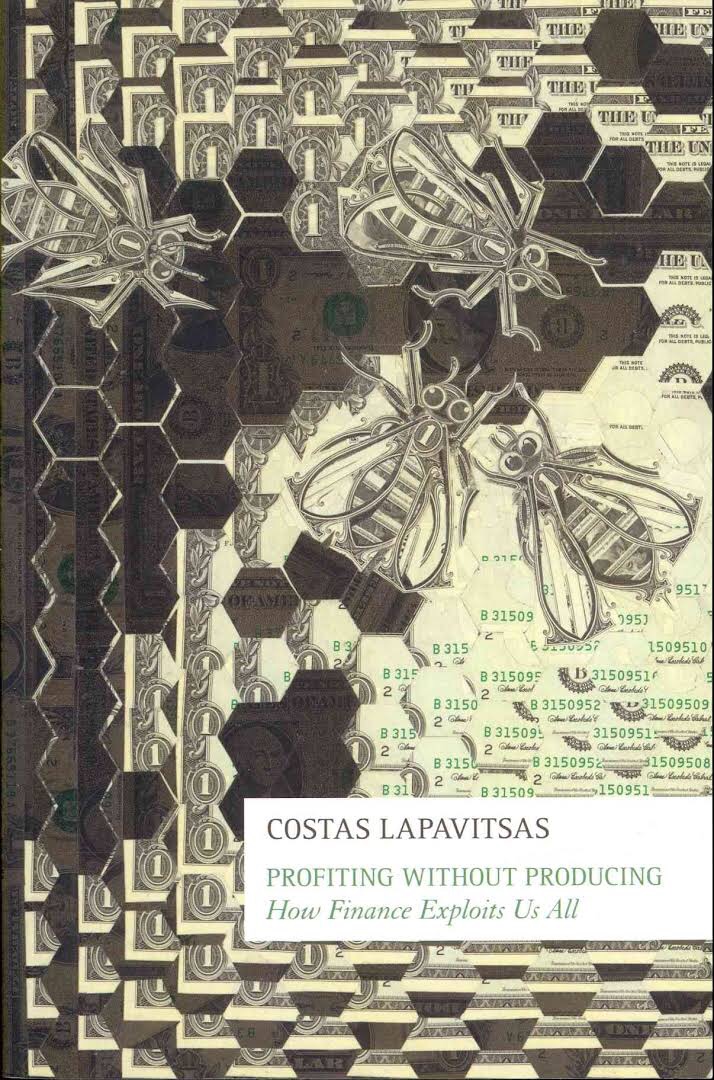
Costas Lapavitsas in his new book, Profiting without Producing (2013) gives an interesting theoretical account of the effects of crisis on the credit economy – the growth in NPAs, bad loans, aggravating the crisis further.

The starting point of Marx’s analysis is trade credit, which is assumed to expand in the course of a boom, creating large volumes of bills of exchange and thereby stretching production and trade. As the boom unfolds, however, banking credit enters strongly into play: banks discount bills of exchange, thus supplying loanable money capital that covers the needs of capitalists for liquid funds. At the later stages of the boom, financial speculation begins to occur on a large scale mostly by creating bills of exchange purely to be discounted by banks. Such bills are often tenuously related, or even completely unrelated to productive activity. The overextension of credit (both trade and banking) contributes to overaccumulation and overproduction, resulting in inventory accumulation and excess supply in commodity markets. Given the difficulty of sales, the expansion begins to unravel and a commercial crisis emerges.

For Marx, the appearance of commercial crisis has a decisive impact on the overextended mechanisms of credit. Inability to sell finished output implies inability to honour maturing bills of exchange on the part of borrowing capitalists. Consequently banks begin to accumulate non-performing assets. As the quality of bank assets falls and the creditworthiness of borrowers declines, banks become reluctant to lend. The restriction of banking credit occurs at a moment when liquid money capital is heavily demanded by functioning capitalists pressed by the difficulty of selling. Gradually banks become reluctant to lend even to each other, with the result that the money market becomes extremely tight and interest rates rise rapidly. That is, an absolute shortage of liquidity begins to emerge.

Faced with a liquidity shortage, capitalists no longer demand money capital to sustain or expand the circuit of productive capital. Rather, they are under pressure to obtain plain money to settle bills and other loans that fall due. Maturing loans would have been incurred during the upswing in the expectation that liquidity would be easily available at the time of settlement from banks, or elsewhere. But the destruction of confidence among banks implies that fresh funds are not forthcoming; the banks (and other participants in the money market) prefer to hoard money. In a liquidity crisis, cash becomes king and promises to pay among private capitalists are devalued. In a remarkable turn of phrase, Marx claimed that in a capitalist crisis there is ‘a sudden transformation of the credit system into monetary system’.