Marxism in academia – don’t lament, but fight!!!


I have never been comfortable with lamenting over the marginalisation of Marxism in academia, in which many comrades time to time indulge. In fact, there is no such marginalisation happening globally – just look at the publishing projects of Marxists throughout the globe, with books priced exorbitantly. Of course, this Marxism is not meant for activists – they can be fed with free blogs and free tweets/fb entries (even these are accessible to a tiny minority only)! A senior ‘Marxist’ in Delhi once told a students conference in the early 1990s, how much she and her colleagues have contributed in Marxism – the only job left for leaders and activists now is to put that knowledge in use. Perhaps the neoliberal rightwing assault on this academic comfort (and liberalism, which liberalised Marxism too) gives an opportunity to liberate Marxist theorisations, regrounding them in real class struggle and proletarian practice (even in academia).

David Laibman correctly historicised this state of Marxism and its implications in his 1997 book, Capitalist Macrodynamics:

The shifts in political and economic power have… been accompanied by ideological transformations as well. Marxism, having been largely removed from its earlier position of influence in the labor movement and other social spheres, has taken refuge in the academy. There, under intense intellectual pressure, a certain fragmentation has taken place, as the formerly unitary Marxist world view has conformed to the disciplinary specialisations: thus we have ‘Marxist sociology’, ‘Marxist economics’, and so on. The unifying generalizations of historical materialism have also come under continuous fire, as Marxists have retreated to more ‘defensible’ positions.

SR2003: Linguistic-Communal Politics and Class Conflict in India


Here is an old essay on communal politics in India, which was published in Socialist Register 2003:

SR2003


Labour Mapping through Workers’ Inquiry


(Preface to a report on labour mapping exercise in Odisha)

Here is a report of an exercise in labour mapping undertaken in specific regions of Odisha in the last couple of years. Over the years, committed indigenous and rural activists have seen a tremendous deradicalisation of the old modes of organising and mobilisation. They have been made complicit in ritualism and clientilism of competitive democracy. Neoliberalism that vows to counter an activist state has in fact further extended the ritualistic clientilist character of the state. It has accommodated private civil players in its network by putting out several state functions to them. The rampant localisation and ngoisation of activism is in fact one of the chief characteristics of the political process under neoliberalism – it minimises the state formation, but infinitely extends its magnetic impact.

The purpose of labour mapping has been to understand rural social relations in several districts of Odisha – Jharsuguda, Sambalpur, Dhenkanal, Angul, Cuttack, Jajpur, Jagatsinghpur, Nayagarh and Boudh – from the perspective of labour. The dynamics of rural transformation under neoliberalism has changed the character of rural struggles and there is a need to seriously engage in the task of programmatic refocusing of rural mobilisations. As rural Odisha is being transformed increasingly into a labour reserve, agriculture and other allied rural economic activities are now less concerned with their profitable nature, rather they are increasingly becoming means to sustain surplus population. In this situation, labour mapping becomes essential to reconnect activism with everyday struggles of the “rural” population – to visualise their footlooseness as a ground for new kinds of peoples’ struggles. In this report, workers, activists and researchers (in most cases all these identities converge in same individuals involved in this inquiry) have tried to trace self-activism and organisation in the everydayness of workers’ struggle for survival. The choice of population clusters for inquiry is made on the basis of their location in the organisational networks of these activists, so that self-inquiry becomes possible.

1

At the very inception, we should make it clear that this engagement was not a voluntary choice made by researchers to fulfil some project requirements. The aim and the means had roots in the exigencies of activism. It was a task that emerged out of the organic experience of activists who were involved in the mobilisation and struggles of indigenous population and oppressed communities in parts of Odisha since the late 1990s. At that time the entry point to grasp the everyday lives of these people was their identities.

One must remember that the 1990s was the period when throughout India the developmentalist politics around exclusion that had dominated the political discourse since independence, especially since the 1960s, suddenly encountered the neoliberal novelty of network, that changed the character of socio-political discourse overnight. Now nothing seemed to be excluded, rather everything was found differentially included. Activists became less concerned with a share in the pie, rather they found themselves confined in its sticky layers. But as they struggled more and more to free themselves from this mire, witnessed in the numerous spirited struggles against primitive accumulation, to preserve indigeneity against global corporatist onslaught, to maintain and increase the distance, the novel networking of neoliberalism revealed itself by subsuming their moves as mere means of determining the levels of differentiality in its global system of inclusion.

The very entry-point to grasp the everyday lives of the indigenous and backward class population seemed superfluous. It is not that the specificities collapsed, but specifics became mere shades in the constitution of the general. Those who remained stuck to this entry-point, they succumbed to existentialist politics – either trying to survive in marginality, as voices helping or forcing the system to develop checks and balances, or by accepting the role of agencies of inclusion as neo-elites within respective communities. Identitarianism lost its critical edge; in fact, it affirmed the rainbow configuration of neoliberalism.

It was this deficiency of identitarian politics in sustaining the task of anti-capitalist transformation that led many groups of indigenous and other social activists to grasp the limits of identity politics and endeavour a leap beyond. Activists who resisted succumbing to the lures of the system, were mostly those who already had found themselves engaging mainly with the ‘subalterns’ within the identities. Thus, objectively they had started finding identity politics insufficient in rendering meaning to their experiences. In fact, now the question of indigeneity too could not be explained in its own terms – in terms of its exclusivity, its internal culture and history. Rather, it became important to grasp how and why “the greatest leveller,” capital as social power, reproduced and instrumentalised such exclusivity. Now, it was important to grasp the question of indigeneity and other forms of identities in terms of social processes within capitalism.

The languages of subalternity, which were founded only in specificities of identitarian oppression and devoicing could not satisfy these new subalterns. In fact, those languages themselves became means of reification and labelling to fashion the general capitalist language of competition. Any attempt to restrict these subalterns to the discourse of identity became part of the general capitalist mode of increasing competition among the segments of the general class of new subalterns across identities, the class of workers, i.e., the working class. It was the social process of classification that broke open the reified homogeneities of competing identities. However, this process did not do away with identities, rather it provided them a new significance, a new role – of both waging class struggle and obfuscating it. That is to say, identities provided the hegemonic capitalist class a tool to compose itself through competition between particular (identitarianised) capitals where other classes are invested as supporting masses – thus constructing the field for democratic and political competitions, the heightening of which is war. This dampens the class struggle by decomposing the working class, by increasing competition among identitarianised segments of workers. But this dampening is what can be termed as “class struggle from above,” as this helps in reproducing the hegemony of capital. This way identity politics in fact contributes in constructing the terrain for class struggle and conflict, in shaping up capitalism’s superstructure. It further contributes in the political recomposition of the working class by politicising the intra-class inter-segmental relations. Thus, working class politics too could not be envisaged by avoiding differences and internal conflicts, which are invested as socio-technical composition of labour for capital accumulation. Any organisational effort to unite workers from outside by wishing away such composition, its inherent divisions and conflicts will reproduce the capitalist agencies within the class. The working class recomposes itself politically only through these conflicts, by utilising the fissures in the socio-technical composition of labour, by re-envisaging it as a new terrain of class struggle.

The crisis of identitarian politics against exclusion during neoliberalism led to a focus on the process of proletarianisation, even if the direct reference to the working class was and is still generally resisted. But the ideological legacy of identitarianism and its revalorisation in the capitalist polity tends to keep the understanding of the phenomena of dispossession, alienation, etc., at mere experiential levels, as invasion, colonisation and onslaught, not as part of the internal reproduction of capitalism through originary accumulation, not as continuously shaping the successive regimes of capital. The ideological baggage and objective advancement frequently come into conflict. The duality of exclusion/inclusion and politics around it are rendered asunder by this refocus, as the process of proletarianisation is both exclusion and inclusion. It is by excluding people from the ownership of means of production that they are included in capital relations. Honest activists in the resistances against primitive accumulation in the 1990s and 2000s without class focus found themselves now and then betrayed by the mainstreamisation of popular aspirations – which seemed to resist exclusion to bargain for better ‘inclusion’ or compensation.

It was around the mid-2000s that we see once again the struggle for entitlement, inclusion and compensation becoming attractive for NGOs and social activists. And this time the language of labour was found enticing but it was itself identitarianised in the process. This new discourse of labour was administered by various commissions, government pronouncements and legislations that sought to ready the neoliberal regime to face the effects of the global economic crisis with fragmentary dosages of age-old welfare state measures. Those who accused Marxists of talking about workers and not about other identities and small producing classes in rural India suddenly were engaged in organising workers – and the trick was done by various labour legislations for the unorganised sector that proliferated in the neoliberal era. These legislations were brought to help market forces to sustain labour supply – flow and reserves – in those sectors where demand and supply are always volatile. More than labour laws regulating employment relations, they were social laws that constructed welfare boards and other basic support system which in effect kept labour reserves and supply intact. Construction labour legislations, National Rural Employment Guarantee Act (NREGA) etc came, in which essentially the role of organising and struggle was to register workers in the respective welfare boards, for provisioning of I-cards and tools and the functioning of schemes. It was really about endowments and entitlements of a class as a group of people but not at all about class struggle, not about the struggle of a class, which is congenitally bound in a conflictual relationship and exists only in the diverse strains of that relationship.

Any talk about labour politics and working class without grounding it in class relations and struggle amounts to a depoliticisation of these relations. It becomes all about individuated workers being endowed and exchange-entitled in accordance to their endowments. It is about the uplifting of those workers, giving them voice without allowing them to question the very structure of work relations in which they are workers. They are simply deconstructed into sections of population – social stratum with numerous sub-strata. And, everybody inches towards becoming closer to the ideal of an average man – generally referred to as a middle-class. The structure of work-relations are taken for granted. Specific relations are sometimes focussed only to ensure that they continue to sustain the fairness of exchange-entitlements.

2

The purpose of labour mapping in our case is to understand the digits of changes in specific work-relations, and how much their averaging is taking the shape of a generalised structure of fundamental social relations. It is a cartographic exercise to recognise on the one hand how elements of indigeneity and identity become specifications of the general structure in a particular socio-cultural context, i.e, how the dominant mode of commodity production and exchange is overdetermined by diverse modes and relations of production and exchange. On the other, it is a process mapping of the neoliberal network of production and exchange that subsumes and connects various levels of activities in which labourers are simultaneously and consecutively engaged. It is the cartographic tracing of the nomadic hordes of the (post)modern working class and accounting for its footlooseness. This perpetual footlooseness which was earlier considered to be a mark of an insufficient actualisation of the subsumption of labour by capital is valorised in the post-fordist regime of capitalism as an essential endowment of labour that could help sustain capital mobility and the flexibilisation of the work processes.

The task of labour mapping was undertaken to overcome the problems that neoliberalism posed before some of the peoples’ organisations and social movements in Odisha. Once it is realised that the rural indigenous population too is internally differentiated and sections are differentially included in the system, and that it is the mobilisation of labour through local state apparatuses and agencies of capital that has become central to the rural economy in Odisha, there is a strategic refocusing to overcome the existential crisis that the neoliberal regime of accumulation has created for older organisational forms grounded in perspectival dualism – exclusion/inclusion, we-don’t-have-this/we-want-this. It is a return to the original organisational principle that saw self-organisation as a multiple of conflictual relationships between labour and capital, on the one hand, and associational relationships among labourers, on the other. In other words, diverse organisational forms are found in the operation of these relations – which organisational form(s) will eventually succeed in constituting the revolutionary expression of the working class is the age-old question of class praxis and is an issue for militant investigations or inquiries.

This brings us to the notion of workers’ inquiry. Inquiry here is not an objectivist exercise by a sociologist which reduces workers to an object, ultimately resonating with the theories of human resource management and mainstream economics that reify workers simply as inputs in the commodity economy (thus, any activism on their part is a deviance to be controlled or managed). Rather, central to the notion of inquiry is the understanding of the workers as a subject-object. Therefore, inquiry is about developing “a reflective community of workers-organisers”. Operaismo (workerism), a major tendency within Italy’s workers’ movement in the 1960s-70s, saw the practice of workers’ inquiry as “joint research” between workers as militant researchers and workers in capital-labour relationship. For Operaistas inquiry was an antidote to the ossified vanguardist practices of the established organisations that throttled self-activism and self-organisational abilities of the working class. Antonio Negri, a prominent Italian Marxist, who was one of the major militants of operaismo, explains:

“The practice of joint-research was simply the possibility of knowing, through inquiry, workers’ levels of awareness and consciousness as productive subjects. If I go into a factory, get in touch with the workers and carry out with them an investigation into the conditions of their labour, the joint-research is obviously the description of the productive cycle and the identification of the functions of each person within that cycle. But at the same time, it is also a general evaluation of the levels of exploitation that each and every one of them suffers, of the workers’ ability to react in relation to their consciousness of exploitation in the system of machines and before the structure of command. This way, as the research advances, the joint-research creates outlooks of struggle in the factory and defines threads or devices of cooperation beyond the factory. Evidently, this is where the hegemony and centrality of praxis in research reside: this praxis helps our understanding of the cycle of production and exploitation and is enhanced when it determines resistance and agitation, which is to say, when it develops struggles. Thus, it is practically possible to constitute an antagonistic subject, because this is what the argument is about.”

The endeavour to map labour right from its initial mobilisation, in production and circulation spheres through workers’ inquiry is actually a recognition of the existential crisis of organisational forms sanctioned from above and an attempt to redefine social activism in the everydayness of class struggle, of struggle between labour and capital.

THE ORGANISATIONAL QUESTION OF THE WORKING CLASS IN ODISHA – A Note


This is a note for a TU workshop in Odisha to be held in December (2014)

1. The mobility of capital and precarity of labour characterise the neoliberal transition of the economy. It is the fear of capital’s mobility that regiments governments to do everything in their capacity to make capital stay. Odisha’s government has similarly demonstrated its willingness to submit the tremendous natural wealth in the state to attract corporate capital, disregarding and even crushing every popular opposition.

2. In these more than two decades of implementing neoliberal policies, entailing a process of accumulation by dispossession has transformed the rural areas into an appendage to this developmental process. The dispossessed communities have been mobilised to support this process in the name of employment generation.

3. However, what we see today is a complete transition of rural areas into a vast reserve of “relative surplus population”, completely at the beck and call of corporate interests as cheap and dispensable workforce. This has changed the character of social and land relations in these areas. The integration in neoliberal capitalism has reinforced the subsistence character of agriculture. Instead of the productivistic and industrial character of capitalist agriculture, which can be found in restricted pockets, we find the function of the village economy being predominantly to sustain surplus population – to subsidise the cost of reproducing labour power of the floating and latent reserve army of labourers, thus ensuring an abundant supply of cheap labour force. This is statistically evidenced by the fact that Odisha is among a few states where the primary source of rural income is wage-labour, not profitability on agriculture.

4. It is this context in which the new social movement must be recognised and strengthened. The intensified process of proletarianisation that made various segments of population anxious in the 80s-90s and provided a ground for the rise of competitive identity struggles, is now rendering an opportunity for coordination and networking across identitarian and segmental divides.

5. The hegemonic institutions and ideologies continue to enforce divisions, of which Odisha has been a hotbed in recent years. But the prospect of countering this too has become stronger. Those who were working with tribals, dalits, forest dwellers and other marginal sections of the society, asserting their traditional exclusivist rights and livelihood are increasingly realising the re-signification of their work in the new context.

6. For instance, the institution of MGNREGA, whatever be its role in realpolitiks and in the management of migration, has made a drastic contribution in reenvisaging rural struggles. Wage and employment suddenly emerged at the core of rural struggles, and rural workers their vanguard. This fact has given new meanings to the activities that these workers do to sustain themselves – in forest, on land, in cooperatives, in SHGs, as migrants. A continuum can be easily visualised across reproductive and productive engagements of these workers that can provide an opportunity for recognising forms of struggles and organisations that can coordinate with one another. It is this critical awareness about workers’ struggles and organisations which needs to be strengthened and disseminated. This awareness is not something that can be reified and frozen, it needs to be transformed into a constant alertness and sensitivity towards the dynamism of class struggle.

7. Organisational forms are frameworks through which we try to grasp the daily struggles of the working class, which are waged at various levels of collectivity. When we talk about the “unorganised” nature of the working class today, it is essentially the crisis of existing organisational forms which are finding it difficult to comprehend the patterns in daily class struggle and in new forms of self-organisation and self-activity that evolve within these struggles. This crisis is productive in the sense that it gives an opportunity to the institutionalised labour movement to reground itself in the new conjuncture of class struggle characterised by informalisation, casualisation and contractualisation of the work process, which has drastically recomposed the working class.

8. As stated earlier, today in Odisha, too, we find a stable State totally committed to neoliberal development and industrialisation systematically transferring the infrastructure and natural resources for corporate profiteering. It is a tremendous task before the already marginalised labour movement here to organise itself to confront this sudden expansion of capitalist hegemony in every sector of economic activity. We find an intensification of primitive accumulation through old methods like land acquisition, deforestation, etc, coupled with new instruments of financialisation (chit funds etc.). This has intensified the process of proletarianisation, which along with an expansion of urban and semi-urban economies has drastically transformed the role of the village economy and agriculture – that of predominantly sustaining surplus population or footloose labour.

9. The increasing population of unemployed and underemployed youth being exploited as cheap and casual labour is an important element of the recomposed working class today. With no job security and an intensified competition for jobs of cheap, casual and contractual nature, today’s workers are vulnerable to all kinds of manipulations by state agencies (that includes political formations) which are reflected in sectarian conflicts on communal/caste lines, between ‘native’ and ‘outsiders’ etc. A recent significant case of such manipulation was visible in Talcher where the old contractor and the new contractor of loading/unloading activities in Talcher mines who were associated with main parliamentary political parties in Odisha used workers for violently settling their scores. It is in this lethal situation that the labour movement finds itself today, already mired by marginalisation and fragmentation on political lines. It poses the importance of autonomous workers’ organisations grounded in daily conflicts between labour and capital.

On the Automobile Workers’ Convention organised by Maruti Workers in December 2012


The following text was translated in Hindi and published by our comrades in Nagpur, for the first issue of “Parivartan ki Disha” (January 2013):

Maruti Workers organised a whole day convention of automobile workers on December 9 to oppose continuing contractualisation and casualisation of the workforce and to press for the workers’ rights to organise and to get decent wages. They showed their commitment to the struggle that they have been waging for the last two years despite intimidation and repression. The continuous attempts to alienate their representatives from them, either by buying them off or by accusing them of criminal offences and incarcerating them have failed to deter their resistance. Of course, the process of open victimisation that has started after the July 18 incident has embroiled a major section of the workforce in the legalese, which has put the workers on defensive. However, this call for a convention demonstrated their political astuteness, since only such moves can rebuild their strength and can renew their struggle to a wider scale.

It is difficult to assess the immediate impact of organising symbolic events like a convention – but it is a marvelous example of how workers themselves develop their political agencies and institutions within their own experiences. Of course, the proceedings of the convention were not unique and fell into the line of the usual spectacles which workers are forced fed, where leaders of various trade unions and workers organisations competed to sell diverse shades of representative languages and tactics. But as said earlier what matters is workers’ resolution to test and taste all forms of institutions available to them and go ahead searching for newer ones until they find ones that can really resonate with the levels of their everyday struggle and consciousness.

The Maruti Suzuki workers’ struggle is different from earlier struggles in the automobile sector in the sense that in this struggle there has been a continuous destruction of the various forms of segmentation that capital imposes on workers to break their unity. Earlier, the forms of workers organisation and struggles were determined by these segmentations, thus they remained largely within the limits of law and capital’s control. But Maruti workers have openly subverted the industrial order, reducing even the legal forms of organisation to mere instrumentality (i.e., even when the official union is that of the permanent workers, the non-legal form of workers unity across industrial divides is primary, thus reducing the union to a mere tool to negotiate and issue statements).

After the July 18 incident, the police repression was meant to subdue the workers, and alienate them from their arrested comrades. Of course, it put them on defensive, but the bond among workers forged during their long struggle was never broken. In fact, it strengthened more and more, and workers came out openly in support of their comrades both within the factory premises and outside. Whenever the management tries to appease the workers (like, by proposing to form a grievance committee), workers refuse to negotiate until their comrades are in jail.

Another aspect of the post-July 18 developments has been a wide support among the regional working class for the Maruti workers. The official and mainstream unions have been forced by their rank-and-file to rally in support of Maruti workers. Even the company union of Maruti’s Gurgaon plant had to extend their support. A general perception of Maruti (Manesar) workers has been that of a self-sacrificing youth committed against the contract labour system, wage disparities and oppressive working conditions. All this has put them in the leadership of the regional working class and its struggle. And this convention too showed their determination to take up this responsibility.

On Maruti violence, workers’ struggles etc


READ THE FULL ARTICLE HERE

In one of the discussions that we had with workers in other industrial regions about the Maruti ‘violence’, a worker expressed how they work for the fear of the daily hunger and for feeding their family. Otherwise who would like to work under iron discipline and invisible eyes constantly watching over you, reprimanding you for every small mistake? Workers continuously look for every small opportunity that would enable them to dodge and abuse this system of surveillance.

The (more-or-less) open violence of primitive accumulation that joins the fate of labour to capital readies it for the inherent violence in the active imposition of work that capital as social power with its various apparatuses seeks to ensure. There is nothing reactive about workers’ actions to break out of this panoptic circuit which is now expanded throughout the society. The diverse immediate forms that these actions take are meant to surprise capital.

It is not the question of defeat or success of these forms or agitations that should concern us. In fact, our every success makes our actions predictable, increasing the reproductive resilience of the hegemonic system. Who knew this fact better than Karl Marx? He stressed on the need to watch out for opportunities to stage sudden radical leaps away from the guerrilla forms of daily resistance against the encroachments of capital, or else workers will be evermore entrenched within the system of wage slavery despite – and because of – frequent achievements in their everyday negotiations with capital. Those radicals suffer from the same Second International reformism and co-option politics, of which they accuse everybody, when they visualise class maturation as a linear succession of successes and achievements, not in the increased activity of the working class to catch capital off-guard by its volatile, yet collective thrust.

Today, the dynamism of this workers politics poses a crisis not just for capitalist strategies but also for itself as it constantly outmodes its own forms. The significance of the Maruti struggle and the July 18th incident lies in this process – they demonstrate the increasing inability of the legal regulatory mechanisms and existing political forms to ensure “industrial peace”.

Poverty Line and the Trade of Economics


What is economics, if not an art of huckstering? It “came into being as a natural result of the expansion of trade, and with its appearance elementary, unscientific huckstering was replaced by a developed system of licensed fraud, an entire science of enrichment” (Engels). Montek S Ahluwalia or even Manmohan Singh for that matter are good Economists, in the sense that they make a good support team for modern-day huckstering. But remember huckstering does not rely on truth, but speculations. They speculate on everything, then why not on poverty? What more do we expect from these “modern bagmen of free trade”? They regard “the proletarian (aam aadmi)… like a horse” (Marx), and there are enough horses around to replace one, so why bother feeding them well?

Planning Commission member Abhijit Sen conceded that “anyone who wants to see India looking very rosy would like having low poverty line”. “The (poverty) number can not have any normative basis. It (any poverty number) is arbitrary thing in many ways,” he added.

India’s overseas investments – some facts and meaning


This is a draft report that I submitted to an organisation early last year on the need to develop a labour perspective on India’s rising overseas investment in other developing economies. The report mainly analyses investments in Africa (esp Kenya and Sudan). It’s nothing great, but at least it grasps the urgency of developing such a perspective. It urges us to move beyond postcolonial anxiety and complexes in our understanding of India’s political economic location in global capitalism. At least, people in our neighbourhood and in economies far off, where Indian intervention has reached and increased, are beginning to understand the myth of third world homogeneity. See our interview with a prominent Bangladeshi Marxist, Anu Muhammad.

Download the report

For my earlier take on the issue,
Bush’s Passage to India: Why Does India Carry His Water? (Counterpunch, Feb 2006)

Marx, Ambedkar and Indian villages


I used to wonder whether there can be a common explanation for one of the varieties of post-Independence Indian Socialists’ discomfort towards both Marx and Ambedkar (obviously to be politically correct, they have to keep mum on the latter, diverting all their anger towards Marx). I think there is one commonality between them that seem to disturb our champions of village democracy and rural communitarianism – Marx’s and Ambedkar’s powerful indictment of the Indian village system.

While Marx can easily be accused of orientalism for saying the following:

“we must not forget that these idyllic village-communities, inoffensive though they may appear, had always been the solid foundation of Oriental despotism, that they restrained the human mind within the smallest possible compass, making it the unresisting tool of superstition, enslaving it beneath traditional rules, depriving it of all grandeur and historical energies… We must not forget that this undignified, stagnatory, and vegetative life, that this passive sort of existence evoked on the other part, in contradistinction, wild, aimless, unbounded forces of destruction and rendered murder itself a religious rite in Hindostan. We must not forget that these little communities were contaminated by distinctions of caste and by slavery, that they subjugated man to external circumstances instead of elevating man the sovereign of circumstances, that they transformed a self-developing social state into never changing natural destiny, and thus brought about a brutalizing worship of nature, exhibiting its degradation in the fact that man, the sovereign of nature, fell down on his knees in adoration of Kanuman [Hanuman], the monkey, and Sabhala, the cow.”

What accusation can be hurled upon Ambedkar, a sufferer himself?

“It is said that the new Constitution should have been drafted on the ancient Hindu model of a State and that instead of incorporating Western theories the new Constitution should have been raised and built upon village Panchayats and District Panchayats. There are others who have taken a more extreme view. They do not want any Central or Provincial Governments. They just want India to contain so many village Governments.

“I hold that these village republics have been the ruination of India. I am therefore surprised that those who condemn Provincialism and communalism should come forward as champions of the village. What is the village but a sink of localism, a den of ignorance, narrow-mindedness and communalism? I am glad that the Draft Constitution has discarded the village and adopted the individual as its unit.”

The effect of Binayak Sen’s conviction


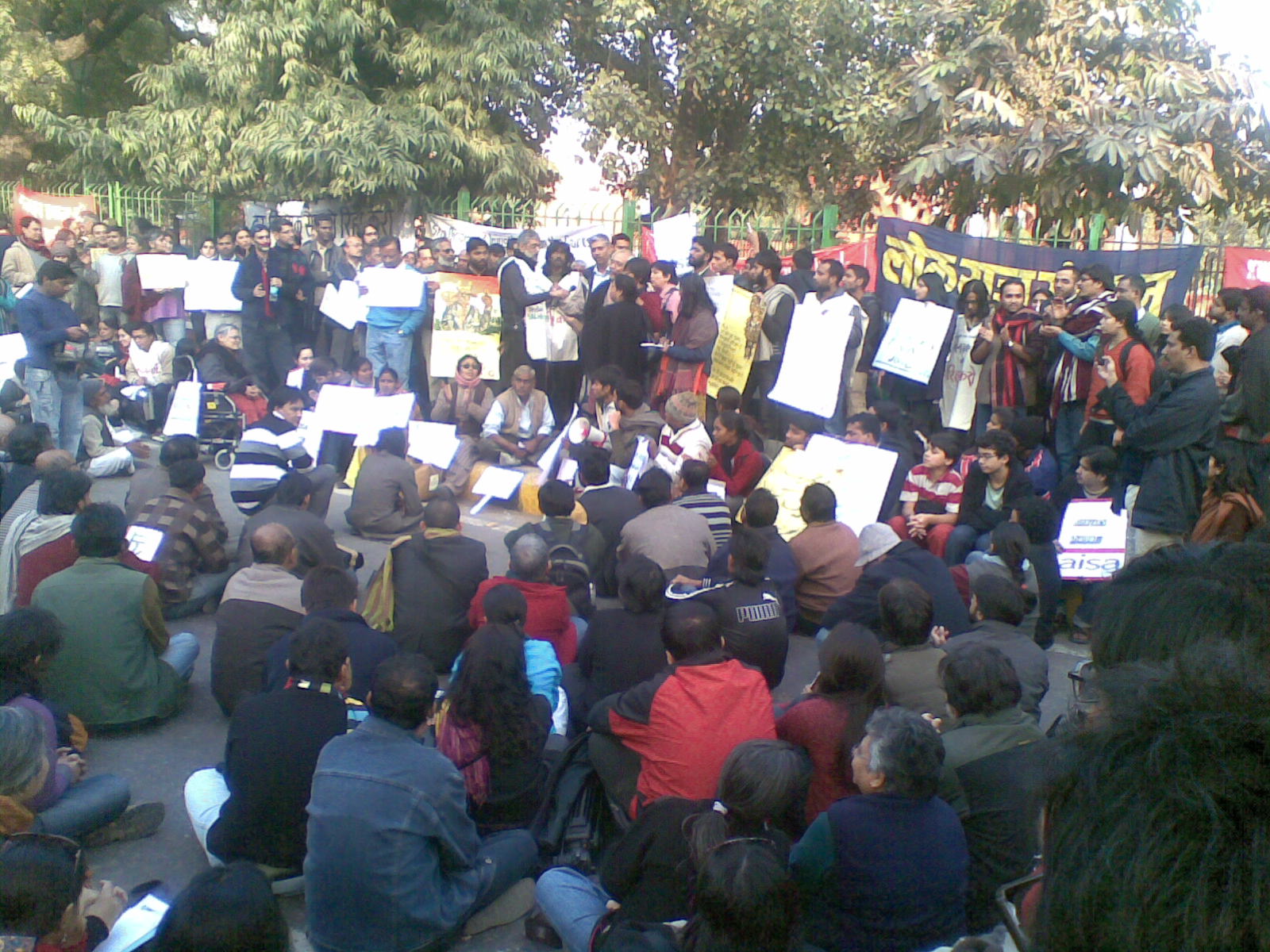
Yesterday, we saw many faces and forces converging on the streets, whom we missed during many programmes against the operation greenhunt over the past several months.

Binayak Sen’s conviction only reaffirms for those who forgot the simple civic science fact that the judiciary is ultimately part of the State, and it has to complement other organs of the State. This complementarity is sometimes contradictory. Such contradictory complementarity has its own functions, which are not simply ideological. Only through such contradictions the state subsumes its own excesses – resolving the problem of coordination between its various organs. One must not confuse these contradictions as some sort of autonomy, as many rights activists do. The overall tenor that the State acquires at a particular phase of societal development is what informs all its organs, one complementing another, even at many times by countering, so that the normality is established.