Progressive Regression in Nepal


Pratyush Chandra

Only one aspect of Nepal’s Finance Minister Ram Sharan Mahat’s budgetary speech delivered on July 12, 2006 is stunningly consistent: its ceremonial mentioning of people’s movement, their aspirations and their martyrdom. Along with references to “rural empowerment”, “peace” and “sharp cuts in royal palace allocations”, these incantations are intended to provide new discursive “instruments of legitimation” for the Nepali state, or as the World Bank Country Director for Nepal, Ken Ohashi, says, all these are necessary for “establishing the credibility of the state” (“Seizing the open moment”, Nepali Times, 7-13 July 2006). Only time will tell if radical forces are able to expose the new regime’s opportunism under cute baubles: the progression of regression in Nepal.

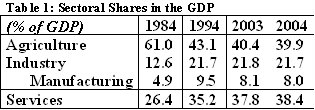
Let us first ponder briefly over the present state of Nepal’s economy to understand the full meaning and implications of the budget. In 2004, Nepal’s population was around 25.2 millions, of which around 85% resided in the rural areas, suggesting their dependence on agriculture. The per capita income in 2004 was US$260, which is far below the average per capita income in low-income countries ($510) and in South Asia ($590). Particularly revealing is the structure of the economy according to the sectoral shares in the Gross Domestic Product (GDP):

Source: World Bank (2006), “Nepal at a glance”.


Source: World Bank (2006), “Nepal at a glance”.

As Table 1 shows, there has been a continuous decline in the share of agriculture in the GDP. The industrial sector’s share definitely did expand from 1984 to 1994. However, since 1994, at least, its share has been stagnant, while the manufacturing industries’ share is on the decline. It seems that the non-manufacturing industries and services sector have been compensating the decreasing share of agriculture in the GDP, but as evident from Table 2, none of these sectors have been promising in their self-expansion. In fact, the average annual growth rate in the industrial sector has drastically reduced in the period 1994-2004.

Even though the increasing share of non-agricultural sectors in the GDP is a universal trend, in Nepal, like in other South Asian countries, this has not been accompanied by a proportionate shift in the labour force from agriculture to the other two sectors. According to the estimates of the Food and Agriculture Organisation (FAO) of the UN, the percentage of agricultural labour force in total labour force in Nepal remains almost unchanged since 1979 – it was 94% during 1979-91, while for several years now it is stuck to 93%.

All these indicate a huge rural/urban divide – an immense sea of rural poverty encircling a few islands of urban affluence. Taking into consideration the inequitable distribution of land holdings (Table 3) and semi-feudal forms of exploitation in an increasingly monetised rural setting, one can only imagine the state of the poor peasantry, semi-proletarians and the landless.
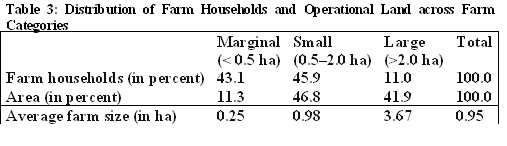

Source: Devendra Chhetry, “Understanding Rural Poverty in Nepal”, in Christopher Edmonds and Sara Medina (ed.), Defining an Agenda for Poverty Reduction (Vol. 1), Asian Development Bank (Manila, 2002). The figures are drawn from National Sample Census of Agriculture Nepal, 1991/92, Analysis of Results, Central Bureau of Statistics (Kathmandu, 1994). Ha= hectares

Even the World Bank admits (Economic Update 2002) that poverty could not be reduced in Nepal since “growth has been concentrated primarily in the urban areas and particularly in Kathmandu valley, largely excluding 86 percent of the population who live in rural areas, where per capita agricultural production has grown minimally and the overall level of economic activity has been sluggish”.

The disproportion between the share of the non-agricultural sectors in the GDP and the amount of employment generated in these sectors indicates that whatever growth we find in these sectors are either in capital-intensive industries controlled by foreign capital collaborating with a handful of Nepali mercantilist corporates, or in the informal economy where the circulatory migrants from rural Nepal toil with no job security and very low wages.

Moreover, impoverishment in rural (also in urban areas) has resulted in sluggishness in domestic demand for industrial goods, which has further eroded the possibility of an increased industrial growth in Nepal. This fact coupled with the backlash of liberalisation (export-oriented production) has made the industries in Nepal increasingly dependent on external markets – depleting internal resources to feed external demand. This further perpetuates the need for capital-intensity and an import of technologies to compete globally, thus making the dependency total, and the goal of employment-generating industrialisation a chimera.

In this situation, it is expected from any post-April 2006 government, which draws its power from popular radicalism that has enwrapped Nepal today, that it will represent the aspirations of the masses and address their basic problems – rural poverty, inequitable land distribution, unbridled commercialisation, profit-motivated industrialisation, lack of economic activities induced by popular needs, etc. The figures in Tables 1-2 testify the reality of neoliberalism as practiced in the Nepali setting.

It was in 1984 when the Nepali State accepted the IMF/WB liberalisation package, and never deterred from the neoliberal course despite the so-called 1990 democratic achievements. The Maoist revolt was a challenge to this path, and it was obviously expected that a post-April 2006 government would rethink the model of economic management that the Nepali State has been pursuing till now. But this was not to be, at least if we go by Mahat’s budgetary exercise.

In the introductory paragraphs of the speech, the Finance Minister talks about the need to “form a common vision of socio-economic development through dialogue among political and social forces active in the country” and asserts that “the dialogue between Government of Nepal and Nepal Communist Party (Maoist)” is most certainly a formidable step in this regard. In his zeal to make this point, he goes to the extent of visualising the fantastic possibility “to end all forms of conflict prevalent in the country”. However, the revolutionaries would never claim to negotiate for such a utopia, not with the democrats who are still uncomfortable with the possibility of sweeping away the most blatant point of contention: the burden of royalty.

But the Finance Minister himself betrays his and his colleagues’ conscious design of which all this wordiness is an important characteristic. This blueprint becomes clear in the following sentences: “The national debate today has surely centered on determining the future political system and process to achieve sustainable peace. This does not mean that the issue of economic development should be pushed to back burner. Democracy cannot flourish on the foundation of a weak economy. The economy is in crisis for over half a decade. It is looking for a new momentum.”

This statement contains all the essential ideological elements that characterise global neoliberalism, the weaning diet of the leadership of developing countries. First and foremost, the will to separate the economic from the political, that is, to ensure the complete depoliticisation of the former, is expressed in clear terms. To present that the “national debate” is only about politics is not only a gross misrepresentation of Nepali politics, but more importantly, it is a ploy to ensure that “the issue of economic development” does not become part of this “national debate”. Of course, economic development should not “be pushed to back burner”; rather with Mahat it must compete with political development more vigorously. But what will be the course of this economic development? The immediate answer that we seem to get is: No politics, please.

Economic development, for Mahat and his ilk, is unilinear along a neoliberal trajectory, or whichever one set by the global and regional masters. And the fundamental duty of any “national” leadership under the global neoliberal regime today is to police this unilinearity so that politics does not contaminate economics. This is the redefinition of the cherished “rule of law” today. If all conflicts in the politics of economic development are systematically ruled out, then, of course, the fantastic vision that Mahat has about ending “all forms of conflict prevalent in the country” will become real and there will be everlasting “sustainable peace”.

Consider provisions of the budget. As usual, there is an overabundance of promises, allocations and words as proof of the government’s commitment to the people in Mahat’s budgetary speech. All these are duly balanced by its fidelity to “investment-friendly atmosphere” for agro-businesses and “commercial farming”, “to encourage private investment” in every sector and, of course, faithfulness to its donors.

In the name of the pro-poor programme, the government will formulate an agriculture business promotion policy for “enhancing private sector participation in agriculture, market infrastructure development and agro-industries”. “As per the concept of public-private partnership, a policy will be adopted to encourage private sector in the expansion of technology and seeds under agriculture extension programme”. Then, there will be interest subsidy in tea farming, floriculture and milk chilling centres. The “One-Village-One-Product” programme “under public-private partnership will be initiated to increase production of commodities, which have adequate export potentials in foreign countries”. “Assistance will be provided for improved seeds, fertilisers and technology to jute producing farmers”. And the clincher – “concessional credit facility will be provided to the landless people for the purchase of land”.

Thus, the government will alleviate rural poverty, to ensure food security and implement land reforms. Market is the magic wand. What if there is no food, no land? Market will resolve everything.

Is it too demanding to realise the implications of these budgetary provisions? Where do they locate rural Nepal and its toiling masses in the global agro-industrial complex by excessive commodification of their lives? They are milled into “a new division of labour in agriculture”, where “the centre has specialised in capital-intensive production of grains and dumped them in the periphery, while peripheral states have battled for saturated markets for traditional exports, or have discovered ‘comparative advantage’ in various ‘non-traditional’ goods and land uses, namely ‘exotic’ fruits, cut flowers and vegetable, as well as ostrich husbandry and ‘wildlife’ management (ecotourism). In turn, all of these have been biased towards large-scale landholding, controlled by corporate capital, and destined for luxury peripheral and metropolitan consumption.”(Sam Moyo and Paris Yeros (ed), Reclaiming the Land: The Resurgence of Rural Movements in Africa, Asia and Latin America, Zed Books, London, 2005, p.18)

In the industrial sector too, Mahat has all his recipes ready for resolving industrial difficulties. He dips straight into undergrad textbooks on Economics to derive his recipes. For private sector there is a development and rehabilitation programme. “An Industrial Rehabilitation Fund will be established with the participation of the government, central bank, financial institutions and interested industrialists and entrepreneurs in order to rehabilitate the conflict-affected sick industries”. There will be a new labour law too, amenable to the needs of new industries, special economic zones and export processing zones.

This means the institutionalisation of the already informal labour market with no security for the workers. And, if these workers organise themselves and agitate, they will be accused of serving “the narrow interests of a small group”, as World Bank Country Director Ken Ohashi (“Seizing the open moment”, Nepali Times, 7-13 July 2006, p. 4) puts in an article published on the eve of the budget submission, since “peace, social and political inclusiveness, and economic growth” can be attained only if energy is directed “away from self interests to a collective purpose”. Strikingly, it seems either Mahat has literally lifted phrases from this article, or else the budget was drafted in the WB’s office. He too pleads for “a balance between the collective wishes and collective means”.

It is not very hard to identify the nature of this collectivity. In a class-divided society, the hegemonic collectivity is that of the ruling class, and the State is a definite instrument to serve its purpose. Hence, to meet this ‘collective purpose’, the Koirala government has everything to offer to their rich protégé-protectors, even a complete tax holiday for the newly-established industries in 22 remote districts for ten years. But for the same ‘collective purpose’, the workers and poor peasantry must understand that all “goals cannot possibly be met by this budget” (Ohashi) and that “the state does not have adequate resources to immediately fulfill unlimited needs of the people” (Mahat).

All this should definitely encourage foreign investors and their local agencies, but Mahat draws something more from the free market of ideas. This time around he desires to satiate the swadeshi and patriotic spirit. For this, he has a Swadeshi Jutta (national shoe) formula: “In order to promote the domestic production, the existing legal provision to purchase the domestic products by the government agencies even in cases where such goods are costlier by 10 percent than the foreign products will be implemented strictly. It is believed that the use of indigenous shoes and clothes by agencies like Nepal Army, Armed Police and Nepal Police under this program will encourage the domestic industries to a great extent.”

While all these development and rehabilitation programmes will be implemented to boost the private sector, the classical medicine is in store for “public enterprises”: Liquidation. It is not very difficult for even a newspaper-reading or TV-watching layperson to decipher the neoliberal ideological character of these budgetary measures, squeezed between the wordy paragraphs on “inclusive society and economy” and poverty-alleviation rhetoric.

The Nepali leadership, which has been historically compliant to the needs of the global masters, literally as their security guards, has never found neoliberal lessons very difficult to learn. Like in other countries, Nepal’s balance of payments crisis in 1982-85 gave the country’s leadership the classical rationale to ride the IMF/WB led neoliberal wave. Thus, they negotiated “a standby credit arrangement with the IMF. Accordingly, Nepal implemented an economic stabilisation programme in 1984/85. This was followed by the Structural Adjustment programme of IMF and the World Bank in 1986/87”. (“Understanding Reforms in Nepal”, Institute for Policy Research and Development, 2005). The political economy of Nepal, which had been a guinea pig in the hands of international finance capital for testing strategic panaceas, was once again brought to the operating table for yet another surgery. When the side effects started showing up in the shape of the democratic uprising, a patchwork was arranged in 1990.

The 1990 political arrangement broadened the experience and reach of this leadership in renting out the local natural and human resources for the benefits of the global machinery of capitalism. The localised elements of the ruling class that were nurtured by the aid regime and extensive commercialisation of the economy were brought into the fold of the State power. The limited democratic “political competition” established in 1990 provided a mechanism to attune the composition of the State to the changes in the ruling class composition. It was visualised that formal democracy would reduce all inter- and intra-class conflicts to competition between lobbies and dissipate any fundamental challenge to the economic structure, while the process of neoliberalism intensified.

The standard remedy in neo-classical bourgeois economics for any crisis due to marketisation is more marketisation with peripheral superstructural arrangements. Thus in Nepal too, “Economic liberalisation and privatisation policies were intensified from 1992 onward with the implementation of the Enhanced Structural Adjustment Facility (ESAF) programme. Given the open border and special trade relations with the southern neighbour, the speed and direction of reforms were also affected by the reform drive pursued in India. Since then reforms have either been continued or deepened in the modern economic sphere of trade, industry, finance, exchange rate, and monetary and fiscal policies. As a result, Nepal now stands as one of the most liberalised and open economies in the South Asian region” (ibid). A least developed country has been blessed by the most liberalised economy in the region; such is the endowment of neoliberalism.

This reckless and continuous compliance to the needs of global capitalist accumulation and its political regime nurtured radicalism in the consciousness of the Nepali downtrodden. Before 1984, this was spontaneous and sporadic. Under neoliberalism, it became general and organised, reaching its zenith in the form of Nepali Maoism. In 1990, it was thought that electoral games and formal democracy will keep this radicalism at bay and the Nepali downtrodden playful. On the contrary, it helped in rooting out the local elements of the Nepali ruling classes and neo-rich, revelling in their newfound proximity to Kathmandu and royal institutions. Thus the prism of caste, ethnic and local consciousness that inverted the reality and united the downtrodden with their oppressors was shattered.

As wealth and growth concentrated in few urban areas in a few hands close to power, close to local political linkages of international investment and finance, the rural-urban divide sharpened. There was an unprecedented intensification in vertical and horizontal inequalities leading to the unity of class war and autonomous identity movements under People’s War. The rural poor and migrant workers united with all the other marginalised forces to challenge the basic structure.

The alternative that emerged in the Maoist practice sought for “land to the tillers”, endogenous development geared towards the popular need and political institutions best suited to facilitate such development. The energy that this practice unleashed rocked the fragile 1990 arrangement despite the consistent neoliberal pursuit by all the governments that were formed thereafter. However, there could never be a clear unity within the political elite due to increased competition for commissions in administering the aid regime and proximity to global and regional players. At the wake of the parallel governments under the Maoists, this competition was further accentuated as the formal structure’s reach of influence narrowed spatially. This overcrowding wrecked the political arrangement that was inaugurated with so much fanfare with the blessings of the global powers. This led to the royal regression, while the democrats for the first time had the time to listen to the radical voices outside the parliament, and thereby allied with the Maoists.

The Koirala government formed after the reinstatement of Parliament in Nepal was, however, quick to realise the significance of the depoliticisation of the economic in order to sustain the Nepali State’s role as the local agency for global and regional capital. Negotiations with the Maoists are making the international forces, especially India and the US, increasingly nervous. The rushed visit to India and Mahat’s presentation before Indian capitalists was to assure Indian and other ‘donors’ that they have not deviated from the neoliberal path. The act of presenting the budget without consulting the Maoists is part of this design. What else could be the reason to overload any future regime with so many prior obligations, but to reassure the supremacy of global capitalist interests after the post-April fluidity?

This brings us to another neoliberal ideological element, which is subtly evident in Mahat’s statement quoted in the first section, where he seeks to pose democracy as the end not the means to attain economic development. This is intrinsically part of the same project of depoliticisation of the economic. If democracy is the end, you do not need to practise democracy in deciding and pursuing the course of economic development. On the contrary, the elite push for liberalisation will itself engender democracy. So wait and suffer!

Of course, this is the ideal of bourgeois democracy: a system of elite decision and public ratification, as Chomsky defines it. But did Nepali people really come on the streets and suffer bullets for this brand of democracy? Royal regression can go, but the Nepali leadership continues to serve the neo-liberal counter-revolution, that leaves the lives of the labouring majority at the mercy of the ups and downs of the globalising market.

Under the neoliberal regime, capital effectively dodges every regulation and controls politics by threatening to fly away in the wake of any uncomfortable circumstances, while the political elite rationalises its anti-labour policies in the name of making the environment investment-friendly. In the name of removing market imperfections caused by “extra-economic” factors, a new authoritarianism is perpetuated, which Venezuelan Vice-President Jose Vicente Rangel calls, “economic authoritarianism”. This renders the democratic control over human and natural resources impossible, while it instrumentalises the state in favour of the hegemonic market interests. As Rangel further says in his address to the 13th Meeting of the Latin American Economic System (SELA) Council in 2003, “Authoritarianism that is dressed in democratic forms is difficult to fight. The neoliberal model and economic decisions, which sustain and reproduce it, need a democratic façade to feign legitimacy.” Hence, the fetish of elections, as “the beginning and the end of democracy”, while economic authoritarianism continues.

(This is a slightly modified version of the article originally published in Combat Law, September-October, 2006)

Ambush Journalism


Pratyush Chandra & Bela Malik
International Nepal Solidarity Network

A spate of print media reports, mainly in the Times of India, but also elsewhere (kantipuronline.com), point to tendencies in the media that have their provenance in geopolitical games. All the reports taken up here have the Maoists as their point of reference. Many of the articles are just sniper-style attacks, absolutely lacking in substance or authenticity. They are remarkable also for the uniformity of screaming sensationalist headlines.

The Wadhwa affair

On 1 August 2006, Times of India (ToI) carried a series of reports about the plight of Indians in Nepal. The shocking headlines are modified for the Delhi, Mumbai and online editions of the newspaper:

1. Mumbai Edition (page 1) “Maoists force Indians to leave Nepal” (print edition)
2. Delhi Edition (page 1) “Maoists are hounding out Indians: A New Threat emerges in Nepal”
3. Maoists: “We shoot those who don’t listen to us” (print edition)
4. “We were very scared
5. “Trouble for Nepalis here?”

All these reports have been authored or co-authored by Indrani Bagchi, a reporter who talked about India’s “nasty neighbourhood” not very long ago (ToI, August 21, 2005). These reports all bear the stamp of a new breed of journalists who are trying hard to graduate into the growing ranks of jingoist security intellectuals in India, tawdry imitations of the American breed of all-purpose experts, whose essential job is to compete with one another for the patronising approval of the imperialist mafia.

Bagchi has a short “page-13” eyewash about the possible backlash on the Nepalis toiling in India, if the Maoists target Indians (“Trouble for Nepalis here?”). The report is supposed to be based on unnamed sources, who only the writer, from all the journalists in India, has access to. But the tenor of the “report” betrays rabid jingoism, warning the Nepalis in Nepal to “behave” themselves.

It pointedly draws the readers’ attention to the Indian government’s patient tolerance. “Thus far, the Indian government has been remarkably lenient, confining themselves to talking to the Nepalese government quietly on these thorny issues. But if things take an ugly turn, the government in Delhi will have to react, particularly as it affects Indian interests.” So, the interests of sleazy businessmen in the gambling trade are to be identified as “Indian interests”. Bagchi also introduces the Chinese factor, obviously, to exploit the Indian elite’s perpetual fear of China: “If Indian trade and business is threatened, said some business interests in Nepal, it is not inconceivable that Chinese could be used to fill the gap”.

As if this weren’t enough, in “Nepal Maoists are hounding out Indians”, Bagchi writes:

“Indians are being hounded out of Nepal by the Maoists. Death threats, 24-hour deadlines for leaving with bag and baggage have been received by Indian hospitality sector employees and businessmen, creating a sense of deep fear in the community.

“The frightened community leaders have gone to the Indian embassy in Kathmandu for protection. Although the foreign office here confirmed that chauvinistic Maoists are driving out Indians, it has surprisingly not taken a public position on the issue — apparently, it will when the threat triggers a deluge.”

The Ministry of External Affairs (MEA, India)’s spokesperson clarified on the same day (August 1),
“I have seen the press report in question. I can only confirm to you that we have received a specific complaint in our Embassy by Mr. Rakesh Wadhwa who is the Executive Director of Nepal Recreation Centre Pvt. Limited about the threat received from the Maoist affiliated, All Nepal Hotel and Restaurant Workers Union. On receipt of this complaint, we have taken up the matter strongly with the Government of Nepal through our Embassy.”

The MEA official statement went to add, “It is not correct to say, as I have heard, that community leaders are rushing to the Embassy etc. That is factually incorrect.” Aside from the obvious fact that Wadhwa is clearly seeking to utilise diplomatic pressure to resolve labour dispute, possibly in his recreation centre (casino?), is the question of reporting.

The “reporters” did not check with the Indian Embassy, an obvious port of call. Neither did they check the facts with the concerned trade union and workers involved in the dispute to get a balanced report.

Salik Ram Jamarkattel, President of the All Nepal Trade Union Federation (Revolutionary) clarified on a phone interview to Nepal 1 (a TV on Nepal channel run by Nalini Singh) that they have not threatened anybody (Indian business class or otherwise) and that they have no such policy/programme of getting Indian citizens out of Nepal. Further, regarding the threat to the Indian workers about which the reports talk, Jamarkatel said that there was some debate between the management and the workers regarding two Indian employees, and eventually 586 workers voted against them and 27 in favour of them. Then they were removed through a democratic process.

As in May this year, when industrial disputes in Birgunj were projected as extortions, once again the above-mentioned sensational reports about industrial matters dub the Maoist’s labour activism as threats to Indian interests. This time too, the Ministry of External Affairs statement said that there “…have been incidents of extortion against businessmen and industrial units including Indian joint ventures in Hetauda-Birgunj area…” and went on to clarify, “I would not like to characterize these as a pattern and to give (say) anything that leads to an alarmist situation.”

Obviously, first page news items with such titles in a national newspaper proud of its “pulp” status are bound to be sensational, and we all know why and when such news is placed in such manner. These items follow the pattern of analyses that informed the US-Indian diplomatic exercises ever since the Maoists-Seven Party Alliance (SPA) understanding erupted into an unanticipated popular revolution in April this year. The motivation has been to force a convergence in the mentality of the paranoiac “national” middle classes in India and Nepal, reiterating the illegitimacy of the Maoist by tainting them with new “sins” both against Indians and against their property. This move is also designed to give a handle to opportunists in the SPA’s rank-and-file to repudiate the Maoists on the pretext of both Maoism’s incorrigibly violent nature as well as the need to desist from displeasing India. They only served to sensationalise the issue and exploit the rising neo-liberal jingoist paranoia in India and to keep the Maoists on the back foot always having to issue clarifications.

Axis of evil: a case of two news reports

On 26 July 2006, an article “Nepal Maoists aiding the underworld?” filed by Pradeep Thakur in Delhi appeared in the Times of India.

It claimed to be based on information “leaked” from the Directorate of Revenue Intelligence (DRI), India. The said DRI report finds threats from every corner of the “nasty neighbourhood”. Apart from Nepal, the report mentions Indo-Bangladesh and Indo-Myanmar borders used for smuggling arms and ammunition into the country. The 1,800-km Indo-Nepal border which touches Uttaranchal, UP, Bihar, West Bengal and Sikkim is at present the most active and vulnerable sector from the smuggling point of view, the report adds. The Indo-Bangladesh border, stretching over 2,650 km along Assam, Tripura, Meghalaya and West Bengal, is an open border and illegal cross-border movement of people through it is extensive. Another sensitive sector used for smuggling arms and ammunition is India’s 2,896-km-long border with Pakistan across the states of J&K, Punjab, Rajasthan and Gujarat. “Smuggling by residents of border villages is suspected despite heavy patrolling by the armed forces,” the report notes.

There is again no corroboration.

Then a news report appeared in Kantipuronline on 2 August (server time 9:12:26) by a “Special Correspondent” that claimed that (Nepali) Maoists have links with (Indian) Naxalites. It said that the Indian Minister of State for Home Prakash Jaiswal gave a written reply to the lower house of parliament, Lok Sabha, dated 1 August that Indian Naxals are “reported” to “have ideological and logistic links with Nepalese Maoists. The Naxals, in turn, have links with Islamic organisations like Lashkar-e-Taiba, he is quoted to have added.” The links between Indian and Nepali Maoists are news, while the Naxals are assumed to have links with Lashkar-e-Taiba. Thus, by transitivity Nepali Maoists are part of the “terrorist network” and ultimately part of the ISI and Al Qaeda operation to destabilise the “civilised” societies. The report concludes with

“Over 200 districts in 14 Indian states are grappling with the menace of Naxal activities such as bombings of railway and other infrastructures and attacks on security patrols. India has adopted a two-pronged approach –counter insurgency and economic development — to deal with the crisis described as number one threat to national security.”

With such predictably Indian intelligence-speak, it appears that indeed one department of the great Indian State went out on a limb and shot off its mouth.

But that was not the case here. The Government of India’s official Press Information Bureau, had put up a press release on 1 August 2006, 4:27 p.m. IST, began clearly:

“Indian naxal outfits are reported to have ideological and logistic links with Nepalese Maoists. There are no reports to suggest links between Indian naxalites and Lashkar-e-Taiba.”

And concluded:

“This information was given by the Minister of State for Home, Shri Sriprakash Jaiswal in written reply to a question in the Lok Sabha today.”

How does one then explain the Kantipuronline report? Is it a simply a grave mistake, or is it mischief, or, worse, malafide?

Indian Fascists find Bush their "National"


A Comment

The chamaleon character of Indian fascism does not allow us to rely on its views except on its consistent barbaric Hinduism. However, it is sometimes worthwhile going through the weekly magazine, ORGANISER, of the Rashtriya Swayamsevak Sangh (RSS), India’s mother fascist organization, to understand how and why it reacts to certain issues in certain manners. One such interesting piece is the edit on the US-India nuclear deal published in this weekly dated July 09, 2006.

When one starts reading this edit, it seems to be a standard write up from an organisation in opposition jealously opposing the achievements of the party in power. It talks about anonymous skeptics saying, “that there are many hidden clauses perhaps in the deal”, and finds ruling government’s unilateralism “as most worrying”. It goes to the extent of accusing the government of destroying “the hard work of Indian scientists with a deal that permits outside interference that emasculates its nuclear options in military and civil sectors. This deal has made India perpetually dependent on the US on nuclear energy. The deal has put restrictions on India’s capacity to have a minimum nuclear deterrent capability.” All these are standard salvos targeted against the deal by both left and right.

Definitely, unilateralism as such is not a problem for the RSS. Unilateralism was far graver when the RSS’ political wing – the BJP led government tested nuclear bombs at Pokhran in 1998, and made the parties then in opposition, which included the Congress that leads the ruling coalition presently, desperate for credits for at least the researches that made India nuclear-capable. Undeniably, what is happening between India and the US today, including the deal, has a strong foundation in the past, especially the Vajpayee Government. Hence, it is natural for the BJP and RSS to accuse the UPA government for attempting to take all the credits for the deal. So the edit asserts, “[T]he NDA government under Atal Behari Vajpayee proudly declared India a nuclear power in 1998. That is a process which has culminated in the present deal.”

The edit makes it a point to differentiate the RSS-BJP’s criticism from the Communist opposition to the deal. And in this zeal it clarifies that it does not have anything to say against the deal.

This feeble attack on the deal is surpassed by the tremendous appreciation expressed for it after the two introductory paragraphs. Whatever lacuna it finds with regard to minimum deterrence etc “can be taken care of if the Indian government insists, when the US legislation that seeks to exempt India from the 1954 Atomic Energy Act is taken up in the full floor of the House of Representatives this month end”. On the whole, the “deal has presented India with a new opportunity. The other option was to continue with its nuclear isolation, and perpetually be in competition with Pakistan”.

Typically, the edit finds pride in Bush supposedly taking the deal “as his most important foreign policy success”. And “skeptical Democrats …don’t want to be seen as voting against India”, that is why they are supporting the deal. What a revelation or pity! The American politicians nowadays go in such deals not for their strategic significance, but more because they are afraid of being seen opposing it. Then, definitely, “it only proves India’s growing clout as a world power. This should make India proud.” And all those who are opposing the deal must be part of the “pro-Pakistan lobby” or “inspired by the Islamabad-Beijing nexus”

But most revealing is the final ecstatic couplet – “American companies and the NRIs [Non-Resident Indians] lobbied hard with hostile Congressmen to make the deal possible. The bottom line is enlightened national interest.” What does one make out of this separately paragraphed final in the cacophonous arrangements of arguments in the edit? When the domestic opposition is “pro-Pakistani”, American companies have “enlightened national [Indian=Aryan] interest” in mind! Certainly, the CEOs of American companies must have found that they are from some lost tribe of Aryans; only then they could find “enlightened national interests” in making the deal possible.

The Historic Agreement in Nepal and the Immediate Challenge


Pratyush Chandra

Nepal continues to create history. Within a few weeks from now there will be an interim government with the Maoists’ participation to pre-empt any further betrayal to the basic immediate demands of the Nepali people for a constituent assembly and for exercising their right to decide the fate of the moribund monarchy and its institutional shields. Definitely, the political developments in Nepal after the April mobilization have approximated to what the parliamentary parties agreed upon in their understanding with the Maoists.

But as Reuters put (June 19), “The pace of change has been as breathtaking as the Himalayan scenery…This week Nepalis are asking themselves if it is all too good to be true”. Given the tremendous hostility that the global and regional hegemonies display, to the degree that they still label the Maoists terrorists, and opportunism of the parliamentary leadership, which was till recently struggling within itself to gain royal proximity and to become trusted agency for the external powers’ interests, has the situation really arrived for the revolutionaries to put their trust in the vestiges of the ancien régime? However, it is the level of popular vigilance and radicalism that have affected even the grassroots of the parliamentary parties, complementing the revolutionaries’ faith in the Nepali downtrodden, that makes them confident to take such unprecedented risk.

Popular Vigilance

After the restoration of their parliamentary privileges, the Nepali democrats have re-baptized the established institutions with new names and cut the wings of the royalty. Of course, all these do help in building the atmosphere amenable for taking the first step towards the resolution of the “Nepali crisis”, which is the formation of the Constituent Assembly as the body that will have the capacity to establish the basic rules, norms and ‘institutions’ necessary for, what Chairman Prachanda calls, “political competition”.

The local elites and their global sponsors had thought that the April radicalism on the urban streets of Nepal would die down after the restoration of the old parliament. But they were time and again rebuffed when the vigilant Nepali people took to the streets to check and decry every compromise and regression in the air. The Maoist rejection of the April compromise did not allow this radicalism to sleep. Deuba, Koirala and others known for their moderate royalism and elitist anti-Maoist stance in the past are constantly watched, and any statement and action from them that reek of the design to give space to decadent institutions and their representatives are duly criticized by spontaneous showdowns on the streets.

Not a single day has passed since the April agitation without meetings and gatherings where diverse sections of the Nepali people discussed the future regime and contents of the future constitution. Various sections of the marginalized majority of the Nepali society have been coming and demonstrating in Kathmandu for ensuring their representation and the inclusion of their demands and rights in the future political system. This remarkable spirit of self-determination rejects any compromise that is short of what the Nepali people have promised themselves. It is this spirit that destroyed the “Royal Regression” and continues to eliminate any possibility of the Parliamentary Regression, of making the old parliament an end in itself. And the June 16 agreement between the Maoists and the government is the definite result of this Popular defiance.

The Elitist Game Plan

But the Nepali crisis was never just related to the accommodation of the Maoists and establishing institutions for such accommodation. It is most importantly linked with the political economic empowerment of the Nepali downtrodden. Until and unless the radical needs of the Nepali laboring classes – workers and peasantry – that have found expression in the Maoist movement are not dealt with, the crisis is not going to be resolved. And here lies the tension that is clearly visible in the political developments in Nepal.

Just before the recent June agreement the Prime Minister arrived from a very “successful” trip to India. And as expected the parameter of this success in Nepal is how much monetary aid the leader is able to raise. And India as the new recruit in the Imperial Project struggling to obtain a definite share in the continuous re-division of the world has recently been too ready to fulfill such requests. Hence, the success was unprecedented.

In return, Finance Minister Ram S. Mahat sold the newfound peace and sovereignty, for which the Nepali people have been fighting, to “captains of Indian industry” at a function organized by the Confederation of Indian Industries (CII): “This is a new era after the establishment of the people’s sovereignty in Nepal. Peace has now been restored after the end of a decade long conflict that had held back the country’s socio-economic advancement… It is in this context that our attention is now focused on increased investment, public and private, domestic and foreign.” An Indian newspaper, The Hindu (June 10) reports, “Referring to the fact that India faced higher labour and operating costs of production, Mr. Mahat said cheap and abundant labour, educated technical workforce and other less expensive inputs provide investors incentives for producing intermediate products for Indian companies in Nepal.”

This economic hyper-activism just before the installation of the interim government is meant to pre-empt any future attempt to radically transform the economic path that the Nepali state and ruling classes have pursued for the last five decades – of economic clientilism and dependency. It seeks to depoliticize the arena of economic policy by overburdening the future political regime with all sorts of economic arrangements that would maintain status quo in the basic political economic structure. The Koirala government has effectively utilized its time to ensure that the basic economic framework is in place which would be difficult to change drastically under any future political transformation. Only after this did it become comfortable with the idea of the dissolution of the parliament and the formation of the interim government with the Maoists.

All this is very aptly complemented by the recent attempt to reduce the “Nepali crisis” and the Democracy Movement to the question of the position of the Nepali royalty and the accommodation of the Maoist “rebels” in the mainstream political system. Clearly, the most formidable way to dilute any radical resolution of this crisis is to simply ignore what it is all about. The recent political discourse of “People’s Movement” and “People’s Power” which sought to de-“classify” the movement, ignore its class constituents and their diverse aspirations, homogenize it under an amorphous category of the “people” was the first attempt in this regard. Moderate royalists, corporate media (foreign and national) and foreign funded NGOs and “civil society” groups led this santization campaign. Foreign interests too found this discourse worthwhile, as it minimizes the damage, by eliminating the clarity of the demands. It effectively evades the Maoist element and puts the Nepali movement in line with the “color revolutions” of Eastern Europe, coloring the corrupt elements of the old regime to provide a “stable”, yet “experienced”, leadership to the new.

Obviously on every front, the Nepali ruling classes are trying hard to de-link the question of democracy from the issue of building the essential institutions for fulfilling the popular needs, giving “land to the tillers”, political and economic self-determination of the diverse downtrodden sections of the Nepali society. They seek to sweep aside the whole question of endogenous development – of accounting the endogenous resources, putting them under democratic control for fulfilling the popular needs.

The Revolutionary Resolution

On the other hand, the popular classes of Nepal – Nepali workers and peasantry – were for the first time mobilized independently during the People’s War, undiluted by the opportunism of the disgruntled sections of the landlord-merchant-moneylending classes and the clientele petty bourgeoisie nurtured as local “nodes” for implementing the social agenda of imperialism. It was in the Maoist movement that for the first time the Nepali landless and near landless, involved in circular national and international migration to meet their ends, found an organized political expression. The rural roots of the Nepali laboring classes even in the secondary and tertiary sectors allowed the popular democratic aspirations unleashed by the Maoist movement to integrate virtually the whole Nepali society behind the New Democracy Movement, despite the claims by other political forces to have achieved democracy in 1990.

Obviously, Prachanda’s concept of “political competition”, which the Maoists in Nepal have developed in one or the other way right from the time they put forward their 40-point demand in 1996, has to be interpreted in this background. They seek an open competition between the “democracy from above” that the 1990 arrangement established and the aspirations for the “democracy from below” that they have inculcated in the daily lives and struggles of the Nepali downtrodden. In standard terms, at the level of economic policy, it is a competition between the growth-oriented and need-oriented frameworks. With the June 16 agreement, the possibility of such competition as the new level of class struggle has become almost certain. But it will be interesting to see how the revolutionaries in the interim government, when established, are able to undo what the Nepali ruling classes have already achieved to make this competition inherently lopsided in their own favor by imposing the basic framework for pre-empting any conclusive assault from below.

(Modified version of the article written for ML International Newsletter (July-August))

Angels and Demons in the People’s Movement in Nepal


Pratyush Chandra

International Nepal Solidarity Network

Today, the talk of people’s power in Nepal is the order of the day. Even the Mainstream Media, Moriarty, Manmohan and their intellectual goons are full of that. Evidently they are having hysterical fits intensified by the return of the Cold War paranoia. The possibility of the Maoists’ coming over ground and their revolutionary agenda — targeting the Nepali dependency — being constitutionalized is definitely a grave crisis for Indo-American imperialism in South Asia. And in order to have a scope for diplomatic engineering, they need sanitized expressions like people’s movement, people’s power etc without identifying who the people are and without detailing their demands.

Definitely the mainstream hatred against the Maoists knows no bound. The media campaign to denigrate the Maoists has never been so vigorous as now, showing the crisis and desperation in the imperialist camp — its failure to color and control the democratic upsurge in Nepal as in East Europe and other parts of the world. As one of the coup organizers against Chavez in Venezuela, Vice Admiral Ramírez Pérez told a private channel just after the coup on April 11, 2002, “We had a deadly weapon: the media.” And as Pablo Neruda, once reminded us, “He’s the skulking coward hired to praise dirty hands. He’s an orator or journalist. Suddenly he surfaces in the palace enthusiastically masticating the sovereign’s dejections”.

1. People’s Movement – a New Phase in the People’s War?

Just a cursory reading of the mainstream media headlines on Nepal and the Maoists today shows that they increasingly concentrate on Maoist “extortions” and other “criminal” activities. One needs to just go through the reports under those headlines to have a glimpse of the conscious game plan. Only to cite a couple of examples:

a) As reported, recently, Indian company Dabur suspended its operations in Nepal. The headline and the first paragraph of the report in Telegraph (May 20), one of the mainstream newspapers in India, told it was because the company refused “to buckle under the extortion threats of the Maoist rebels”. But the same report subsequently went on: “The Maoist-affiliated trade union, All Nepal Trade Union Federation (ANTUF), on May 15 issued a 22-point charter of demands to all the units in the Bara-Parsa-Birgunj industrial belt. They demanded scrapping of the labour contract system, payment of a minimum monthly wage of Rs 5,000 and provisions of housing, medicare and education facilities to the workers and their families. The union warned of dire consequences if its demands were not met within a week.” So the genuine workers movement and its demands in the Nepali sweatshops controlled by Indian imperialists are extortions.

b) The prestigious International Federation of Journalists (IFJ, Asia-Pacific) issued a media release on May 19, where a subheading said – “Maoists attack radio station” (later “attack” was changed to “threaten”). It is obvious that many people who have the habit of reading just headlines will interpret — Oh! These gun-trotting “polpotists” must have raided the radio station. But no! “The Maoist-aligned All Nepal Trade Union Federation issued a letter on May 12, 2006 accusing the two FM radio stations of exploiting their respective staffs, dismissing staff without reason, extreme excesses and mental torture of the staff, and called for the immediate termination of the Kalika FM station director, alleging him to be a pro-royalist.” So, this was an attack!

In order to understand the impact of such unambiguous media reports, one needs to remember how even a great novelist from the Left Jose Saramago went on to dub the great guerrilla movement under the Frente Armada Revolucionaria de Colombia (FARC) as an “armed gang” dedicated “to kidnapping, murdering, violating human rights.” One can only imagine what will happen in the case of Nepal.

The international left movement divided into innumerable sects is taking its toll on the Nepali movement too. So we find even sober Marxist analysts indulging in subjective analyses of the peasant movement in Nepal displaying their rich repertoire of inter-sect abuses ready for the Maoists just because they have learnt from the Chinese peasant movement and call themselves Maoists. The irresponsible reactive armchair leftism ever online enamored of the rights discourse and neutrality too in its efforts to justify its own passivity is increasingly involved in this media redbaiting. As James Petras noted in his open letter to Saramago (Counterpunch, December 22, 2004):

“[T]here are many types of “communists” today: Those who stole the public patrimony of Russia and became notable oligarchs; Those who collaborate with the US colonial regime in Iraq; Those who have struggled for forty years in the factories, jungles and countryside of Colombia for a society without classes; And those “communists” who fear the problem (imperialism) and fear the solution (popular revolution) and make it all a question of personal preferences.”

All kinds of media and ideological manipulations are going on endeavoring to disrupt the New Phase of People’s War in Nepal — its extension to the urban streets with its own peculiarities, to the urban proletarian struggle – with the increased Maoist interventions in urban mobilization and trade union activities. We find rosy words being showered on the People, while denigrating their War. The rightists, “leftists” and imperialists are all united in this propaganda campaign.

Personalities who were never on the streets to suffer police beatings and face bullets were the first ones to declare victory of the People’s Movement with the King’s pronouncements. The desperate Indo-US imperialism and its media touts were booed when they prematurely partied after the King’s April 21 invitation to the parties to name the prime minister, which every force in the movement duly rejected, including the nervous parliamentary leaders. However the panicky US-EU-India interests ultimately found loyal agency in this “responsible leadership” when it unilaterally accepted the April 24 declaration restoring the defunct parliament.

And thus started the sanitization program — of talking about People’s War vs. People’s Movement, of the failure of the first against the successes of the latter as proof of the virtue of non-violence. The hidden agenda is very apparent, that is to restore the sanctified institutions of State Terror while disarming the People by preaching them non-violence. The neutral apostles of Human Rights do this by treating the State’s offence at par with the Popular defense. Imperialisms do this via their “Community Faces” too – through well funded “Civil Society” groups and NGOs, who specialize in administering and selling the social agenda of Neoliberalism, providing “Social Cushion” in the face of the growing marginalization and social unrest. As perfect plainclothesmen, all these apostles of non-violence can be spotted here and there in the Nepali unrest with their clear job of policing the movement from within. After the so-called “victory” of April 24, their additional job has been to write anecdotes about their participation in the “Turn-the-other-cheek-Revolution” with the mainstream and “civil society” media ever ready to channel the processes of sanitization and betrayal.

In this regard, it suffices to quote Black revolutionary Malcolm X who was himself the epitome of Popular Suffering, Anger and Movement right in the belly of the beast:

“I don’t go for anything that’s non-violent and turn-the-other-cheekish. I don’t see how any revolution—I’ve never heard of a non-violent revolution or a revolution that was brought about by turning the other cheek, and so I believe that it is a crime for anyone to teach a person who is being brutalized to continue to accept that brutality without doing something to defend himself. If this is what the Christian-Gandhian philosophy teaches then it is criminal—a criminal philosophy.”

2. The Nepali Movement Beyond Sectism

There is far more to a movement than just its personalities and ideologico-cultural labels – Zapatistas, Chavistas and Maoists. However, there is always a mainstream tendency to relegate these movements to a few personalities, symbols and ideological lineages. This definitely benefits the status quo as the movements are effectively portrayed as sects with some innate pathological tendencies. The failures and problems of the older movements whose idioms the present movements have adopted and adapted to mobilize and organize the masses are extrapolated to vilify the latter. The fundamental issues of the changed conjuncture and the composition of the movements are effectively swept aside through this exercise, ideologically arming the status quo to contravene the ‘subversive’ forces.

Feeding to this is the widespread sectism prevalent within the Left, which aids the hegemonic forces in this regard. The leftist dissection, labeling and libeling are more effective than any repression and mainstream media propaganda in forming and deforming the opinion, as they can be projected as internal dissensions. Karl Marx while summarizing his experience in the First International rightly notes in his letter to Friedrich Bolte (November 23, 1871):

“The development of the system of Socialist sects and that of the real workers’ movement always stand in inverse ratio to each other. So long as the sects are (historically) justified, the working class is not yet ripe for an independent historic movement. As soon as it has attained this maturity all sects are essentially reactionary.”

The recent upheaval in Nepal has once again brought this sectism to the center-stage as people everywhere are trying to cope up with the Maoist element in it. We find Mao’s failures and Pol Pot’s barbarism discussed more than what the Nepali Maoists have done in Nepal – how they have energized the issues of land, land reforms, decadent forms of gender, national and ethnic oppressions, neo-liberal commercialization, distress migration etc as their central concerns.

In the hands of the Maoists, the issue of the constituent assembly, which was forgotten by the democrats, became a rallying point for uniting the rural and urban downtrodden. It was the Maoists’ strength with the growing influence of their slogans and radicalism on the lower leadership and the mass base of the petty bourgeois parliamentary parties that shattered the Nepali ruling machinery’s ability to control the growing rage of the people’s war. Eventually the 1990 historic “compromise” between the royalty and the democrats brokered by the imperialist interests in the region collapsed leading to the latter’s historic alliance with the Maoists in 2005.

This alliance triggered the mass upsurge that we witnessed throughout April this year. The imperialist onlookers were awe-stricken by the response to the General Strike called by the Seven Party Alliance facilitated by the unilateral ceasefire declared by the Maoists in the Kathmandu region with an increased armed assault on the (then Royal) Nepalese Army in other regions. US Ambassador went on with his rumor mongering and presented the situation as “pre-revolutionary” in one of his interviews, which was correct but was meant to terrorize the Nepali petty bourgeois leaders and mobilize international opinion against the revolutionaries. India, who has the history of utilizing the unequal treaties with Nepal for changing the internal political arrangement that best suited India’s interests that necessarily used to include a cosmetic democracy, this time was (and is) desperate to preserve the monarchy. However the Indian response has been moderated due to the immense mobilization within India in solidarity with the Nepali democracy movement.

The petty bourgeois leaders of the parliamentary parties feared direct action in the rocking streets and burning fields of Nepal destroying every institution that mothered them. Instead of the path of revolution, they chose the path of legislation, which allows manipulation and compromise. Afraid of the revolutionary ‘uncertainty’ they found a ready opportunity to withdraw their support to the movement when the King restored their parliamentary privileges. But the movement continued as the Maoists and the grassroots of these parties rejected this compromise and sustained the spontaneous upsurge in popular consciousness, ever vigilant of the old leadership returning to its old habits and forcing some concrete progressive “concessions” that we hear in the news today.

3. Hands Off Nepal: Rebuff the possible ‘Plan Nepal’

Today, most dangerously, all imperialist manipulations, media propaganda and the parliamentary drunkenness in Nepal might prepare the background for something like Plan Colombia, which derailed the similar process of overgrounding of the peasant and people’s upsurge in Colombia under the leadership of the FARC. The FARC in 1999-2001 suspended their armed struggle and negotiated with the Pastrana regime, insisting on a demilitarized zone, putting forth “a political program of agrarian reform, national public control of strategic resources, and massive public works programs to generate jobs”. All these radical measures were destined to destroy the reactionary political economic institutions that allowed the imperialist network to operate in the country, devastating the peasantry, indebting the economy and entrenching corruption in the state structure. Therefore, “with the backing of the US government the Pastrana regime abruptly broke off negotiations and launched an attack on the demilitarized zone” and restarted funding, training and arming the drug traffickers and private armies of the landlords as para-military forces to harass and destroy the people’s movement.

There are well-documented evidences of the drug mafia network under the CIA of which “The King of Nepal” has been an important part. Last year there were reports that Crown Prince Paras “has been allegedly in the drug business for seven years, but his stakes and that of the Nepali royal family have grown by leaps and bounds in the last few years…[T]he crown prince is now reported to be operating his network beyond South Asia.” (Newsinsight.net, July 6, 2005) With the history of the linkages between the drug trade and the US’ counter-insurgency drive, one cannot ignore the possibility of a Plan Nepal in the pipeline until and unless the revolutionary Nepali people are vigilant enough forcing the country’s ever shaky “democratic” leadership to facilitate the ‘overgrounding’ of the Maoists and the crushing of the military leadership trained for imperialist wars, thus thwarting the danger of any imperialist manipulation.

Remember the US insists to keep the Maoists on its terror list, which allows it to intervene and manipulate regimes beyond the seven seas for its domestic security interests. The first thing that the US did after “welcoming” the April 24 proclamation was to sit with the military leaders, not even with the King. The parliamentary forces might remove R(oyalty) from the name of every institution, might add Secular in the official name of Nepal, but the country needs the negation of the whole system nurtured by 200 years of semi-colonialism, that allowed the imperialist powers to use the Nepali people, army and resources as reserve for crushing liberation struggles internationally (in India, Afghanistan among others), as canon-fodder. And all these in exchange with a promise that the Nepali royalty and elite could handshake and dine with the White Royalty, while the Nepali people suffered dual exploitation, and later, in exchange with rents in the form of foreign aid.

In the age of neo-liberalism, when the Nepali soldiers are not sent for killing, they can be used as guinea pigs too for pharmaceutical researches. Recently, there was news about “the American government’s exploitation of Nepali soldiers as human guinea pigs to find a Hepatitis vaccine.” As Jason Andrews wrote in The American Journal of Bioethics: “Noting the millions of dollars, military training, and arms that the State Department and Military have been giving to the RNA to help them put down the Maoist rebellion, it seems plausible that the resultant military and economic dependence of the host institution/population (RNA) upon the research sponsor (the U.S. Military) threatened the voluntary nature of the institutional and individual participation in the trial. That is, the RNA probably was not in a good position to say ‘no’ to the small request by their generous benefactor.”

Servility and loyalty towards global imperialism entrenched in the Nepali state structure and elites can never be removed only by legislations — it needs a complete structural transformation, it needs a revolution, which has just begun and can go anywhere from here. With the growing imperialist counseling to the newly formed Nepali government, and the consensual ideological campaign endeavoring to alienate the movement from its revolutionary leadership through ‘neutral’ rights discourse and by media, any complacency on the part of the revolutionary masses of Nepal at this juncture will curb the process of democratization of the Nepali society and state.

The Royal Nepalese Army and the imperialist agency in Nepal


Pratyush Chandra

International Nepal Solidarity Network

After King Mahendra (Gyanendra’s father) and his Royal Nepalese Army (RNA), overthrew his government in 1960, the first democratically elected Prime Minister of Nepal BP Koirala asked himself in his jail diary: “Is the democratic system in Nepal compatible with the preponderance of the Nepalese Army?” After five decades of the democracy movement in Nepal, this question still haunts the Nepalis. Mesmerised by the royal proximity, Nepali democrats have time and again lapsed into amnesia, comfortably and willingly. But by one or another way the question has found expression and has been answered negatively in the popular upsurges and daily struggles of the downtrodden.

As Nepal’s foremost revolutionary leader Prachanda stated, just after the royal coup in February 2005, “Ultimately, the so-called royal proclamation of February 1 has not only exposed the irrelevance of reformism in the Nepalese politics, but also shattered the collective lethargy of the parliamentary political politics.”. Although the reinstatement of the old parliament once again poses the danger of the relapse of the “collective lethargy”, the politically charged Nepali masses are ever watchful of the parliamentarist deviations. Along with the issue of forming the Constituent Assembly, the question of controlling the RNA is going to be one of the decisive (and divisive) elements in the course of the Nepali democratic revolution.

This army has been the major force behind enforcing the betrayal of the democratic aspirations of the Nepali people for more than five decades. Nevertheless, as Marxist-Maoist leader Baburam Bhattarai rightly notes, “Any ordinary student of military science would know, the victory or defeat of a particular army ultimately depends more on its social class base and the political goal.” And, “the feudal reactionary nature of the royal army and its complete hegemonisation by the ruling Shah-Rana families may be gauged from the fact that of the thirty commander-in-chiefs since 1835, twenty-six belonged to the ruling Shah-Ranas and four to their close courtiers, Thapa-Basnets. Hence, there should be no doubt, at least to the progressive and modern-minded, that the current fight in Nepal is précised for ending this age-old feudal tyranny and to usher in a real democracy suited to the 21st century.”

The RNA has been the major “saboteur”, “with the prompting of some foreign powers” (whom we are all familiar with) in every peace talk in Nepal. Its time-tested principal method of sabotage is senseless massacres of the civilians in the name of defending its soldiers against the revolutionaries while the peace process is going on. In 2003, “the most serious and provocative incident was the massacre of nineteen unarmed political activists by the RNA in Doramba (Eastern Nepal) on the very day of start of third round of talks on August 17”. Again, a few days back on April 29, on the eve of GP Koirala’s swearing in ceremony as a result of the mass upsurge that we saw recently, “Royal Nepalese Army (RNA) launched an aerial attack on a peaceful mass meet called by the CPN (Maoist)… An RNA chopper rained bullets on the mass meet organised in the jungle adjoining a human settlement, where around 10,000 civilians were gathered for the program”.

The RNA is definitely a major concern, as it gets more and more desperate about its own future with the debilitating royalty. International powers that have been arming the reactionary RNA are already having meetings with its chief and other officials, enquiring about their Will.

The recent visit of US Assistant Secretary for South Asia, Richard Boucher is a pointer in this regard. He did not meet with the beleaguered monarch, rather chose to remain satisfied with his direct meeting with the RNA chief Pyar Jung Thapa.

On April 3, in a press conference after the meeting, Boucher was asked whether he thinks “the Royal Nepalese Army is going to be one of the decision makers in future instead of parliament”.

Boucher’s reply was, “I don’t think I quite used the word decision maker, but I said something like that. I think that the army is going to have a very important role to play. The army has to help defend the nation; it has to help defend the nation against threats. They also have to be able to implement the ceasefire, and carry it out. So I wanted to check with the army and see, first of all, that they were supporting the political process, that they were supporting the civilian leaders in Nepal, and second of all talk to them about how they saw their job in the days ahead, and how, when a civilian leadership wanted us to, we could support them in the future.”

What a mode of professing a civilian control over the RNA! A US official makes an official visit to find the will of the Army chief directly, whether he supports the political process or not, instead of asking the government to ensure the submission of the RNA to the civilian control.

However this incident is not at all surprising, since US Ambassador James Moriarty’s chief job after the 12-point agreement between the parliamentary forces and the Maoists last year has been to defend the RNA’s existence in every significant statement. He has been trying hard to mobilise the moderate and wavering democrats and former prime minsiters, like GP Koirala and Sher Bahadur Deuba who were the main exponents of using the RNA to crush People’s War till recently. Replicating Conan Doyle’s Professor Moriarty – a Supervillain or the “Napoleon of Crime”, the US Ambassador time and again has been tying to make the democrats, who lack Moriarty’s “common sense”, understand the virtue of not weakening the RNA, which he calls, in one of his nauseating self-proclaimed “provocative” speeches, “the parties’ one logical source of defense”, despite the well-known fact that it has never respected the self-styled democratic leadership.

If we can learn something from the US’s history of imperialist intervention and of nurturing military juntas, we can at least be sure of the US’s desperation in Nepal to preclude the Nicaragua-type situation, where the revolutionaries disbanded Somoza’s army, and even after the Sandinistas’ defeat in 1990, the Sandinista Army remained as the popular national army and the prime vehicle of democratisation (notwithstanding a considerable dilution of the army’s revolutionary character). As an ex-Nicaraguan Army chief Joaquín Cuadra Lacayo said in the year 2000: “Despite everything the Sandinista revolution eventually led to free elections and democracy, and…the Sandinista People’s Army became the National Army of Nicaragua. For the first time in the history of Latin America, an army that was born as a guerrilla force and matured as part of a government became an army for the nation without political overtones.” In spite of the fact that the ruling elite of Nicaragua has reversed the major gains of the Sandinista Revolution, and the military is completely integrated with the State, the popular revolutionary past of the Army officials and Sandino’s portraits in military headquarters and offices still haunt the US and the local elites. An obvious question for the global hegemony today is: where will the army be once the new radicalism that is gripping Latin America affects Nicaragua? Obviously, the Nicaraguan arrangement can never keep paranoiac imperialists at ease. Therefore ensuring a premature disarming of the Maoists, without crushing the R(oyalty) of the RNA, is the prime game plan of the international hegemonies and their local cahoots in Nepal.

Only such design will ensure the demobilisation of the revolutionary intent of Nepal’s downtrodden that has been heightened during the decade-long People’s War, politically rejuvenating every section of the society. The imperialist network fears that this rise of the red scourge in this supposed “backwater” of global capitalism will blow away the mirage of the new Asian “miracles” in the region, who have been long fishing their booty in these same “backwaters”. With the struggle of democratisation at every level succeeding in Nepal, and the possibility of an open mobilisation, by the “Maoism in the 21st century”, of the proletarians, semi-proletarians and poor peasantry, there is a danger that the class conflict will spread throughout the region, providing “plenty of recruits for Maoist armies and other forms of resistance to global capitalism”, as Alex Callinicos puts it.

In Nepal, The Saga of Compromise and Struggle Continues


April 26, 2006

Pratyush Chandra

As sniffing K9s of the global hegemony, the corporate media around the globe smelled Maoist activists’ and pamphlets’ presence in the post- April 6 protests as proofs of the Maoist infiltration. The BBC reported on April 24: “There are very real fears that Maoist rebels could well use the opportunity to fill the void and take control of the protests. Maoist activists are already believed to have been present at many of the rallies, and there have been several instances of Maoist campaign pamphlets being distributed among the protesters. The last thing the parties want is for the protests to spin out of control and for the Maoists to move in, a view that is fast gaining currency.”

Such rumour mongering by the corporate media is definitely sufficient to send their own masters to psychotic fits of Global McCarthyism. It can also buy a compromise between the King and the anti-communist section of the Nepali middle class trained during the US’ Cold War aid regime who grabbed the leadership of many moderate democratic parties after the 1990 arrangement. However, it means nothing to the local population. They know that the Maoists were the only force facilitating their politicisation to the degree that they could sustain mass strikes for so many days.

Of course, the 7+1 alliance was a great jolt to the vastness of “popular exclusion” that the Nepalese polity and its sponsors have till now maintained by utilising the weapon of “divide and rule”. And we saw literally a new version of Samudra Manthan (churning of the seas) and the whole Nepal was drowned in the resulting tide. The General Strike in Nepal that continued to gain momentum since April 6 demolished the floodgates already tattered in the course of Maoists’ continuous assaults for a decade. These gates erected during the six decades of continuous betrayals forged and financed by the complex international network that combines the global, regional and local ruling classes had trapped and ‘subalternised’ the confidence and consciousness of the Nepalese downtrodden.

Today the gates are nowhere. Throughout Nepal curfews and “shoot-on-sight” orders have been enforced and defied. “Emotionally charged sea of the masses in the streets manifests that the liberation forever from the feudal monarchy, which has been betraying since the past 250 years in general and 56 years in particular, is the earnest and deep aspiration of the Nepalese people” (Prachanda’s Statement, April 22).

Justin Huggler aptly captured the scenario for Independent (UK) on April 22 after King Gyanendra did his first bid to buy off the leadership by offering the protesting parties the Prime-Ministership. “Looking tense before the camera, King Gyanendra said: ‘We are committed to multi-party democracy and a constitutional monarchy. Executive power of the kingdom of Nepal, which was in our safekeeping, shall from this day be returned to the people.'” On the other side of the political fence: “‘Death to the monarchy!’ they chanted as they marched. And as they walked, the people of Kathmandu lined the streets to cheer them on. This was a nation on the march. Several police lines fell back before them. Soldiers guarding the airport grinned and gave them signs of support.”

After the King’s second bid on April 24 once again the million-dollar question remains “whether the announcement will be welcomed as readily on the street, where hundreds of thousands of Nepalis have called for the monarchy to be abolished” (Huggler in Independent, April 25), despite the fact that the Seven Party Alliance (SPA) has accepted the King’s offer to reinstate the Parliament, dissolved in 2002 on the recommendation of one of the leaders in the SPA. Guardian (April 25) reports, “There is a danger that crowds may take to the streets in defiance of the political leadership. Yesterday, speakers at rallies in the capital’s suburbs repeatedly said they would not be “tricked” by the king.”

What we witness in Nepal today is a unique dialectic of spontaneity and organization in full operation that characterises any great movement. “The masses are in reality their own leaders, dialectically creating their own development process” and the ‘leaders’ are forced to or willingly “make themselves merely the mouthpiece of the will and striving of the enlightened masses, merely the agents of the objective laws of the class movement”. (Rosa Luxemburg) At least one section of the political leadership is conscious of this dialectic, when it says: “[T]his movement has not now remained to be a movement only of either seven political parties or the CPN (Maoist) or civil society or any particular group but as a united movement of all the real democratic forces, who have been repeatedly deceived by the feudal autocratic monarchy since 1949.” (Prachanda & Baburam Bhattarai’s statement, April 17, 2006)

By rejecting the present compromise the Maoists show their respect to the Nepalese downtrodden who fought valiantly for the basic demand to form the constituent assembly – the institution that will give them at least a say in the process of ‘democratisation’ curtailing its patrician character and may serve as the foundation of the new democratic Nepal. Even though the wavering petty bourgeois parliamentary leaders afraid of the radicalised masses unilaterally withdrew their support and rejoiced on the restoration of their privileges, let us hope the Maoist rejection and the grassroots unity across various political formations built in the yearlong united people’s struggle will keep them sober.

A commenter on International Nepal Solidarity Network’s website (insn.org) thus reacted to the news of the King’s announcement:

“In protests, for a moment, people from all classes were present… They will once again split into the political camps, who best represent their class interests. The only ‘people’ who will continue to be on the streets are those who were already there on the streets and fields before the protests – who will continue to fight to survive. The ‘protests’ have at least given them a rough map of the political scene of Nepal, and heightened their confidence and consciousness.”

However, we must admit that the recent protests marked a new phase in the Nepalese struggle for democracy and self-determination. From now onwards nothing remains consecrated in Nepal, beyond popular scrutiny and criticism. Every section of the society is politically charged. We see democracy in action in the streets of Nepal.

Tariq Ali rightly puts (Guardian, April 25): “What the uprising in Nepal reveals is that while democracy is being hollowed out in the west, it means more than regular elections to many people in the other continents”. It means the people’s right to root out their own poverty, the democratic control of the Nepalese human and natural resources, ending the caste, national and gender privileges and discriminations… It means to have a Constitution that secures all these fundamental rights, and for that they demand a constituent assembly.

Versions: Counterpunch, Countercurrents, INSN, ZMag

Pure-and-Simple Revolutions in Nepal and Venezuela


COUNTERPUNCH

For a decade or so, the media has been talking about new color and flower revolutions with colorful revolutionaries like “orange” ones in Ukraine. But, after so many sponsored, colored and sanitized revolutions, as additions in the market of “a series of products deprived of their malignant property: coffee without caffeine, cream without fat, politics without politics the other deprived of its otherness” (1), once again we are witnessing pure-and-simple revolutions and revolutionaries, in Latin America and Asia (and of course, there are many in the streets of Paris, and among the immigrants in the US, too). Nepal and Venezuela are two hot centers of pure-and-simple revolutions.

The parallel between the Nepalese and the Venezuelan movements that I draw rests upon some of their basic commonalities. There might be people for whom such comparisons would be outrageous–how can one compare the sophisticated experiments in Latin America with a violent and uncompromising movement of Nepal? Although it is not my purpose here to make the Nepalese movement palatable, but this parallel allows me to expose some of its basic facets.

1. “The Object and the subject of power”

Broadly, I attempt to understand the Nepalese experience as part of the global struggle for democracy, self-determination and socialism. As I see, both the Maoist movement in Nepal and the Bolivarian revolution in Venezuela (along with other Latin American movements), evolve as continuous critiques of capitalism and its political forms, especially formal bourgeois democracy, from the perspective of the downtrodden classes and communities in the respective countries. The element of negativity defines the basic unity between them.

In the Americas, there are many “sui generis” laboratories of revolution, where people in their daily practice of “humanist and cooperative logic” transform themselves colliding at every step “with the capitalist logic of profit” and their own exploited existence.(2) In this daily experience they find their own power and political expression. “Rather than putting the Venezuelan people asleep in order to enslave by making the act of voting ‘into the beginning and end of democracy,’ Chávez wrote in 1993 that ‘sovereign people must transform itself into the object and the subject of power. This option is not negotiable for revolutionaries.'”(3)

On the other side of the global south, who understands better than the Nepalese, the farce of voting as “the beginning and end of democracy”? They also know the various ways in which this farce could be enacted. Each time their grassroots consciousness become a decisive challenge to the status quo, a newer version of this farce has been enacted in Nepal to distract them, co-opt a few representatives, de-popularize policy-making and dissipate whatever energy is left in the streets.

Even the day, which is celebrated as the “Democracy Day”, was the day when Indians re-instated the Shah Dynasty on the throne with an arrangement with the Nepali Congress to preempt the radicalization of the uprising in the countryside. Eight years after that, when the unrest on the unfulfilled promises seemed simmering again, elections were held in 1959. B.P. Koirala won on the plank of providing ‘land to the tiller’. But in December 1960, King Mahendra banned all parties for dividing the country and found, on the basis of researches probably done in the US’ universities, that the parliamentary system, being a foreign creation, was not much in “step with the history and traditions of the country”. The homegrown panchayat ‘democracy’ institutionalized the indigenous Hindu hierarchy as a political system with the King on its top as the reincarnation of Vishnu. Destroying commons, unprecedented commercialization, uprooting the people and growing unemployment radicalized the youth and forced the rural poor to self-organize in the 1970s; and the political elite–the royalty, with the democrats’ assent–needed to stage another ‘democratic’ farce–a referendum on the panchayat system, with far more ballots than registered votes. Finally, right at the time when global imperialism was full of expectations for its hegemonic stability in the late 1980s with the crumbling of East Europe, a new compromise in Nepal was reached in 1990 to preempt the organized revolutionary tide that seemed certain.(4)

The history of Modern Nepal is the history of the crisis of democracy, as a system of “elite decision and public ratification” (5). The exploited and downtrodden Nepalis have time and again refused to accept this opiate of voting as “the beginning and end of democracy” and took the burden of exercising democracy in the streets and in their daily lives. The Nepali ruling classes and their international sponsors in their desperation have tried many exotic forms of putting them to sleep in order to control them, but have repeatedly failed. The Maoist uprising is the longest and most systematic (in official terms, brutal) attempt by the Nepalese landless, poor peasantry and the proletarians to transform themselves “into the object and the subject of power”. And thus they refused to be duped.

2. “New Democracy”

As far as the details of what the movements in Nepal and Latin America posit and the way they posit are concerned, there are definitely many differences. But then, as Lebowitz tells us,

“We all start from different places in terms of levels of economic development— and, that clearly affects how much of our initial activity (if we are dependent upon our own resources) must be devoted to the future. How different, too, are the situations of societies depending on the strength of their domestic capitalist classes and oligarchies, their degree of domination by global capitalist forces and the extent to which they are able to draw upon the support and solidarity of other societies which have set out on a socialist path. Further, the historical actors who start us on the way may be quite different in each case. Here, a highly-organized working class majority (as in the recipe books of previous centuries), there a peasant army, a vanguard party, a national-liberation bloc (electoral or armed), army rebels, an anti-poverty alliance and variations too numerous to name or yet to emerge— we would be pedantic fools if we insisted that there is only one way to start the social revolution.”(6)

The Maoist movement might seem as a critique of global capitalism from outside the political economic mainstream–the ‘marginal majority’ of the peasantry and the landless. But the ‘outside’ is not equal to something autonomous from global capitalism. In fact, on the contrary, in the stage of imperialism, capitalism flourishes by preserving its diverse stages and even ‘pre-capitalism’ simultaneously–backwardness and advancement together. The persistence of the agrarian ‘outsiders’, as in Nepal, contributes in stabilizing the global rule of capital by providing a stable and informal reserve of potential proletarians to be drawn as scums and blacklegs whenever needed, guardsmen for international security and imperialist agencies, and peripheries for expansion of the late capitalist economies like those of India and China. It is in this regard that I find the “instability” in Nepal, the rise in the democratic aspirations of the Nepalese people and their struggle for advancement and development as a definite crisis for the politics of imperialism, for global capitalism in South Asia.

One might object to the above perception by saying that the Maoists have defined the goal of their struggle as “new democratic”, not socialist. Moreover, a new democratic revolution, classically, intends to complete the ‘national’ transformation towards capitalism. But it is important to note the factors that left this transformation incomplete, and for whose elimination we need a revolution. Even for Mao who defined “new democracy” in the Chinese context, the most formidable hurdle in such a transformation in a “semi-colonial” society was clearly global capitalism that had reached the stage of imperialism (“the invasion of foreign capitalism and the gradual growth of capitalist elements”). Moreover, for him, “any revolution in a colony or semi-colony that is directed against imperialism, i.e., against the international bourgeoisie or international capitalism is no longer a revolution of the old type led by the bourgeoisie with the aim of establishing a capitalist society and a state under bourgeois dictatorship.” The ‘new democratic revolution’ “serves the purpose of clearing a still wider path for the development of socialism. In the course of its progress, there may be a number of further sub-stages, because of changes on the enemy’s side and within the ranks of our allies, but the fundamental character of the revolution remains unchanged”, i.e. it is “part of the world revolution”, which “no longer refers to the old world revolution, for the old bourgeois world revolution has long been a thing of the past, it refers to the new world revolution, the socialist world revolution”(7).

So the immediacies of the ‘new democratic revolution’ constituting the “sub-stages” are determined by the task of intensifying the class struggle, which is the only road towards the “development of socialism”. Imperialism or global capitalism with its ‘national’ hegemonic nodes peripheralizes and retards economic development at various locations to stabilize those hegemonies. Any democratic assertion from below in any form in these peripheries is an assault on imperialism and its political arrangements. Venezuelan and Nepalese movements are united in this regard.

Further, after Soviet Union and China succumbed to the political economic exigencies of international capitalist competition and the politics of “peaceful coexistence”, there was a temporary crisis for the world revolutionary challenge to capitalism. With the vestiges of official socialism swept aside, the global challenge to imperialism, the “highest” stage of capitalism, is once again visible, and only naive journalistic exercises, which fiddle with apparent dissimilarities and descriptions, will find the linkage between the Venezuelan and Nepalese movements uncanny. Even the police state of global capital is far more aware of the underlying unity challenging its hegemony, forcing it to mention the “demagogue” Chavez, the “anti-American dictator” Castro and the “vicious” Maoists together in its National Security Strategy 2006.

The dissimilarities between these movements are rooted in diverse “concrete situations” in which the revolutionaries find themselves. Obviously, as Michael Lebowitz time and again reminds us, “socialism doesn’t drop from the sky”. Venezuela with its tremendous oil assets and relatively higher level of systematic industrialization and proletarianization, along with its (counter-)hegemonic relationship with other Latin American countries bestow on the revolutionaries tasks very distinct from those in the backward, aid-driven economy of Nepal. But none of these ‘concrete’ local conditions can undermine the basic unity and complementary character of these movements in challenging the “concrete whole” of global capitalism. In fact, what makes the Venezuelan and Nepalese experiences stand out among the plethora of anti-capitalist, anti-globalization movements is the definiteness of their goals–the political-economic self-determination, to create a situation where the laboring majority would toil to satisfy their “own need for development”. As the Latin American working classes have evolved co-management and asambleas barriales to reclaim their collectivity and its fruit, the Nepalis for their self-liberation will need to first destroy the shield of the whole hierarchy of the officialdom and its privileges fed and armed by foreign aid and ensure a complete agrarian transformation to reclaim their resources and labor from global capital and its local agencies.

3. The Inside-Outside Dialectic

However, there is an interesting political economic dialectic that operates in Nepal and Venezuela making these movements mirror images of one another. Both are engaged in the process of transcending the dichotomy between the ‘outside’ and the ‘inside’ that global capitalism creates for its own expansion. The Maoists are doing so by forging an alliance with the forces that are struggling ‘within’–the trade unions, other working class organizations and petty bourgeois parties/fronts, while the Bolivarians are trying to establish a democratic space beyond the institutionalized framework of bourgeois democracy that subsumes every participatory initiative into its competitive dungeon.

As mentioned earlier, the loci of Venezuela and Nepal in global political economy are highly dissimilar, even opposite. Venezuela as a fully capitalist economy challenges capitalism from within; hence the Bolivarian movement for a complete social transformation needs to build and sustain apparatuses and institutions outside the established political and economic paradigms. Co-management and barrios formed on the participatory principles are the expressions of this ‘convex’ need of the movement. As Massimo de Angelis rightly puts, “The “outside” created by struggles is an outside that emerges from within, a social space created by virtue of creating relational patterns that are other than and incompatible with the relational practices of capital”(8).

In Nepal, on the other hand, the six decade-long Nepalese democratic movement achieved its partial victory in 1990, with the accommodation of the “democrats” in the power structure, which eventually frustrated the movement’s vigor, alienating its committed vanguards and grassroots–institutionalizing “popular exclusion”, without the semblance of “popular inclusion” that bourgeois parliamentarism or representative democracy provides for self-legitimacy. Herein lies the root of the internal instability that has marred the political arrangement of 1990 and the secret of twelve Prime Ministers in thirteen years. In fact, parliamentarism became Monarchy’s instrument of legitimacy.

It was this ‘illegitimate’ arrangement that provided a ready opportunity for an independent political mobilization of the ‘excluded majority’–mobilization and dispersal of the movement ‘outside’/beyond a few urban centers. The cry for democracy ­ for “self-determination” ­ reached hitherto untouched zones of the society, giving birth to the “dual power”. Evidently, it aggravated the crisis in the established hierarchy (broadened by the 1990 arrangement), which sustained itself and the hegemony of its international sponsors by such exclusion–sustaining Nepal’s peripheral character, as a ‘reserve’ for capitalist expansion and accumulation. The Maoists assaulted right at the middle of the passage, through which the “included minority” leeched upon the ‘excluded’. The consequent internal mutation choked the parasitic political economic hierarchy. The 1990 arrangement was critically shattered in 2005.

A decade long success of the Maoist movement today has reoriented the aspirations of the Nepalese petty-bourgeoisie forcing the “democratic” parties to form an alliance with the revolutionaries against “the autocratic monarchy”. The 12-point agreement between the Maoists and seven parliamentary parties last year, along with the unilateral ceasefire by the revolutionaries marked the beginning of a critical phase in the Nepalese democratic struggle, in the struggle for self-determination. This agreement creates the possibility for an open ‘competitive’ struggle (as a manifestation of the deeper class struggle) between democracy as a mere form or mode of decision-making and democracy as practice or “a way of people developing in struggle and emerging as a class for itself through a process of self-transformation” (9). In other words, it potentially opens the road for a confrontation between the practice of formal democracy and “insurgent” popular democratic “practice” based on the collective needs and aspirations of the landless, proletarians and the poor peasantry that the Maoists have helped in developing and sustaining in their decade long armed struggle.

In other words, the “outside” is increasingly reclaiming the “inside”–i.e., the Nepalese movement is ‘concaving’ in, seemingly in contrast to the Venezuelan experience. It is in this dialectic of inside/outside that these movements realize the complete transformation of the respective societies. Only by transcending this dichotomous binary can a society comprehensively move “beyond capital”.

4. “Sukumbasis” as the protagonists

For many years now, the aid and remittance economies have fed the mainstream political economic institutions in Nepal. They nurtured a polity based on the ‘cut and commission regime’, which in turn facilitated these businesses of foreign aid and legal-illegal human trafficking. They survive on the toil of millions of exploited and oppressed Nepalis working abroad and for the agencies usurping the indigenous commons and resources. Internal and international migration has been a persistent feature of Nepal motivated by immense agrarian inequality, reinforced further by the commercialization of the local societies through foreign aid. Industries that were established in the country have been heavily dependent on foreign capital, especially from India, and do not generate sufficient employment because of their capital intensity. Of course, ‘alternative’ industries in service sector like tourism have definitely flourished, but only the local population knows what it means to work in this sector heavily based on informal labor with no security and degenerating exploitation of human beings, not just their labor. Hence, circular migration across the borders, even beyond the seas, with falling back on land is a viable option before the Nepali.

Regarding the rural scene, a prominent Nepali political economist, Nanda R Shrestha says, “Overall, near-landlessness remains prevalent as a permanent fixture of the Nepali agrarian economy” and outmigration–especially, circular migration to India–has been an important survival strategy, that helps sustain “the hill economy in general and the hill near-landless in particular”(10). However, since the 1970s there has been a remarkable degree of self-organization among the landless peasants (Sukumbasis), which has been evident in their organized land encroachments and spontaneous settlements, time and again crushed by the Shah Regime. It is beyond the class capacity of the petty-bourgeoisie and the legalist-opportunist politics of petty-bourgeois radicals and democrats, who generally represent the landed gentry and are ever ready to compromise on any concession from the royalty, to give a radical turn to this ‘new’ peasant spontaneity.

However, “the rage simmering under every poor peasant’s feet is finally being ignited by a cadre of unwavering Maoists. Irrespective of political persuasion, few can deny that this is a fire that can no longer be smothered by the state and its armed forces no matter how much larger and better-equipped these forces are in relations to any force that the Maoists can muster with its limited resources. What looms heavy over Nepal’s political horizon, therefore, is the unyielding question of who the masses will side with–with the forces of fractured democracy, with the ever-sinister hands of the absolutely dysfunctional royalty, or with the uncharted territory of the Maoist vision. Maoists derive their power from the people.”(11)

It is evident that the agrarian question which confronts Nepal today and provides the basis for the Maoist upsurge, once again, puts the Nepalese movement in line with the great “new peasant movements” (as James Petras describes them) in Latin America and Africa that decisively threaten ‘third world’ dependency and the global capitalist hegemony. In this regard, it is worth noting that as global capitalism develops, ‘unresolved’ agrarian question becomes more and more that of labour, less of capital. As Henry Bernstein tells us, “the many popular struggles over land today are driven by experiences of the fragmentation of labour (including losses of relatively stable wage employment in manufacturing and mining, as well as agriculture), by contestations of class inequality, and by collective demands and actions for better conditions of living (‘survival’, stability of livelihood, economic security), and of which the most dramatic instances are land invasions and occupations. There is now a revival and restatement of the significance of struggles over land to the social dynamics and class politics of the ‘South’ during the current period of globalization and neo-liberalism.” Referring to James Petras’ work on Latin America and Paris Yeros’ work on Zimbabwe, Bernstein concludes, “Contemporary land struggles are significantly different from the (‘classic’) peasant movements of the past, and are much more rooted in the semi-proletarian condition: that of ‘a workforce in motion, within rural areas, across the rural­urban divide, and beyond international boundaries’.”(12)

5. “Human beings in all their determinateness”

One may have doubts about the “participatory” element in the Maoist movement. But this doubt comes from a sterile presupposition and deification of trans-historical pluralism and democracy. It is important to keep in mind the class composition of every movement that shapes the character of ‘democracy’ and ‘participation’ in it. The experiences of the peasant movements and struggles show that democracy from below in a rural setting will come with all its ‘violence’, ‘primitiveness’ and ‘distortions’, devoid of the preconceived urban sophistications. What is important is the raised political consciousness of the Nepalese landless, poor peasantry and proletarians, and their active willingness to decide and build their own future. However, the tension between the participatory element and its institutionalized alienation in the process of consolidating movemental gains, which create status quoist interests, is always there, as also with the Venezuelan experience.

It is well recognized that a fundamental contribution of the Maoist movement has been to inculcate the issue of self-determination at every level of the Nepalese society. Even the most vehement critiques of the Maoists recognize that it is the contribution of these “economic determinists” that the issues of socio-cultural oppression based on identities, gender, nationalities, castes have found definite political expressions. As one analyst complains, the Maoists “were quick to identify” the ethnic discontent in the Nepalese society and tried “to ride it to their purpose, taking advantage of the supposed correlation between ethnicity and poverty”.(13) Another notes that the Maoist movement “has also set precedents for alternative experiences, practices and discourses on gender equality”.(14)

Dalit intellectuals, from the communities that are lowest in the caste hierarchy, find, “Insurgents have raised the economic, social and political issues of Dalits as well as the issues of women, indigenous people and others”. Further, in “people’s war”, “Maoists refocused on social intervention in their stronghold areas. Maoists have initiated a campaign called ‘caste integration and people’s awareness campaign’ in order to overcome hesitation of non-Dalits in breaking age-old practices of untouchability. In the Maoist heartland in Rolpa district, the untouchability and caste discrimination has been reduced. They have declared ‘caste free villages’. They have strictly made villagers not to practice caste discrimination. The Bista System (in which occupational Dalit castes receive grain annually for the services they provide to non-Dalit households), considering it an economical exploitation as well as a way of maintaining feudal relations of domination and subordination, has been transformed into daily remuneration for labor, which is now the norm in the Maoist base areas”.(15)

Since its inception, the Maoist movement in Nepal understood the fact that, “While no one liberates himself by his own efforts alone, neither is he liberated by others.”(16) The Maoists facilitated the creation of a definite space for solidaristic praxis where these autonomous ethnic, gender and community-level struggles for self-determination could coordinate their liberatory praxes. The active participation of the oppressed identities in “people’s war” has armed their identity assertion, their aspiration for self-dignity and freedom against a brutally oppressive Hindu hierarchy. In its turn, the ‘reflective participation’ of these entities has strengthened the support base of the Maoist movement.

However, this identity of the oppressed and exploited in diverse social relations with a class movement derives from the basic fact that this class of proletarians and semi-proletarians are “human beings in all their determinateness”. Hence their complete liberation requires liberation from all forms of oppression and exploitation. The unity between dalit, women, national and other liberation movements is the laboring majority’s self-assertion as human beings. It means that they are fully aware of the secret through which the global capitalist class, directly or indirectly, maintains its power, i.e., by the ‘parcelisation’ of their ‘selves’ according to sex, age, race and nationality, among other aspects.(17)

In “participatory” experiences of both countries–Nepal and Venezuela, despite differences in the levels of sophistication (due to the differences in the “levels of economic development”), the element of force or “coercion” is important. In the case of Venezuela, it is provided by the ‘transitional’ State, while in Nepal, it is the ‘provisional’ state, constituted by the Maoists, that stands in the background of those experiences. However, arbitrariness is the price of the provisional and the insurgent nature of the ‘force’ in Nepal. But post-2001 developments demonstrate that the Maoists are fully aware of this problem, and their internal debates and readiness to form an alliance with other ‘forces’ are indicative of their efforts to transcend it. It will be interesting to see if their resistance against the local representatives of the extraordinarily dense and widespread imperialist network of relationships and connections will bear any immediate success. Or, will global hegemonies and their agencies succeed in buying a compromise and betrayal that the Nepalese people have seen so many times in their struggles for self-determination?

Pratyush Chandra can be reached at: ch.pratyush@gmail.com

References:

(1) Slavoj Zizek (2004), A Cup of Decaf Reality.

(2) In the laboratory of a revolution: Interview with Marta Harnecker, Venezuela Analysis, Sep 22, 2005.

(3) Michael Lebowitz (2006), BUILD IT NOW: SOCIALISM FOR THE TWENTY-FIRST CENTURY, Monthly Review Press, forthcoming

(4) For an interpretation of the political history of Nepal, see my short articles–‘Pre-1990 “Democratic” Experiments in Nepal and The Evolving Pattern’ (August 2005) and ‘The 12-point Agreement and the Future of Democracy in Nepal’ (December 2005)

(5) Noam Chomsky (1987), ON POWER AND IDEOLOGY: THE MANAGUA LECTURES, South End Press

(6) Michael Lebowitz (2006), op cit

(7) Mao tse-Tung (1940), ‘On New Democracy’, Selected Works Vol. 2, Peking

(8) De Angelis, Massimo (2006), ‘Enclosures, Commons and the “Outside”‘, University of KwaZulu-Natal Centre for Civil Society Colloquium on the Economy, Society and Nature, Durban

(9) Completing Marx’s Project: Interview with Michael Lebowitz, Weekly Worker 608, January 19 2006.

(10) Nanda R. Shrestha (2001), THE POLITICAL ECONOMY OF LAND, LANDLESSNESS AND MIGRATION IN NEPAL, Nirala, New Delhi. (New edition of ‘Landlessness and Migration in Nepal’, West View Press, 1990)

(11) Ibid.

(12) Henry Bernstein (2004), ”Changing Before Our Very Eyes’: Agrarian Questions and the Politics of Land in Capitalism Today’, Journal of Agrarian Change, Vol. 4 Nos. 1 & 2.

(13) Deepak Thapa (2001), ‘Day of the Maoist’, Himal South Asian, Vol 14 No 5.

(14) Mandira Sharma & Dinesh Prasain (2004), ‘Gender Dimensions of the People’s War: Some Reflections on the Experience of Rural Women’, in Michael Hutt (ed) HIMALAYAN PEOPLE’S WAR: NEPAL’S MAOIST REBELLION, Indiana University Press.

(15) Tej Sunar (2006), ‘Fighting Caste Discrimination in the Context of Conflict in Nepal’, DNF.

(16) Paulo Freire (1993), PEDAGOGY OF THE OPPRESSED, Continuum Books, New York.

(17) Michael Lebowitz (2003), BEYOND CAPITAL: MARX’S POLITICAL ECONOMY OF THE WORKING CLASS, 2nd Edition, Palgrave.

And Now, Nepalis say- Ya Basta!!!


EXTREME COMPARISONS?
A COLLAGE

Pratyush Chandra

“But today, we say ENOUGH IS ENOUGH. We are the inheritors of the true builders of our nation. The dispossessed, we are millions, and we thereby call upon our brothers and sisters to join this struggle as the only path, so that we will not die of hunger due to the insatiable ambition of a … dictatorship led by a clique of traitors who represent the most conservative and sell-out groups…For hundreds of years we have been asking for and believing in promises that were never kept. We were always told to be patient and to wait for better times. They told us to be prudent, that the future would be different. But we see now that this isn’t true. Everything is the same or worse now than when our grandparents and parents lived. Our people are still dying from hunger and curable diseases, and live with ignorance, illiteracy and lack of culture. And we realize that if we don’t fight, our children can expect the same. And it is not fair. Necessity brought us together, and we said “Enough!” We no longer have the time or the will to wait for others to solve our problems.”

How honestly these words represent the Nepalese people’s struggle for freedom and democracy, for self-determination. But the people who uttered these words lived very far from Nepal, and perhaps the majority of them knew nothing about the Nepalese people and their struggle. These were the words of the Zapatistas declaring war against the Mexican state from Lacandona Jungle (December 31 1993). They expressed the sentiments of not only the Mexican Indians but of everyone who are waging the “struggle that is necessary to meet the demands that never have been met by [the] State [in their region]: work, land, shelter, food, health care, education, independence, freedom, democracy, justice and peace”.

On April 9, the 4-day general strike in Nepal was supposed to end, but it continued. An activist said, “The Nepali people want the king to abdicate and he needs to go. There is no other option, otherwise the country will continue to see riots and demonstrations.”

Guardian further reports, “On the border with India, hundreds of demonstrators stormed government buildings to declare Nepal’s Chitwan district the kingdom’s “first republic”. Troops later drove them out. It has also been reported that students in smaller towns have taken to the streets with the slogan “death to Gyanendra”.”

The New York Times quotes the editor of the Nepali Times who wrote, “As we write this on Sunday noon, public anger is boiling over…This is a surprising uprising: even without the parties, neighborhoods have got together to set up road barricades, stoning police and pouring out into the streets to defy curfews. Each day that passes, the pro-democracy chariot is picking up momentum.”

This saying strangely connects once again the struggles on the two corners of the globe with each other. Well-known Marxist Harry Cleaver noted in 1994 in his Introduction to ‘Zapatistas! Documents of the New Mexican Revolution’, “Today, the social equivalent of an earthquake is rumbling through Mexican society. Every day brings reports of people moving to action. Campesinos [villagers] and Indigenous peoples completely independent of the EZLN [Zapatista Army of National Liberation] are taking up its battle cries and occupying municipal government buildings, blockading banks, seizing lands and demanding “Libertad.” Students and workers are being inspired not just to “support the campesinos” but to launch their own strikes throughout the Mexican social factory.”

A prominent pro-democracy and peace activist, Mathura P Shrestha (a retired professor and former Secretary of Health, aged 72), arrested for endangering the security and sovereignty of the country poses Lokatantra (full democracy) against formal democracy in his interview to Lucia de Vries, “Lokatantra is the rule of the people. Nepal was democratic until four hundred years ago. People didn’t vote but they talked until a consensus was reached. Only the powerful voted… What I am researching now is how the dictatorship of the proletariat can be transformed into the rule of the proletariat. If a constituent assembly is properly elected we can establish the rule of the people. I do not think ceremonial monarchy goes together with lokatantra…”

But the US State Department still chants, “The United States calls upon the King to restore democracy immediately and to begin a dialogue with Nepal’s constitutional political parties. It is time the King recognizes that this is the best way to deal with the Maoist insurgency and to return peace and prosperity to Nepal.” It refuses to acknowledge that insurgency is general, just backed by the Maoists and democrats. India too refuses to listen to the unrest in Nepal and demonstrations of solidarity in its own streets.

But, again stealing words from Cleaver, “[L]earning to listen is not always easy, even today. To clear the way, we have to learn to cut through the “noise” of official discourse, to recognize and avoid debates over how to “solve” the crisis within the old frameworks. We have to learn to decode the official jargon, to cut through the euphemisms that cloak the “business as usual”.”

On April 8, “the rallies occurred on the 16th anniversary of Nepal’s first pro-democracy movement, when the present king’s brother and predecessor, Birendra, accepted demands for parliamentary elections. Political activists say the king needs to “understand the public”. (Guardian) Officially three people died in Nepal in police firings, and Nepalese Home Minister vows, “We will get stricter now to preserve law and order and keep the situation normal”(BBC), as the general strike becomes indefinite.

The Nepalese Royalty’s pig-headedness has proved at least to the Nepalese people, what Baburam Bhattarai said in his reply to the International Crisis Group in 2003, “Laat ko bhoot baat le mandaina” (the devil of force won’t listen to persuasion).

And, today the Nepali says in her own way: YA BASTA! Enough is enough!!! A protester told Reuters news agency, “We are not afraid of bullets, we have to get democracy at any cost and we will get it.” (BBC)

[For latest news and views on Nepal, visit International Nepal Solidarity Network‘s website]

Ceasefire and Democracy in Nepal – the Global Semantics


The Maoists in Nepal have once again demonstrated exemplary resilience by declaring a unilateral and indefinite ceasefire on April 3, as proof of their commitment to their understanding with the “democrats”. They ceased all military actions in the Kathmandu Valley considering “the requests from the seven-party alliance and from the civic societies”…

Today, the defiant resistance by Castro’s Cuba, the possible comeback of the Sandinistas in Nicaragua and the resolution of the Nepalese ‘problem’ with an active Maoist participation re-establish the link between the present “Post-Cold War” revolutionary democratic movements and the revolutionary movements of the past…

Full Text: ZNET INSN COUNTERCURRENTS