
In one of the discussions that we had with workers in other industrial regions about the Maruti ‘violence’, a worker expressed how they work for the fear of the daily hunger and for feeding their family. Otherwise who would like to work under iron discipline and invisible eyes constantly watching over you, reprimanding you for every small mistake? Workers continuously look for every small opportunity that would enable them to dodge and abuse this system of surveillance.
The (more-or-less) open violence of primitive accumulation that joins the fate of labour to capital readies it for the inherent violence in the active imposition of work that capital as social power with its various apparatuses seeks to ensure. There is nothing reactive about workers’ actions to break out of this panoptic circuit which is now expanded throughout the society. The diverse immediate forms that these actions take are meant to surprise capital.
It is not the question of defeat or success of these forms or agitations that should concern us. In fact, our every success makes our actions predictable, increasing the reproductive resilience of the hegemonic system. Who knew this fact better than Karl Marx? He stressed on the need to watch out for opportunities to stage sudden radical leaps away from the guerrilla forms of daily resistance against the encroachments of capital, or else workers will be evermore entrenched within the system of wage slavery despite – and because of – frequent achievements in their everyday negotiations with capital. Those radicals suffer from the same Second International reformism and co-option politics, of which they accuse everybody, when they visualise class maturation as a linear succession of successes and achievements, not in the increased activity of the working class to catch capital off-guard by its volatile, yet collective thrust.
Today, the dynamism of this workers politics poses a crisis not just for capitalist strategies but also for itself as it constantly outmodes its own forms. The significance of the Maruti struggle and the July 18th incident lies in this process – they demonstrate the increasing inability of the legal regulatory mechanisms and existing political forms to ensure “industrial peace”.
Category: Working Class
“Guerrilla engagements on cultural questions”
Whatever EP Thompson says in the inaugural issue of NLR in his response to Alasdair MacIntyre’s “reproof to the New Left” is quite fair, especially:
1. Any serious engagement in cultural or political life should not dissipate, but generate, socialist energy. Because:
2. We do not have one “basic antagonism” at the place of work, and a series of remoter, more muffled antagonisms in the social or ideological “superstructure”, which are in some way less “real”. We have a class-divided society, in which conflicts of interest, and conflicts between capitalist and socialist ideas, values, and institutions take place all along the line. They take place in the health service and in the common room, and even—on rare occasions—on the television screen or in Parliament, as well as on the shop floor.
However, if we understand “basic” (as essent-ial) in a logical sense then the danger of which MacIntyre talks about lingers prominently even today (perhaps more prominently, with overproduction in the virtual free market of ideas) as in the 1950s-60s:
“The danger is that one will fight a series of guerrilla engagements on cultural questions which will dissipate socialist energy and lead nowhere. What one hopes is that opening up these questions will lead one to see the basic antagonism in our society at the point of production.”
India’s overseas investments – some facts and meaning
This is a draft report that I submitted to an organisation early last year on the need to develop a labour perspective on India’s rising overseas investment in other developing economies. The report mainly analyses investments in Africa (esp Kenya and Sudan). It’s nothing great, but at least it grasps the urgency of developing such a perspective. It urges us to move beyond postcolonial anxiety and complexes in our understanding of India’s political economic location in global capitalism. At least, people in our neighbourhood and in economies far off, where Indian intervention has reached and increased, are beginning to understand the myth of third world homogeneity. See our interview with a prominent Bangladeshi Marxist, Anu Muhammad.
Download the report
For my earlier take on the issue,
Bush’s Passage to India: Why Does India Carry His Water? (Counterpunch, Feb 2006)
Stuart Hall’s editorial for the inaugural issue of NLR
It is sometimes useful to read the older texts of socialist movements. They provide insights into our socio-ideological reality too. Stuart Hall’s opening write-up for NLR in 1960 is a decent piece to ground an effort like NLR in its contemporary context. We are still in the need to undertake the same tasks:
What we need now is a language sufficiently close to life—all aspects of it—to declare our discontent with “that same order”.
How very true, the language of discontent should be sufficiently close to life. If they are not so, it is once again ideological like any other ideology.
Now, on the dialectic of theory and practice:
At some point, the distant wariness between intellectual and industrial workers must be broken down.
The gap is seen as between workers, which is institutionalised through the so-called division of labour.
What we need are not only discussion groups, but centres of socialist work and activity—rallying points of disturbance and discontent within the local community, the nerve centres of a genuinely popular and informed socialist movement.
We definitely need “centres of socialist work and activity” grounded in concrete locations, today.
The last refuge of scoundrels today is no longer the appeal for “patriotism”, but the cry that we must sink our differences in the interests of Party Unity. Socialists should cease to squander their energies upon scoundrels, and should cease to allow them to betray the enthusiasm of the young.
How much we have wasted our energies in preserving Parties’ Unities (!), we know that.
And finally,
The Labour Movement is not in its insurrectionary phase: we are in our missionary phase. [We] must pioneer a way forward by working for socialism as the old missionaries worked: as if consumed by a fire that is capable of lighting the darker places in our society. We have to go out into towns and cities, universities and technical colleges, youth clubs and Trade Union branches, and—as Morris said—make socialists there.
Is the Maoist movement in India “pre-political”?
In a recent meeting our comrade, Saroj Giri called the recent Maoist upsurge “pre-political”, which makes both Maoists and those against them uncomfortable. Obviously, there can be an endless debate over the textual lineage and correctness of this usage, as some raised in the meeting, but that is not my concern. Before that in an article in EPW he said (more ironically):
“Today when the country is promoting itself as a modern global democracy, with technocratic, security-centric, good governance replacing populist, messy ways of governing the masses, the combination of Maoists, who are literally the adivasis (“old, obsolete ideology”) of left politics, with the adivasi masses, seems to give rise to not just an “undemocratic” force but something almost primordial, pre-political…”
I find this characterisation interesting. For me, the notion of “pre-political” as used for Maoist ‘politics’ has two definite connotations:
Firstly, it stresses on the organicity of this ‘politics’ – i.e., it is not something simply representative and thus external;
Secondly, this ‘politics’ is embedded in the subalternity of a particular section in the working class – which is subaltern in the sense, that it has not found its generalised political expression as that for the working class.
In this regard, one must remember that a political movement, in Marx’s understanding, is
“a movement of the class, with the object of achieving its interests in a general form, in a form possessing a general social force of compulsion.”
A ‘working-class’ movement is pre-political, if it is still jammed at an identitarian level, is sectional (“primordial”), i.e.,
“the working class is not yet far enough advanced in its organisation to undertake a decisive campaign against the collective power, i.e., the political power of the ruling classes”.
But these pre-political (“economic”) struggles are important because they train the various sections of the working class for that decisive campaign
“by continual agitation against and a hostile attitude towards the policy of the ruling classes”.
Whose puppet is the Nepal govt and what for?
Leave aside this talk about puppet, colonial, expansionist etc. They are mere rhetorics. India is clearly an imperialist country – a country which controls around 45 percent of FDI in Nepal has much on stake. You cannot appeal to India’s good conscience and put it on the ‘right’ track by sarcasm (just asking for “a paradigm shift in relations with India by recognizing the changed political context in Nepal”) . Only a popular unity of the working masses across boundaries can defeat this South Asian imperialism. However, this would require inculcating a Zimmerwaldian spirit among Indian comrades – and that is the most difficult task, indeed!!!
http://news.outlookindia.com/item.aspx?679967
Ahead of their planned massive show of strength against the “puppet” regime of Madhav Nepal on May 1, Nepalese Maoists have intensified their anti-India campaign by releasing posters and pamphlets against New Delhi.
The former rebels are planning a major rally on May 1 to demand the ouster of the 22-party coalition government headed by Madhav Kumar Nepal, calling it a “puppet” regime, coinciding with the International Labour Day.
Ten days before the rally, walls in capital Kathmandu adorn posters and paintings against India, which authorities feel would further fan anti-India sentiments in Nepal.
“Get rid of the puppet government”, “abrogate the Nepal India Peace and Friendship Treaty of 1950” and “Indian Army vacate Kalapani and Susta” are some of the slogans that have made way into the posters.
Some posters say the May one agitation is to protect “national independence and fight against colonial and expansionist forces.”
Maoists have been accusing India of interfering in Nepal’s internal affairs, but New Delhi has rejected it.
Last week, Indian Ambassador Rakesh Sood had met Maoist chief Prachanda to express concern that the rally would further fan anti-India sentiments in Nepal.
CPN-Maoist leader say the May 1 rally is to “fight against those forces which have been conspiring against the peace process and the process of drafting the constitution.”
The party has also appealed to labourers to participate in the rally.
Bondage, Vestiges and Capitalism
Following paragraphs are taken from a review that I wrote for Labour File in 2008:
It is important to understand Marx’s conception of “wage slavery” here. The usage of this phrase was not at all allegorical or rhetorical, as many tend to believe. It conceptualised the unfreedom or coercion inherent in the dual freedom of labour (from physical compulsion and from the means of production). On one hand, this dual freedom creates an ambience that compels a labourer to sell his/her labour power. On the other hand, once labour power is sold for a period, the labourer has no control over its expenditure for that duration. It should be remembered though the custom is to pay the wages after labour-power is exercised, wages are, in fact, already advanced prior to the labour process not only for the purpose of records, but also as capital required for production – i.e., it constitutes variable capital that is required to buy labour-power and put it to work. In the circuit of capital given below, Money (M) is advanced to buy Means of Production (MP) and Labour Power (LP) before Production (P) can take place.
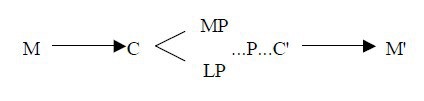
In fact, “whether money serves as a means of purchase or a means of payment, this does not alter the nature of the exchange of commodities”.(Karl Marx, Capital, Penguin, pp. 279) As “a means of purchase” money is advanced to the sellers of labour power prior to production, while as “a means of payment”, it remains as the worker’s “credit to the capitalist” until production is completed to be paid as wages afterwards. Functionally it hardly makes any difference – “this does not alter the nature of the exchange of commodities”. And both institutionalise labour vulnerabilities in their own way – advance (partial or whole) can easily be transformed into debt, creating liabilities that shape bondage, while wages can be delayed or even lost (when the capitalist goes bankrupt). In fact, the delay in receiving wages is a significant reason for indebtedness among workers. If in Marx’s England debt played a part in tying the worker more to a shop as a consumer, or to sustain the “truck system”, it can instigate other systems, too, to institute labour vulnerabilities. Ultimately the purpose is to increase these vulnerabilities and thus, reproduce the hegemony of capital over labour. The report remarkably succeeds in showing how this is done in various parts of India through debt bondage.
—————————————————————
Here are some more observations that I made during that time:
A. The process of proletarianisation to which the majority is subjugated, not the number of ‘ideal’ proletarians or wageworkers, defines capitalism. The actualisation of this process – and thus the degrees of proletarianisation or the “dual freedom of labour” differs according to the concrete contexts defined by the needs of capital and class struggle. More technically, this process is a long thread (not necessarily historical) between the formal subsumption to the actual subsumption of labour by capital – its two ends. At various junctures archaic unfreedom, like slavery, which generally characterised pre-capitalism is formally adopted (more aptly, exapted as explained in B) and transformed according to the conjunctural needs of capitalist accumulation. If we don’t recognise this processual aspect of capitalism, we will be lost in the miasma of overproduced forms and appearances in capitalism.
B. Stephen Jay Gould’s conception of exaptation, I believe, is very useful in understanding the dialectical internalisation of “vestiges” by new stages in evolution – both biological and social. Gould and Elisabeth S. Vrba in their 1982 paper defines exaptation as (i) “a character, previously shaped by natural selection for a particular function (an adaptation), is coopted for a new use”; and, (ii) “a character whose origin cannot be ascribed to the direct action of natural selection (a nonaptation), is coopted for a current use”. This concept allows us to comprehend the reproduction of “vestiges” as a process internal to the new stage in development, not as something hindering the ‘complete’ realisation of the new stage.
C. The “purist” idea that “vestiges” obstruct (not shape or contextualise) capitalist development has for a long time informed the theory and practice of Marxism in the so-called third world countries – engaging the revolutionaries in the fruitless exercise of fighting the “vestiges” before taking on the basic system, thus investing their revolutionary vigour in the reformist project of the capitalist development. It is interesting to note that this is not only true about the “Leninists” and “Maoists”, as some “anti-Leninists” allege. Many anti-Leninists and anti-Maoists present more vehement denial of the feasibility of any socialist project in “backward” countries. Their conceptualistion of revolution not only goes against the thesis of “revolution in permanence” – “the downfall of all the privileged classes, and the subjection of these classes to the dictatorship of the proletariat by maintaining the revolution in permanence until the realisation of Communism, which is the final form of organisation of human society” – but is also an unconscious reinforcement of the notion of “socialism in one country”, which they profess to hate.
Problems and prospect of the “Maoist” Strategy
Rural society and the market are so intertwined throughout India that you cannot squeeze the markets (or towns) off by abruptly cutting their connection with the villages (the logic of encirclement). In fact the opposite has occurred in most of the cases – in Bihar and many places in Jharkhand, ML groups couldn’t sustain their “zones” because the villages were squeezed off by the elongated disruption of their relationship with the market. They were successful and that too marvellously as long as people perceived “liberation” as “strikes”, i.e., as strategies for bargaining for prices – prices of labour and labour power (interestingly, Marx termed strikes as guerrilla attacks). When these “strikes” tend to create “liberated zones” – a semi-permanent rupture in the relationship between the larger market and local communities, the local support starts getting alienated and disgruntled.
At many places, the naxal movement has successfully opposed the oppressive “diku” intermediary system in Tendu-leaves type trades, but the impossibility of posing an alternative economic system in a piecemeal fashion within the isolated “liberated zones” (this is due to India’s political economy) helped reestablish the similar oppression, however, with a notable change that now we find locals (not dikus) for the role of mediating a more intense internalisation of capitalist relations – “mutually embedding” of the market (labour, capital and commodity) and communities. Hence, we see ex-comrades becoming part of the established political formations (as for instance during the last elections in Jharkhand) or as traders, contractors etc. It is this section, which was the immediate beneficiary of many local militant struggles and which became agencies of the status quo. The phenomenon of Salwa Judum can also be perhaps explained in this framework – it is constituted by those elements in the tribal communities who have benefited by the expulsion of diku intermediaries, and now they want an accommodation within the hegemonic establishment.
But all this demonstrates the success of the Naxal movement in developing right “tactics” for organising locally, but the problem comes when those tactics are institutionalised as strategies (when guerrilla battles are confused with the whole war). This is the problem of spatio-temporal overgeneralisation, of essentialising particular tactics beyond spatial and temporal contexts. This problem occurs due to a partial critique of India’s capitalist political economy – viewing particular/apparent forms that it takes in specific locations (according to which specific tactics are formulated) as the essence or the general reality. The lack of a comprehensive critique of India’s political economy in revolutionary practice (but “without revolutionary theory there can be no revolutionary practice”) has led to the cornering of “the political” and foregrounding of the voluntaristic military operations.
The ‘generalised’ guerrilla tactics that we saw in China (also in pre-republican Nepal) were conjunctural (based on the concrete analysis of concrete situations). If we go through Mao’s writings (not just those published officially), we can see self-organisation of the working population (even with their ‘unsophisticated’ consciousness) at the centre of his politics (see his Hunan report and intensive/extensive land investigations in which we find him engaging in throughout the revolutionary phases). In fact, the guerrilla tactics was organically grounded in this as a ‘specific’ vehicle to interconnect various locations of experiences. This specificity derived from a feudalised political economy that was present there (I am calling it thus, because the post-Qing Chinese state was virtually a network of local militarised (warlords) interests).
On Jairus Banaji’s response to Arundhati Roy
One point that interests me in Jairus Banaji’s post in Kafila and the subsequent debate on the post is his focus on labour as the centre of the movement. I think this focus is fundamental in order to ground various local/localised struggles in political economy (or rather in its critique) and to understand the underlying interconnections between them (whether the leadership of these struggles understand them in this manner is immaterial – did not Marx appreciate Paris Commune even when Blanquists were in hegemony?).
Marx’s conceptualisation of labour and of capital-labour relations is rich enough to provide tools for comprehending various struggles against capitalist accumulation (both primitive and normal). He understood subsumption of labour by capital as a process (not some particular fixed states), which starts from being formal to real – from a stage where labour is subsumed through non-capitalist “forms” of exploitation to the actual subsumption in “pure” wage-labour form. Between these two poles, subsumption can take a plethora of forms. Who knows better than Jairus that unwaged labour (reproductive or otherwise) is also part of the capitalist subsumption of labour.
So how do we understand tribals and “peasants” struggles against land and resource alienation within this framework? They are essentially fighting against capitalist efforts to alienate them from their resources, which create (or, better, reproduce) conditions for the subsumption of their labour by capital. Whether they will become wage labourers is not at all essential; if they are not employed, or even employable, they still remain labourers as part of the reserve army of proletarians or surplus population (stagnant, latent and floating) reproducing themselves on their small pieces of land, or by food gathering (in forests or trash cans). Their struggle, in a Marxist sense, can be understood as part of the anti-systemic working class struggle to control the conditions of production and, I stress, reproduction too.
Now coming to the forms of struggle (armed, unarmed, etc), I think we as Marxists (of all hues and colours) cannot act as idealists, by considering only those movements as working class movements or anti-capitalist movements, which are projected in our idioms, and are developing according to our framework of strategic-building. The working class can throw diverse forms of struggles according to its internal constituents or class composition. However, one must critique forms in order to show the limitations and problems of those forms, in order to avoid the problem of overgeneralisation of particular forms, and also in order to undertake the revolutionary task of generalisation seriously, which essentially means to see a revolutionary building up against capitalism within and through all forms of working-class struggles.
 Beyond Capital