36 Billionaires in India, what does it mean?


36 of the 946 billionaires featuring on the Forbes’ list of richest are Indian citizens. This is being posed as India’s march forward. But is this so?

They are stinking rich. Their richness, wealth stinks. Is this a complement? But still identity-hungry Indians toiling in global sweatshops – academic, industrial etc, are asked to rejoice in the growing capacity of a few to stink. This world is really a PORCILE – with the number of Indians stinkers being only next to Russians (another group of gangster capitalists, who emerged during the post 1989 loot of public property), with the US and Germans, being front-runners.

I killed my father. I ate human flesh and I quiver with joy.” Farmer suicides are increasing with a growing number of underemployeds being ravished in the panopticon world of new industries, call centres and peripheral informal sector units, while we are asked to quiver with joy.

——

Absolute Poverty (not just relative poverty with growing divide between rich and poor, which is generally recognised) is increasing, as people are more and more dispossessed, alienated from their means of production, losing control over their conditions of production. Even if we find consumerism rising – with new gadgets cropping up in the home of the new poor, it only increases her material and mental destitution and dependence – this is not a sign of enrichment. The secret of the billionaires’ wealth too is not more gadgets and things at home, but their ability to control over the majority’s means and conditions of production. Then why more gadgets and things at home be the parameters of judging the poor’s poverty?

"The last shall be first, and the first last"


Pratyush Chandra

The Bush-Blair duo’s statements immediately after Zarqawi’s death were very interesting. The adolescent victorious spirit that they generally display was clearly absent. Bush said: “The difficult and necessary mission in Iraq continues. We can expect the terrorists and insurgents to carry on without him. We can expect the sectarian violence to continue.” And Blair echoed: “The death of Zarqawi is a strike against al-Qaeda in Iraq and therefore a strike against al-Qaeda everywhere but we should have no illusions. We know that they will continue to kill, we know that there are many, many obstacles to overcome.” Evidently, the ‘optimism’ that they demonstrated after Taliban’s and Saddam’s defeats was nowhere to be seen.

There is only one reason behind this cautiousness in the imperialist camp, that the duo themselves makes clear, is that the death of all these “evil” symbols will not curb the continuity of insurgency. In fact, as these symbols are rubbed off the media lenses, the anxiety increases with the revelation of the continuous and mass character of the insurgencies in both Iraq and Afghanistan.

The presence of al-Qaeda has been a boon in the post-Cold War era, providing a definite target and rationale for the continued military expansion to cover up the political economic fragility of US-British imperialism. The domestic opinion was easily mobilized by this comic-strip type situation of the two Supermen countering the bearded and hideous aliens. With these aliens dying in their own fire, the Superiority of the “good” men diminishes. And that is dangerous. Thus we find Bush/Blair fumbling for words to characterize the ‘new’ insurgency, and to convince the public of continuing their own ‘noble’ mission. In fact, Blair in his statement on Zarqawi’s death went to the extent of completely shifting the subject to the irrelevant “domestic agenda”, which meant to tell the public that – don’t always stress on our gymnastics, we know we have landed in a thick soup, let’s talk about something else.

And we find them trying hard to convince their international allies, too: “And what I’ve always said about this is whatever people think about the original decision to remove Saddam — I mean, that happened now three years ago — our forces, American forces, other forces have been there with a full U.N. mandate, with the consent of the Iraqi government to do one thing, and that is stand with the Iraqi people in their desire for democracy.” (Blair)

Looming large on all these efforts to recompose the imperialist camp and its ideological campaign, the most formidable danger is the real danger of the increased and coherent insurgency. Al-Qaeda’s elitist character and its sectarian violence, despite its frequent use of pan-Islamic rhetoric to obtain legitimacy, curb every attempt by the colonized people of Afghanistan and Iraq to self-organize, thus helping the occupying forces in divide and rule. Al-Qaeda’s insistence to be the sole-contractor to “save Islam” in this world forces it to target civilians more than the occupants and oppressors, and indulge in sectarian terrorism replicating the same imperialist policy of divide and rule. It was thus that these ‘holy’ soldiers served the global masters during the Cold War, and after the Cold War they continue to serve them. In fact, throughout the Global South the ‘religiosisation’ and sectization of the nationalist and regional politics that we see today have been the immediate results of Post World War II neo-colonization that found post-colonial secular nationalism and regionalism as grave dangers to the imperial powers’ hegemony.

However, as these self-imposing vanguards vanish one by one, who indulge in physically removing the masses from the center-stage of insurgent politics with the help and for the benefit of the occupying forces, the spontaneous and organized nature of mass insurgency will be smoothly nurtured, which until now was always nipped in the bud after sectarian killings, bombings and kidnappings, forcing it to remobilize itself from scratch. The days are not very far when we might see an organized insurgency independent of all clans and sects, which will insist like the Algerians did in the 1950s – “Placing national interest above all petty and erroneous considerations of personality and prestige, in conformity with revolutionary principles, our action is directly solely against colonialism, our only blind and obstinate enemy, which has always refused to grant the least freedom by peaceful means.”

And the Middle East has a great history of anti-colonialist and nationalist uprisings. Even if the officials (both colonials and their local cahoots) have forgotten this, the Middle Eastern people can never forget it. They don’t need to “borrow history” from others. Zarqawi and bin Laden can inspire fear and admiration among those who have forgotten the brilliant struggle for decolonization, but the people throughout the Global South have continued to live this struggle every moment of their lives – against political and economic tyranny, against direct or semi-coloniality. As violence escalates in Iraq and Afghanistan, the natives are not at all afraid. They are not afraid and innocent; they too threw stones at the passing tanks and brigades in the streets of the Afghani towns. As Fanon aptly taught us –

“This atmosphere of violence and menaces, these rockets brandished by both sides, do not frighten nor deflect the colonized peoples. We have seen that all their recent history has prepared them to understand and grasp the situation…. The native and the underdeveloped man are today political animals in the most universal sense of the word.”

Herein lies the danger for imperialism. Afraid of relying on hired locals, as it increases its force and drowns in its own muck, there is a genuine hope for the organized rise in the aspirations of self-determination among the natives. As Sartre would put, all that these hired soldiers can do is to delay the completion of the uncompleted decolonization process that started long back, but ultimately, as Jesus commanded, “So the last shall be first, and the first last” (Mathew 20:16). Amen.

And thus the colonizers are anxious, and the colonized hopeful.

Progressive Regression in Nepal


Pratyush Chandra

Only one aspect of Nepal’s Finance Minister Ram Sharan Mahat’s budgetary speech delivered on July 12, 2006 is stunningly consistent: its ceremonial mentioning of people’s movement, their aspirations and their martyrdom. Along with references to “rural empowerment”, “peace” and “sharp cuts in royal palace allocations”, these incantations are intended to provide new discursive “instruments of legitimation” for the Nepali state, or as the World Bank Country Director for Nepal, Ken Ohashi, says, all these are necessary for “establishing the credibility of the state” (“Seizing the open moment”, Nepali Times, 7-13 July 2006). Only time will tell if radical forces are able to expose the new regime’s opportunism under cute baubles: the progression of regression in Nepal.

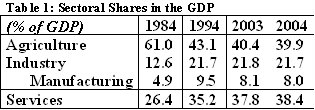
Let us first ponder briefly over the present state of Nepal’s economy to understand the full meaning and implications of the budget. In 2004, Nepal’s population was around 25.2 millions, of which around 85% resided in the rural areas, suggesting their dependence on agriculture. The per capita income in 2004 was US$260, which is far below the average per capita income in low-income countries ($510) and in South Asia ($590). Particularly revealing is the structure of the economy according to the sectoral shares in the Gross Domestic Product (GDP):


Source: World Bank (2006), “Nepal at a glance”.


Source: World Bank (2006), “Nepal at a glance”.

As Table 1 shows, there has been a continuous decline in the share of agriculture in the GDP. The industrial sector’s share definitely did expand from 1984 to 1994. However, since 1994, at least, its share has been stagnant, while the manufacturing industries’ share is on the decline. It seems that the non-manufacturing industries and services sector have been compensating the decreasing share of agriculture in the GDP, but as evident from Table 2, none of these sectors have been promising in their self-expansion. In fact, the average annual growth rate in the industrial sector has drastically reduced in the period 1994-2004.

Even though the increasing share of non-agricultural sectors in the GDP is a universal trend, in Nepal, like in other South Asian countries, this has not been accompanied by a proportionate shift in the labour force from agriculture to the other two sectors. According to the estimates of the Food and Agriculture Organisation (FAO) of the UN, the percentage of agricultural labour force in total labour force in Nepal remains almost unchanged since 1979 – it was 94% during 1979-91, while for several years now it is stuck to 93%.

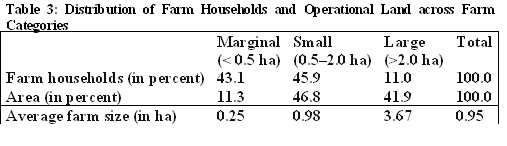
All these indicate a huge rural/urban divide – an immense sea of rural poverty encircling a few islands of urban affluence. Taking into consideration the inequitable distribution of land holdings (Table 3) and semi-feudal forms of exploitation in an increasingly monetised rural setting, one can only imagine the state of the poor peasantry, semi-proletarians and the landless.


Source: Devendra Chhetry, “Understanding Rural Poverty in Nepal”, in Christopher Edmonds and Sara Medina (ed.), Defining an Agenda for Poverty Reduction (Vol. 1), Asian Development Bank (Manila, 2002). The figures are drawn from National Sample Census of Agriculture Nepal, 1991/92, Analysis of Results, Central Bureau of Statistics (Kathmandu, 1994). Ha= hectares

Even the World Bank admits (Economic Update 2002) that poverty could not be reduced in Nepal since “growth has been concentrated primarily in the urban areas and particularly in Kathmandu valley, largely excluding 86 percent of the population who live in rural areas, where per capita agricultural production has grown minimally and the overall level of economic activity has been sluggish”.

The disproportion between the share of the non-agricultural sectors in the GDP and the amount of employment generated in these sectors indicates that whatever growth we find in these sectors are either in capital-intensive industries controlled by foreign capital collaborating with a handful of Nepali mercantilist corporates, or in the informal economy where the circulatory migrants from rural Nepal toil with no job security and very low wages.

Moreover, impoverishment in rural (also in urban areas) has resulted in sluggishness in domestic demand for industrial goods, which has further eroded the possibility of an increased industrial growth in Nepal. This fact coupled with the backlash of liberalisation (export-oriented production) has made the industries in Nepal increasingly dependent on external markets – depleting internal resources to feed external demand. This further perpetuates the need for capital-intensity and an import of technologies to compete globally, thus making the dependency total, and the goal of employment-generating industrialisation a chimera.

In this situation, it is expected from any post-April 2006 government, which draws its power from popular radicalism that has enwrapped Nepal today, that it will represent the aspirations of the masses and address their basic problems – rural poverty, inequitable land distribution, unbridled commercialisation, profit-motivated industrialisation, lack of economic activities induced by popular needs, etc. The figures in Tables 1-2 testify the reality of neoliberalism as practiced in the Nepali setting.

It was in 1984 when the Nepali State accepted the IMF/WB liberalisation package, and never deterred from the neoliberal course despite the so-called 1990 democratic achievements. The Maoist revolt was a challenge to this path, and it was obviously expected that a post-April 2006 government would rethink the model of economic management that the Nepali State has been pursuing till now. But this was not to be, at least if we go by Mahat’s budgetary exercise.

In the introductory paragraphs of the speech, the Finance Minister talks about the need to “form a common vision of socio-economic development through dialogue among political and social forces active in the country” and asserts that “the dialogue between Government of Nepal and Nepal Communist Party (Maoist)” is most certainly a formidable step in this regard. In his zeal to make this point, he goes to the extent of visualising the fantastic possibility “to end all forms of conflict prevalent in the country”. However, the revolutionaries would never claim to negotiate for such a utopia, not with the democrats who are still uncomfortable with the possibility of sweeping away the most blatant point of contention: the burden of royalty.

But the Finance Minister himself betrays his and his colleagues’ conscious design of which all this wordiness is an important characteristic. This blueprint becomes clear in the following sentences: “The national debate today has surely centered on determining the future political system and process to achieve sustainable peace. This does not mean that the issue of economic development should be pushed to back burner. Democracy cannot flourish on the foundation of a weak economy. The economy is in crisis for over half a decade. It is looking for a new momentum.”

This statement contains all the essential ideological elements that characterise global neoliberalism, the weaning diet of the leadership of developing countries. First and foremost, the will to separate the economic from the political, that is, to ensure the complete depoliticisation of the former, is expressed in clear terms. To present that the “national debate” is only about politics is not only a gross misrepresentation of Nepali politics, but more importantly, it is a ploy to ensure that “the issue of economic development” does not become part of this “national debate”. Of course, economic development should not “be pushed to back burner”; rather with Mahat it must compete with political development more vigorously. But what will be the course of this economic development? The immediate answer that we seem to get is: No politics, please.

Economic development, for Mahat and his ilk, is unilinear along a neoliberal trajectory, or whichever one set by the global and regional masters. And the fundamental duty of any “national” leadership under the global neoliberal regime today is to police this unilinearity so that politics does not contaminate economics. This is the redefinition of the cherished “rule of law” today. If all conflicts in the politics of economic development are systematically ruled out, then, of course, the fantastic vision that Mahat has about ending “all forms of conflict prevalent in the country” will become real and there will be everlasting “sustainable peace”.

Consider provisions of the budget. As usual, there is an overabundance of promises, allocations and words as proof of the government’s commitment to the people in Mahat’s budgetary speech. All these are duly balanced by its fidelity to “investment-friendly atmosphere” for agro-businesses and “commercial farming”, “to encourage private investment” in every sector and, of course, faithfulness to its donors.

In the name of the pro-poor programme, the government will formulate an agriculture business promotion policy for “enhancing private sector participation in agriculture, market infrastructure development and agro-industries”. “As per the concept of public-private partnership, a policy will be adopted to encourage private sector in the expansion of technology and seeds under agriculture extension programme”. Then, there will be interest subsidy in tea farming, floriculture and milk chilling centres. The “One-Village-One-Product” programme “under public-private partnership will be initiated to increase production of commodities, which have adequate export potentials in foreign countries”. “Assistance will be provided for improved seeds, fertilisers and technology to jute producing farmers”. And the clincher – “concessional credit facility will be provided to the landless people for the purchase of land”.

Thus, the government will alleviate rural poverty, to ensure food security and implement land reforms. Market is the magic wand. What if there is no food, no land? Market will resolve everything.

Is it too demanding to realise the implications of these budgetary provisions? Where do they locate rural Nepal and its toiling masses in the global agro-industrial complex by excessive commodification of their lives? They are milled into “a new division of labour in agriculture”, where “the centre has specialised in capital-intensive production of grains and dumped them in the periphery, while peripheral states have battled for saturated markets for traditional exports, or have discovered ‘comparative advantage’ in various ‘non-traditional’ goods and land uses, namely ‘exotic’ fruits, cut flowers and vegetable, as well as ostrich husbandry and ‘wildlife’ management (ecotourism). In turn, all of these have been biased towards large-scale landholding, controlled by corporate capital, and destined for luxury peripheral and metropolitan consumption.”(Sam Moyo and Paris Yeros (ed), Reclaiming the Land: The Resurgence of Rural Movements in Africa, Asia and Latin America, Zed Books, London, 2005, p.18)

In the industrial sector too, Mahat has all his recipes ready for resolving industrial difficulties. He dips straight into undergrad textbooks on Economics to derive his recipes. For private sector there is a development and rehabilitation programme. “An Industrial Rehabilitation Fund will be established with the participation of the government, central bank, financial institutions and interested industrialists and entrepreneurs in order to rehabilitate the conflict-affected sick industries”. There will be a new labour law too, amenable to the needs of new industries, special economic zones and export processing zones.

This means the institutionalisation of the already informal labour market with no security for the workers. And, if these workers organise themselves and agitate, they will be accused of serving “the narrow interests of a small group”, as World Bank Country Director Ken Ohashi (“Seizing the open moment”, Nepali Times, 7-13 July 2006, p. 4) puts in an article published on the eve of the budget submission, since “peace, social and political inclusiveness, and economic growth” can be attained only if energy is directed “away from self interests to a collective purpose”. Strikingly, it seems either Mahat has literally lifted phrases from this article, or else the budget was drafted in the WB’s office. He too pleads for “a balance between the collective wishes and collective means”.

It is not very hard to identify the nature of this collectivity. In a class-divided society, the hegemonic collectivity is that of the ruling class, and the State is a definite instrument to serve its purpose. Hence, to meet this ‘collective purpose’, the Koirala government has everything to offer to their rich protégé-protectors, even a complete tax holiday for the newly-established industries in 22 remote districts for ten years. But for the same ‘collective purpose’, the workers and poor peasantry must understand that all “goals cannot possibly be met by this budget” (Ohashi) and that “the state does not have adequate resources to immediately fulfill unlimited needs of the people” (Mahat).

All this should definitely encourage foreign investors and their local agencies, but Mahat draws something more from the free market of ideas. This time around he desires to satiate the swadeshi and patriotic spirit. For this, he has a Swadeshi Jutta (national shoe) formula: “In order to promote the domestic production, the existing legal provision to purchase the domestic products by the government agencies even in cases where such goods are costlier by 10 percent than the foreign products will be implemented strictly. It is believed that the use of indigenous shoes and clothes by agencies like Nepal Army, Armed Police and Nepal Police under this program will encourage the domestic industries to a great extent.”

While all these development and rehabilitation programmes will be implemented to boost the private sector, the classical medicine is in store for “public enterprises”: Liquidation. It is not very difficult for even a newspaper-reading or TV-watching layperson to decipher the neoliberal ideological character of these budgetary measures, squeezed between the wordy paragraphs on “inclusive society and economy” and poverty-alleviation rhetoric.

The Nepali leadership, which has been historically compliant to the needs of the global masters, literally as their security guards, has never found neoliberal lessons very difficult to learn. Like in other countries, Nepal’s balance of payments crisis in 1982-85 gave the country’s leadership the classical rationale to ride the IMF/WB led neoliberal wave. Thus, they negotiated “a standby credit arrangement with the IMF. Accordingly, Nepal implemented an economic stabilisation programme in 1984/85. This was followed by the Structural Adjustment programme of IMF and the World Bank in 1986/87”. (“Understanding Reforms in Nepal”, Institute for Policy Research and Development, 2005). The political economy of Nepal, which had been a guinea pig in the hands of international finance capital for testing strategic panaceas, was once again brought to the operating table for yet another surgery. When the side effects started showing up in the shape of the democratic uprising, a patchwork was arranged in 1990.

The 1990 political arrangement broadened the experience and reach of this leadership in renting out the local natural and human resources for the benefits of the global machinery of capitalism. The localised elements of the ruling class that were nurtured by the aid regime and extensive commercialisation of the economy were brought into the fold of the State power. The limited democratic “political competition” established in 1990 provided a mechanism to attune the composition of the State to the changes in the ruling class composition. It was visualised that formal democracy would reduce all inter- and intra-class conflicts to competition between lobbies and dissipate any fundamental challenge to the economic structure, while the process of neoliberalism intensified.

The standard remedy in neo-classical bourgeois economics for any crisis due to marketisation is more marketisation with peripheral superstructural arrangements. Thus in Nepal too, “Economic liberalisation and privatisation policies were intensified from 1992 onward with the implementation of the Enhanced Structural Adjustment Facility (ESAF) programme. Given the open border and special trade relations with the southern neighbour, the speed and direction of reforms were also affected by the reform drive pursued in India. Since then reforms have either been continued or deepened in the modern economic sphere of trade, industry, finance, exchange rate, and monetary and fiscal policies. As a result, Nepal now stands as one of the most liberalised and open economies in the South Asian region” (ibid). A least developed country has been blessed by the most liberalised economy in the region; such is the endowment of neoliberalism.

This reckless and continuous compliance to the needs of global capitalist accumulation and its political regime nurtured radicalism in the consciousness of the Nepali downtrodden. Before 1984, this was spontaneous and sporadic. Under neoliberalism, it became general and organised, reaching its zenith in the form of Nepali Maoism. In 1990, it was thought that electoral games and formal democracy will keep this radicalism at bay and the Nepali downtrodden playful. On the contrary, it helped in rooting out the local elements of the Nepali ruling classes and neo-rich, revelling in their newfound proximity to Kathmandu and royal institutions. Thus the prism of caste, ethnic and local consciousness that inverted the reality and united the downtrodden with their oppressors was shattered.

As wealth and growth concentrated in few urban areas in a few hands close to power, close to local political linkages of international investment and finance, the rural-urban divide sharpened. There was an unprecedented intensification in vertical and horizontal inequalities leading to the unity of class war and autonomous identity movements under People’s War. The rural poor and migrant workers united with all the other marginalised forces to challenge the basic structure.

The alternative that emerged in the Maoist practice sought for “land to the tillers”, endogenous development geared towards the popular need and political institutions best suited to facilitate such development. The energy that this practice unleashed rocked the fragile 1990 arrangement despite the consistent neoliberal pursuit by all the governments that were formed thereafter. However, there could never be a clear unity within the political elite due to increased competition for commissions in administering the aid regime and proximity to global and regional players. At the wake of the parallel governments under the Maoists, this competition was further accentuated as the formal structure’s reach of influence narrowed spatially. This overcrowding wrecked the political arrangement that was inaugurated with so much fanfare with the blessings of the global powers. This led to the royal regression, while the democrats for the first time had the time to listen to the radical voices outside the parliament, and thereby allied with the Maoists.

The Koirala government formed after the reinstatement of Parliament in Nepal was, however, quick to realise the significance of the depoliticisation of the economic in order to sustain the Nepali State’s role as the local agency for global and regional capital. Negotiations with the Maoists are making the international forces, especially India and the US, increasingly nervous. The rushed visit to India and Mahat’s presentation before Indian capitalists was to assure Indian and other ‘donors’ that they have not deviated from the neoliberal path. The act of presenting the budget without consulting the Maoists is part of this design. What else could be the reason to overload any future regime with so many prior obligations, but to reassure the supremacy of global capitalist interests after the post-April fluidity?

This brings us to another neoliberal ideological element, which is subtly evident in Mahat’s statement quoted in the first section, where he seeks to pose democracy as the end not the means to attain economic development. This is intrinsically part of the same project of depoliticisation of the economic. If democracy is the end, you do not need to practise democracy in deciding and pursuing the course of economic development. On the contrary, the elite push for liberalisation will itself engender democracy. So wait and suffer!

Of course, this is the ideal of bourgeois democracy: a system of elite decision and public ratification, as Chomsky defines it. But did Nepali people really come on the streets and suffer bullets for this brand of democracy? Royal regression can go, but the Nepali leadership continues to serve the neo-liberal counter-revolution, that leaves the lives of the labouring majority at the mercy of the ups and downs of the globalising market.

Under the neoliberal regime, capital effectively dodges every regulation and controls politics by threatening to fly away in the wake of any uncomfortable circumstances, while the political elite rationalises its anti-labour policies in the name of making the environment investment-friendly. In the name of removing market imperfections caused by “extra-economic” factors, a new authoritarianism is perpetuated, which Venezuelan Vice-President Jose Vicente Rangel calls, “economic authoritarianism”. This renders the democratic control over human and natural resources impossible, while it instrumentalises the state in favour of the hegemonic market interests. As Rangel further says in his address to the 13th Meeting of the Latin American Economic System (SELA) Council in 2003, “Authoritarianism that is dressed in democratic forms is difficult to fight. The neoliberal model and economic decisions, which sustain and reproduce it, need a democratic façade to feign legitimacy.” Hence, the fetish of elections, as “the beginning and the end of democracy”, while economic authoritarianism continues.

(This is a slightly modified version of the article originally published in Combat Law, September-October, 2006)

Angels and Demons in the People’s Movement in Nepal


Pratyush Chandra

International Nepal Solidarity Network

Today, the talk of people’s power in Nepal is the order of the day. Even the Mainstream Media, Moriarty, Manmohan and their intellectual goons are full of that. Evidently they are having hysterical fits intensified by the return of the Cold War paranoia. The possibility of the Maoists’ coming over ground and their revolutionary agenda — targeting the Nepali dependency — being constitutionalized is definitely a grave crisis for Indo-American imperialism in South Asia. And in order to have a scope for diplomatic engineering, they need sanitized expressions like people’s movement, people’s power etc without identifying who the people are and without detailing their demands.

Definitely the mainstream hatred against the Maoists knows no bound. The media campaign to denigrate the Maoists has never been so vigorous as now, showing the crisis and desperation in the imperialist camp — its failure to color and control the democratic upsurge in Nepal as in East Europe and other parts of the world. As one of the coup organizers against Chavez in Venezuela, Vice Admiral Ramírez Pérez told a private channel just after the coup on April 11, 2002, “We had a deadly weapon: the media.” And as Pablo Neruda, once reminded us, “He’s the skulking coward hired to praise dirty hands. He’s an orator or journalist. Suddenly he surfaces in the palace enthusiastically masticating the sovereign’s dejections”.

1. People’s Movement – a New Phase in the People’s War?

Just a cursory reading of the mainstream media headlines on Nepal and the Maoists today shows that they increasingly concentrate on Maoist “extortions” and other “criminal” activities. One needs to just go through the reports under those headlines to have a glimpse of the conscious game plan. Only to cite a couple of examples:

a) As reported, recently, Indian company Dabur suspended its operations in Nepal. The headline and the first paragraph of the report in Telegraph (May 20), one of the mainstream newspapers in India, told it was because the company refused “to buckle under the extortion threats of the Maoist rebels”. But the same report subsequently went on: “The Maoist-affiliated trade union, All Nepal Trade Union Federation (ANTUF), on May 15 issued a 22-point charter of demands to all the units in the Bara-Parsa-Birgunj industrial belt. They demanded scrapping of the labour contract system, payment of a minimum monthly wage of Rs 5,000 and provisions of housing, medicare and education facilities to the workers and their families. The union warned of dire consequences if its demands were not met within a week.” So the genuine workers movement and its demands in the Nepali sweatshops controlled by Indian imperialists are extortions.

b) The prestigious International Federation of Journalists (IFJ, Asia-Pacific) issued a media release on May 19, where a subheading said – “Maoists attack radio station” (later “attack” was changed to “threaten”). It is obvious that many people who have the habit of reading just headlines will interpret — Oh! These gun-trotting “polpotists” must have raided the radio station. But no! “The Maoist-aligned All Nepal Trade Union Federation issued a letter on May 12, 2006 accusing the two FM radio stations of exploiting their respective staffs, dismissing staff without reason, extreme excesses and mental torture of the staff, and called for the immediate termination of the Kalika FM station director, alleging him to be a pro-royalist.” So, this was an attack!

In order to understand the impact of such unambiguous media reports, one needs to remember how even a great novelist from the Left Jose Saramago went on to dub the great guerrilla movement under the Frente Armada Revolucionaria de Colombia (FARC) as an “armed gang” dedicated “to kidnapping, murdering, violating human rights.” One can only imagine what will happen in the case of Nepal.

The international left movement divided into innumerable sects is taking its toll on the Nepali movement too. So we find even sober Marxist analysts indulging in subjective analyses of the peasant movement in Nepal displaying their rich repertoire of inter-sect abuses ready for the Maoists just because they have learnt from the Chinese peasant movement and call themselves Maoists. The irresponsible reactive armchair leftism ever online enamored of the rights discourse and neutrality too in its efforts to justify its own passivity is increasingly involved in this media redbaiting. As James Petras noted in his open letter to Saramago (Counterpunch, December 22, 2004):

“[T]here are many types of “communists” today: Those who stole the public patrimony of Russia and became notable oligarchs; Those who collaborate with the US colonial regime in Iraq; Those who have struggled for forty years in the factories, jungles and countryside of Colombia for a society without classes; And those “communists” who fear the problem (imperialism) and fear the solution (popular revolution) and make it all a question of personal preferences.”

All kinds of media and ideological manipulations are going on endeavoring to disrupt the New Phase of People’s War in Nepal — its extension to the urban streets with its own peculiarities, to the urban proletarian struggle – with the increased Maoist interventions in urban mobilization and trade union activities. We find rosy words being showered on the People, while denigrating their War. The rightists, “leftists” and imperialists are all united in this propaganda campaign.

Personalities who were never on the streets to suffer police beatings and face bullets were the first ones to declare victory of the People’s Movement with the King’s pronouncements. The desperate Indo-US imperialism and its media touts were booed when they prematurely partied after the King’s April 21 invitation to the parties to name the prime minister, which every force in the movement duly rejected, including the nervous parliamentary leaders. However the panicky US-EU-India interests ultimately found loyal agency in this “responsible leadership” when it unilaterally accepted the April 24 declaration restoring the defunct parliament.

And thus started the sanitization program — of talking about People’s War vs. People’s Movement, of the failure of the first against the successes of the latter as proof of the virtue of non-violence. The hidden agenda is very apparent, that is to restore the sanctified institutions of State Terror while disarming the People by preaching them non-violence. The neutral apostles of Human Rights do this by treating the State’s offence at par with the Popular defense. Imperialisms do this via their “Community Faces” too – through well funded “Civil Society” groups and NGOs, who specialize in administering and selling the social agenda of Neoliberalism, providing “Social Cushion” in the face of the growing marginalization and social unrest. As perfect plainclothesmen, all these apostles of non-violence can be spotted here and there in the Nepali unrest with their clear job of policing the movement from within. After the so-called “victory” of April 24, their additional job has been to write anecdotes about their participation in the “Turn-the-other-cheek-Revolution” with the mainstream and “civil society” media ever ready to channel the processes of sanitization and betrayal.

In this regard, it suffices to quote Black revolutionary Malcolm X who was himself the epitome of Popular Suffering, Anger and Movement right in the belly of the beast:

“I don’t go for anything that’s non-violent and turn-the-other-cheekish. I don’t see how any revolution—I’ve never heard of a non-violent revolution or a revolution that was brought about by turning the other cheek, and so I believe that it is a crime for anyone to teach a person who is being brutalized to continue to accept that brutality without doing something to defend himself. If this is what the Christian-Gandhian philosophy teaches then it is criminal—a criminal philosophy.”

2. The Nepali Movement Beyond Sectism

There is far more to a movement than just its personalities and ideologico-cultural labels – Zapatistas, Chavistas and Maoists. However, there is always a mainstream tendency to relegate these movements to a few personalities, symbols and ideological lineages. This definitely benefits the status quo as the movements are effectively portrayed as sects with some innate pathological tendencies. The failures and problems of the older movements whose idioms the present movements have adopted and adapted to mobilize and organize the masses are extrapolated to vilify the latter. The fundamental issues of the changed conjuncture and the composition of the movements are effectively swept aside through this exercise, ideologically arming the status quo to contravene the ‘subversive’ forces.

Feeding to this is the widespread sectism prevalent within the Left, which aids the hegemonic forces in this regard. The leftist dissection, labeling and libeling are more effective than any repression and mainstream media propaganda in forming and deforming the opinion, as they can be projected as internal dissensions. Karl Marx while summarizing his experience in the First International rightly notes in his letter to Friedrich Bolte (November 23, 1871):

“The development of the system of Socialist sects and that of the real workers’ movement always stand in inverse ratio to each other. So long as the sects are (historically) justified, the working class is not yet ripe for an independent historic movement. As soon as it has attained this maturity all sects are essentially reactionary.”

The recent upheaval in Nepal has once again brought this sectism to the center-stage as people everywhere are trying to cope up with the Maoist element in it. We find Mao’s failures and Pol Pot’s barbarism discussed more than what the Nepali Maoists have done in Nepal – how they have energized the issues of land, land reforms, decadent forms of gender, national and ethnic oppressions, neo-liberal commercialization, distress migration etc as their central concerns.

In the hands of the Maoists, the issue of the constituent assembly, which was forgotten by the democrats, became a rallying point for uniting the rural and urban downtrodden. It was the Maoists’ strength with the growing influence of their slogans and radicalism on the lower leadership and the mass base of the petty bourgeois parliamentary parties that shattered the Nepali ruling machinery’s ability to control the growing rage of the people’s war. Eventually the 1990 historic “compromise” between the royalty and the democrats brokered by the imperialist interests in the region collapsed leading to the latter’s historic alliance with the Maoists in 2005.

This alliance triggered the mass upsurge that we witnessed throughout April this year. The imperialist onlookers were awe-stricken by the response to the General Strike called by the Seven Party Alliance facilitated by the unilateral ceasefire declared by the Maoists in the Kathmandu region with an increased armed assault on the (then Royal) Nepalese Army in other regions. US Ambassador went on with his rumor mongering and presented the situation as “pre-revolutionary” in one of his interviews, which was correct but was meant to terrorize the Nepali petty bourgeois leaders and mobilize international opinion against the revolutionaries. India, who has the history of utilizing the unequal treaties with Nepal for changing the internal political arrangement that best suited India’s interests that necessarily used to include a cosmetic democracy, this time was (and is) desperate to preserve the monarchy. However the Indian response has been moderated due to the immense mobilization within India in solidarity with the Nepali democracy movement.

The petty bourgeois leaders of the parliamentary parties feared direct action in the rocking streets and burning fields of Nepal destroying every institution that mothered them. Instead of the path of revolution, they chose the path of legislation, which allows manipulation and compromise. Afraid of the revolutionary ‘uncertainty’ they found a ready opportunity to withdraw their support to the movement when the King restored their parliamentary privileges. But the movement continued as the Maoists and the grassroots of these parties rejected this compromise and sustained the spontaneous upsurge in popular consciousness, ever vigilant of the old leadership returning to its old habits and forcing some concrete progressive “concessions” that we hear in the news today.

3. Hands Off Nepal: Rebuff the possible ‘Plan Nepal’

Today, most dangerously, all imperialist manipulations, media propaganda and the parliamentary drunkenness in Nepal might prepare the background for something like Plan Colombia, which derailed the similar process of overgrounding of the peasant and people’s upsurge in Colombia under the leadership of the FARC. The FARC in 1999-2001 suspended their armed struggle and negotiated with the Pastrana regime, insisting on a demilitarized zone, putting forth “a political program of agrarian reform, national public control of strategic resources, and massive public works programs to generate jobs”. All these radical measures were destined to destroy the reactionary political economic institutions that allowed the imperialist network to operate in the country, devastating the peasantry, indebting the economy and entrenching corruption in the state structure. Therefore, “with the backing of the US government the Pastrana regime abruptly broke off negotiations and launched an attack on the demilitarized zone” and restarted funding, training and arming the drug traffickers and private armies of the landlords as para-military forces to harass and destroy the people’s movement.

There are well-documented evidences of the drug mafia network under the CIA of which “The King of Nepal” has been an important part. Last year there were reports that Crown Prince Paras “has been allegedly in the drug business for seven years, but his stakes and that of the Nepali royal family have grown by leaps and bounds in the last few years…[T]he crown prince is now reported to be operating his network beyond South Asia.” (Newsinsight.net, July 6, 2005) With the history of the linkages between the drug trade and the US’ counter-insurgency drive, one cannot ignore the possibility of a Plan Nepal in the pipeline until and unless the revolutionary Nepali people are vigilant enough forcing the country’s ever shaky “democratic” leadership to facilitate the ‘overgrounding’ of the Maoists and the crushing of the military leadership trained for imperialist wars, thus thwarting the danger of any imperialist manipulation.

Remember the US insists to keep the Maoists on its terror list, which allows it to intervene and manipulate regimes beyond the seven seas for its domestic security interests. The first thing that the US did after “welcoming” the April 24 proclamation was to sit with the military leaders, not even with the King. The parliamentary forces might remove R(oyalty) from the name of every institution, might add Secular in the official name of Nepal, but the country needs the negation of the whole system nurtured by 200 years of semi-colonialism, that allowed the imperialist powers to use the Nepali people, army and resources as reserve for crushing liberation struggles internationally (in India, Afghanistan among others), as canon-fodder. And all these in exchange with a promise that the Nepali royalty and elite could handshake and dine with the White Royalty, while the Nepali people suffered dual exploitation, and later, in exchange with rents in the form of foreign aid.

In the age of neo-liberalism, when the Nepali soldiers are not sent for killing, they can be used as guinea pigs too for pharmaceutical researches. Recently, there was news about “the American government’s exploitation of Nepali soldiers as human guinea pigs to find a Hepatitis vaccine.” As Jason Andrews wrote in The American Journal of Bioethics: “Noting the millions of dollars, military training, and arms that the State Department and Military have been giving to the RNA to help them put down the Maoist rebellion, it seems plausible that the resultant military and economic dependence of the host institution/population (RNA) upon the research sponsor (the U.S. Military) threatened the voluntary nature of the institutional and individual participation in the trial. That is, the RNA probably was not in a good position to say ‘no’ to the small request by their generous benefactor.”

Servility and loyalty towards global imperialism entrenched in the Nepali state structure and elites can never be removed only by legislations — it needs a complete structural transformation, it needs a revolution, which has just begun and can go anywhere from here. With the growing imperialist counseling to the newly formed Nepali government, and the consensual ideological campaign endeavoring to alienate the movement from its revolutionary leadership through ‘neutral’ rights discourse and by media, any complacency on the part of the revolutionary masses of Nepal at this juncture will curb the process of democratization of the Nepali society and state.

The Royal Nepalese Army and the imperialist agency in Nepal


Pratyush Chandra

International Nepal Solidarity Network

After King Mahendra (Gyanendra’s father) and his Royal Nepalese Army (RNA), overthrew his government in 1960, the first democratically elected Prime Minister of Nepal BP Koirala asked himself in his jail diary: “Is the democratic system in Nepal compatible with the preponderance of the Nepalese Army?” After five decades of the democracy movement in Nepal, this question still haunts the Nepalis. Mesmerised by the royal proximity, Nepali democrats have time and again lapsed into amnesia, comfortably and willingly. But by one or another way the question has found expression and has been answered negatively in the popular upsurges and daily struggles of the downtrodden.

As Nepal’s foremost revolutionary leader Prachanda stated, just after the royal coup in February 2005, “Ultimately, the so-called royal proclamation of February 1 has not only exposed the irrelevance of reformism in the Nepalese politics, but also shattered the collective lethargy of the parliamentary political politics.”. Although the reinstatement of the old parliament once again poses the danger of the relapse of the “collective lethargy”, the politically charged Nepali masses are ever watchful of the parliamentarist deviations. Along with the issue of forming the Constituent Assembly, the question of controlling the RNA is going to be one of the decisive (and divisive) elements in the course of the Nepali democratic revolution.

This army has been the major force behind enforcing the betrayal of the democratic aspirations of the Nepali people for more than five decades. Nevertheless, as Marxist-Maoist leader Baburam Bhattarai rightly notes, “Any ordinary student of military science would know, the victory or defeat of a particular army ultimately depends more on its social class base and the political goal.” And, “the feudal reactionary nature of the royal army and its complete hegemonisation by the ruling Shah-Rana families may be gauged from the fact that of the thirty commander-in-chiefs since 1835, twenty-six belonged to the ruling Shah-Ranas and four to their close courtiers, Thapa-Basnets. Hence, there should be no doubt, at least to the progressive and modern-minded, that the current fight in Nepal is précised for ending this age-old feudal tyranny and to usher in a real democracy suited to the 21st century.”

The RNA has been the major “saboteur”, “with the prompting of some foreign powers” (whom we are all familiar with) in every peace talk in Nepal. Its time-tested principal method of sabotage is senseless massacres of the civilians in the name of defending its soldiers against the revolutionaries while the peace process is going on. In 2003, “the most serious and provocative incident was the massacre of nineteen unarmed political activists by the RNA in Doramba (Eastern Nepal) on the very day of start of third round of talks on August 17”. Again, a few days back on April 29, on the eve of GP Koirala’s swearing in ceremony as a result of the mass upsurge that we saw recently, “Royal Nepalese Army (RNA) launched an aerial attack on a peaceful mass meet called by the CPN (Maoist)… An RNA chopper rained bullets on the mass meet organised in the jungle adjoining a human settlement, where around 10,000 civilians were gathered for the program”.

The RNA is definitely a major concern, as it gets more and more desperate about its own future with the debilitating royalty. International powers that have been arming the reactionary RNA are already having meetings with its chief and other officials, enquiring about their Will.

The recent visit of US Assistant Secretary for South Asia, Richard Boucher is a pointer in this regard. He did not meet with the beleaguered monarch, rather chose to remain satisfied with his direct meeting with the RNA chief Pyar Jung Thapa.

On April 3, in a press conference after the meeting, Boucher was asked whether he thinks “the Royal Nepalese Army is going to be one of the decision makers in future instead of parliament”.

Boucher’s reply was, “I don’t think I quite used the word decision maker, but I said something like that. I think that the army is going to have a very important role to play. The army has to help defend the nation; it has to help defend the nation against threats. They also have to be able to implement the ceasefire, and carry it out. So I wanted to check with the army and see, first of all, that they were supporting the political process, that they were supporting the civilian leaders in Nepal, and second of all talk to them about how they saw their job in the days ahead, and how, when a civilian leadership wanted us to, we could support them in the future.”

What a mode of professing a civilian control over the RNA! A US official makes an official visit to find the will of the Army chief directly, whether he supports the political process or not, instead of asking the government to ensure the submission of the RNA to the civilian control.

However this incident is not at all surprising, since US Ambassador James Moriarty’s chief job after the 12-point agreement between the parliamentary forces and the Maoists last year has been to defend the RNA’s existence in every significant statement. He has been trying hard to mobilise the moderate and wavering democrats and former prime minsiters, like GP Koirala and Sher Bahadur Deuba who were the main exponents of using the RNA to crush People’s War till recently. Replicating Conan Doyle’s Professor Moriarty – a Supervillain or the “Napoleon of Crime”, the US Ambassador time and again has been tying to make the democrats, who lack Moriarty’s “common sense”, understand the virtue of not weakening the RNA, which he calls, in one of his nauseating self-proclaimed “provocative” speeches, “the parties’ one logical source of defense”, despite the well-known fact that it has never respected the self-styled democratic leadership.

If we can learn something from the US’s history of imperialist intervention and of nurturing military juntas, we can at least be sure of the US’s desperation in Nepal to preclude the Nicaragua-type situation, where the revolutionaries disbanded Somoza’s army, and even after the Sandinistas’ defeat in 1990, the Sandinista Army remained as the popular national army and the prime vehicle of democratisation (notwithstanding a considerable dilution of the army’s revolutionary character). As an ex-Nicaraguan Army chief Joaquín Cuadra Lacayo said in the year 2000: “Despite everything the Sandinista revolution eventually led to free elections and democracy, and…the Sandinista People’s Army became the National Army of Nicaragua. For the first time in the history of Latin America, an army that was born as a guerrilla force and matured as part of a government became an army for the nation without political overtones.” In spite of the fact that the ruling elite of Nicaragua has reversed the major gains of the Sandinista Revolution, and the military is completely integrated with the State, the popular revolutionary past of the Army officials and Sandino’s portraits in military headquarters and offices still haunt the US and the local elites. An obvious question for the global hegemony today is: where will the army be once the new radicalism that is gripping Latin America affects Nicaragua? Obviously, the Nicaraguan arrangement can never keep paranoiac imperialists at ease. Therefore ensuring a premature disarming of the Maoists, without crushing the R(oyalty) of the RNA, is the prime game plan of the international hegemonies and their local cahoots in Nepal.

Only such design will ensure the demobilisation of the revolutionary intent of Nepal’s downtrodden that has been heightened during the decade-long People’s War, politically rejuvenating every section of the society. The imperialist network fears that this rise of the red scourge in this supposed “backwater” of global capitalism will blow away the mirage of the new Asian “miracles” in the region, who have been long fishing their booty in these same “backwaters”. With the struggle of democratisation at every level succeeding in Nepal, and the possibility of an open mobilisation, by the “Maoism in the 21st century”, of the proletarians, semi-proletarians and poor peasantry, there is a danger that the class conflict will spread throughout the region, providing “plenty of recruits for Maoist armies and other forms of resistance to global capitalism”, as Alex Callinicos puts it.

In Nepal, The Saga of Compromise and Struggle Continues


April 26, 2006

Pratyush Chandra

As sniffing K9s of the global hegemony, the corporate media around the globe smelled Maoist activists’ and pamphlets’ presence in the post- April 6 protests as proofs of the Maoist infiltration. The BBC reported on April 24: “There are very real fears that Maoist rebels could well use the opportunity to fill the void and take control of the protests. Maoist activists are already believed to have been present at many of the rallies, and there have been several instances of Maoist campaign pamphlets being distributed among the protesters. The last thing the parties want is for the protests to spin out of control and for the Maoists to move in, a view that is fast gaining currency.”

Such rumour mongering by the corporate media is definitely sufficient to send their own masters to psychotic fits of Global McCarthyism. It can also buy a compromise between the King and the anti-communist section of the Nepali middle class trained during the US’ Cold War aid regime who grabbed the leadership of many moderate democratic parties after the 1990 arrangement. However, it means nothing to the local population. They know that the Maoists were the only force facilitating their politicisation to the degree that they could sustain mass strikes for so many days.

Of course, the 7+1 alliance was a great jolt to the vastness of “popular exclusion” that the Nepalese polity and its sponsors have till now maintained by utilising the weapon of “divide and rule”. And we saw literally a new version of Samudra Manthan (churning of the seas) and the whole Nepal was drowned in the resulting tide. The General Strike in Nepal that continued to gain momentum since April 6 demolished the floodgates already tattered in the course of Maoists’ continuous assaults for a decade. These gates erected during the six decades of continuous betrayals forged and financed by the complex international network that combines the global, regional and local ruling classes had trapped and ‘subalternised’ the confidence and consciousness of the Nepalese downtrodden.

Today the gates are nowhere. Throughout Nepal curfews and “shoot-on-sight” orders have been enforced and defied. “Emotionally charged sea of the masses in the streets manifests that the liberation forever from the feudal monarchy, which has been betraying since the past 250 years in general and 56 years in particular, is the earnest and deep aspiration of the Nepalese people” (Prachanda’s Statement, April 22).

Justin Huggler aptly captured the scenario for Independent (UK) on April 22 after King Gyanendra did his first bid to buy off the leadership by offering the protesting parties the Prime-Ministership. “Looking tense before the camera, King Gyanendra said: ‘We are committed to multi-party democracy and a constitutional monarchy. Executive power of the kingdom of Nepal, which was in our safekeeping, shall from this day be returned to the people.'” On the other side of the political fence: “‘Death to the monarchy!’ they chanted as they marched. And as they walked, the people of Kathmandu lined the streets to cheer them on. This was a nation on the march. Several police lines fell back before them. Soldiers guarding the airport grinned and gave them signs of support.”

After the King’s second bid on April 24 once again the million-dollar question remains “whether the announcement will be welcomed as readily on the street, where hundreds of thousands of Nepalis have called for the monarchy to be abolished” (Huggler in Independent, April 25), despite the fact that the Seven Party Alliance (SPA) has accepted the King’s offer to reinstate the Parliament, dissolved in 2002 on the recommendation of one of the leaders in the SPA. Guardian (April 25) reports, “There is a danger that crowds may take to the streets in defiance of the political leadership. Yesterday, speakers at rallies in the capital’s suburbs repeatedly said they would not be “tricked” by the king.”

What we witness in Nepal today is a unique dialectic of spontaneity and organization in full operation that characterises any great movement. “The masses are in reality their own leaders, dialectically creating their own development process” and the ‘leaders’ are forced to or willingly “make themselves merely the mouthpiece of the will and striving of the enlightened masses, merely the agents of the objective laws of the class movement”. (Rosa Luxemburg) At least one section of the political leadership is conscious of this dialectic, when it says: “[T]his movement has not now remained to be a movement only of either seven political parties or the CPN (Maoist) or civil society or any particular group but as a united movement of all the real democratic forces, who have been repeatedly deceived by the feudal autocratic monarchy since 1949.” (Prachanda & Baburam Bhattarai’s statement, April 17, 2006)

By rejecting the present compromise the Maoists show their respect to the Nepalese downtrodden who fought valiantly for the basic demand to form the constituent assembly – the institution that will give them at least a say in the process of ‘democratisation’ curtailing its patrician character and may serve as the foundation of the new democratic Nepal. Even though the wavering petty bourgeois parliamentary leaders afraid of the radicalised masses unilaterally withdrew their support and rejoiced on the restoration of their privileges, let us hope the Maoist rejection and the grassroots unity across various political formations built in the yearlong united people’s struggle will keep them sober.

A commenter on International Nepal Solidarity Network’s website (insn.org) thus reacted to the news of the King’s announcement:

“In protests, for a moment, people from all classes were present… They will once again split into the political camps, who best represent their class interests. The only ‘people’ who will continue to be on the streets are those who were already there on the streets and fields before the protests – who will continue to fight to survive. The ‘protests’ have at least given them a rough map of the political scene of Nepal, and heightened their confidence and consciousness.”

However, we must admit that the recent protests marked a new phase in the Nepalese struggle for democracy and self-determination. From now onwards nothing remains consecrated in Nepal, beyond popular scrutiny and criticism. Every section of the society is politically charged. We see democracy in action in the streets of Nepal.

Tariq Ali rightly puts (Guardian, April 25): “What the uprising in Nepal reveals is that while democracy is being hollowed out in the west, it means more than regular elections to many people in the other continents”. It means the people’s right to root out their own poverty, the democratic control of the Nepalese human and natural resources, ending the caste, national and gender privileges and discriminations… It means to have a Constitution that secures all these fundamental rights, and for that they demand a constituent assembly.

Versions: Counterpunch, Countercurrents, INSN, ZMag

Ceasefire and Democracy in Nepal – the Global Semantics


The Maoists in Nepal have once again demonstrated exemplary resilience by declaring a unilateral and indefinite ceasefire on April 3, as proof of their commitment to their understanding with the “democrats”. They ceased all military actions in the Kathmandu Valley considering “the requests from the seven-party alliance and from the civic societies”…

Today, the defiant resistance by Castro’s Cuba, the possible comeback of the Sandinistas in Nicaragua and the resolution of the Nepalese ‘problem’ with an active Maoist participation re-establish the link between the present “Post-Cold War” revolutionary democratic movements and the revolutionary movements of the past…

Full Text: ZNET INSN COUNTERCURRENTS

Hobson’s Imperialism And The Desperate Uncle Sam As Naked As Ever


Countercurrents
March 29, 2006

John Atkinson Hobson (1858-1940) was an ‘economist’ who conceptualised modern imperialism for the first time. Though never formally accepted in academia, he could never be ignored, as he overwhelmed the discipline of economics by writing vociferously and touching every field of economic analysis. Although never consistent in his own political conviction, he influenced many diehard revolutionary internationalists and radical pacifists before, during and after the World War I. He is better known as a precursor to the Marxist interpreters of economic internationalisation, finance capital and European politics, despite his avowed liberalism. It is in line with this fact that we generally see him as an economist, giving ‘objective’ analyses of economic processes leading to the world war.

However, any cursory reading of his classic work, ‘Imperialism: A Study’ (1902) shows that he was far more than an ‘objectivist’. The tenor in his work on imperialism makes him a great persuader against the imperialist motivation of the British state, its policy of colonisation and militarism, and the interest groups driving these policies. The economic analysis is simply a part of this overall project. Even if his economic analysis runs out of gas in the changed circumstances today, and seems to be timed without much contemporary relevance, his powerful indictment of jingoism, militarism and “economic parasites of imperialism” makes him immortal.

Hobson photographs the whole imperial machine instituted by finance capital vividly where we find philanthropists, media and politicians complementing the military’s work. He notes the blurring of nationalism/patriotism and expansionism. His description in this regard vividly captures even the post-Cold War imperialist rage today.

THE SAME ROTTEN ‘IMPERIAL ENGINE’

Hobson was not a supporter of the pure economic interpretation of the imperialist expansionist drive. At least on this issue, he ‘dialectically’ linked up the ‘economic’ with the ‘political’, countering today’s reductionist interpretation – so prominent even within the left circles who reduce the recent wars in the Middle East to mere ‘oil politics’. It is true that oil politics is an important “determination” in shaping the direction of the imperialist moves and wars, but reducing the latter to the former is erroneous. Moreover, why only oil? It is still finance capital – an integration of industrial and banking capitals – that feeds into oil politics etc as in the days of Hobson, Hilferding and Lenin. But none of these ‘economic’ analysts at the morn of modern imperialism sought to reduce the imperialist politics to its economic elements.

For Hobson finance was not the “motor-power of Imperialism”, rather “the governor of the imperial engine, directing the energy and determining its work: it does not constitute the fuel of the engine, nor does it directly generate the power.” On the contrary, the question of hegemony in international relations is at the centre of imperialism and its coercive-consensual apparatuses. In our days, one radical Iranian political economist, Cyrus Bina has aptly described the genesis of the post-cold war conflicts in the Middle East in his 2004 essay, “The American Tragedy: The Quagmire of War, Rhetoric of Oil, and the Conundrum of Hegemony” in the Journal of Iranian Research and Analysis:

“History has proven that capitalism is not about self-sufficiency, security, and independence, much less energy and oil independence. It is rather about discursive mutuality and contradictory interdependence. The war-for-oil scenario obtains its lineage from an old, speculative, and ahistorical right-wing economic theory where the right relies on its anachronistic application of oil monopoly and the theory-less and clue-less left on its petty bourgeois interpretation. The oil, however, is the effect—not the cause—of the U.S. war in Iraq. The cause is the collapse of the Pax Americana, the loss of American hegemony, and the self-limiting conundrum of U.S. reactions, which so far the Bush administration portrayed most nakedly and which is a million times more dangerous for global peace and stability than the flimsy oil motive.”

Similarly, Hobson in his analysis notes that “the enthusiasm for expansion” issues from “the patriotic forces which politicians, soldiers, philanthropists, and traders generate”, and finance (and the “merged” industrial interests) harnesses this irregular and blind enthusiasm – “the financial interest has those qualities of concentration and clear-sighted calculation which are needed to set Imperialism to work”. The financial power is the “final determination” which invisibly rides and motivates the horses that “an ambitious statesman, a frontier soldier, an overzealous missionary, a pushing trader” ride.

Even the phraseology of imperialism is hardly different from Hobson’s days. “In the mouths of their representatives are noble phrase, expressive of their desire to extend the area of civilisation, to establish good government, promote Christianity, extirpate slavery, and elevate the lower races.” Of course, the open avowal of Christianity and racism in the official imperialist rhetoric is difficult today but it is self-evident in the eulogy of “ideals that have inspired our [the US’] history” (The National Security Strategy of the USA 2006) that in turn inspire every US leader even today to raise a medieval war cry “God Save America”. It is evident also in Bush’s “crusades”, in the rhetoric of “free nations” advancing “liberty” by occupying the “slave” nations. However, what seems restricted or covert in politics gets free vent and consistency in the media. Hobson was clear about the instrumentalisation of the media and the role that it acquires in the imperialist project:

“The direct influence exercised by great financial houses in “high politics” is supported by the control which they exercise over the body of public opinion through the Press, which, in every “civilised” country, is becoming more and more their obedient instrument. While the specifically financial newspaper imposes “facts” and “opinions” on the business classes, the general body of the Press comes more and more under the conscious or unconscious domination of financiers.”

As, in Hobson’s days, “Her Majesty’s Flag” was “the greatest commercial asset in the world”, so is the “Star-Spangled Banner” today. And the wars that we witness today are nothing but the desperation to preserve this status. Here lies the unity of the economic and the political in the imperialist campaigns.

THE SAME ‘RACIAL ENDOWMENT’

The second part of Hobson’s book starts with an exposé of the “political significance of imperialism”. Here his main target is the myth that “Britons are a race endowed, like the Romans, with a genius for government, that our colonial and imperial policy is animated by a resolve to spread throughout the world the arts of free self-government which we enjoy at home, and that in truth we are accomplishing this work.” We must admit that a century later, this sense of racial responsibility has not died down, except that it has now been transferred to the Americans. An official document, “The National Security Strategy of the United States of America” that was issued on March 16, 2006 confirms:

“There was a time when two oceans seemed to provide protection from problems in other lands, leaving America to lead by example alone. That time has long since passed. America cannot know peace, security, and prosperity by retreating from the world. America must lead by deed
as well as by example. This is how we plan to lead, and this is the legacy we will leave to those who follow.”

And Bush prefaces the document:

“America is at war…America also has an unprecedented opportunity to lay the foundations for future peace. The ideals that have inspired our history — freedom, democracy, and human dignity — are increasingly inspiring individuals and nations throughout the world. And because free nations tend toward peace, the advance of liberty will make America more secure.”

AND THE SAME KILLERS…

BBC recently reported on March 22, 2006, “US army dog handler Sgt Michael Smith has been jailed for six months for abusing detainees in Iraq’s Abu Ghraib prison from 2003 to 2004. Smith, 24, was convicted of using his black Belgian shepherd to menace prisoners for his own amusement. He expressed no remorse for his actions at the court martial, saying soldiers were not meant to be “soft and cuddly”. Prosecutors said he had competed with another handler to see who could make a detainee soil himself out of fear.”

Similarly, the Guardian reported on January 14, 2005 about another accused in Abu Ghraib case, Specialist Charles Graner, sentenced to 10 years of imprisonment. Graner said, “I feel fantastic. I’m still smiling,” during his trial. “Asked on the opening day of his trial if he felt any remorse for what went on at Abu Ghraib, the soldier rolled his eyes and smirked.”

What else do all these abuses demonstrate about the state of the American youth pushed into the war, if not that imperialism necessarily dehumanises its own citizens? They are transformed into Full Metal Jacketed soldiers, or as Hobson told more than a century ago:

“There exists an absolute antagonism between the activity of the good citizen and that of the soldier. The end of the soldier is not, as is sometimes falsely said, to die for his country; it is to kill for his country. In as far as he dies he is a failure; his work is to kill, and he attains perfection as a soldier when he becomes a perfect killer. This end, the slaughter of one’s fellow-men, forms a professional character, alien from, and antagonistic to, the character of our ordinary citizen, whose work conduces to the preservation of his fellow-men. If it be contended that this final purpose, though informing and moulding the structure and functions of an army, operates but seldom and slightly upon the consciousness of the individual soldier, save upon the battlefield, the answer is that, in the absence from consciousness of this end, the entire routine of the soldier’s life, his drill, parades, and whole military exercise, is a useless, purposeless activity, and that these qualities exercise a hardly less degrading influence on character than the conscious intention of killing his fellow-men.”

Bush’s Ports Affair


Countercurrents

Finally Dubai Ports World has decided to transfer US ports business to a “US entity”. Bush must have felt relieved along with his colleagues (both for and against the ports deal). They must have patted each other for effectively creating a drama around the deal that achieved two ends – it has homogenised and ‘jingoised’ the American opinion to a certain degree, while giving a softening touch to the warrior image of Bush.

Full Text: click COUNTERCURRENTS

Dinner with George and Manmohan: Bush in India


COUNTERPUNCH

The Joint US-India statement issued after the meeting between President Bush and Prime Minister Singh on March 2 clearly reflects the Indian approval of the principles on which the US hegemony is established globally. The five sections, in which the statement is divided, to summarize the broad areas of cooperation, enumerate the basic concerns of the US hegemony, and India’s willingness to cooperate.

Full Text: http://counterpunch.org/chandra03032006.html