Revolutionary movement and the “spirit of generalisation”


RADICAL NOTES

“There are no miracles in nature or history, but every abrupt turn in history, and this applies to every revolution, presents such a wealth of content, unfolds such unexpected and specific combinations of forms of struggle and alignment of forces of the contestants, that to the lay mind there is much that must appear miraculous”. V.I. Lenin

Can there be a Maoist movement or for that matter, a Marxist movement? We have been using the phrase “Communist Movement” for a long time, but what does it signify? What is the utility of these phrases in the context of today’s people’s and working class struggle? In my view, these terms at best can help us identify particular ideological streams in that struggle. But to present them as “movements” themselves demonstrate a “sectist” tendency to extol or deprecate particular ideological currents within the larger people’s movement, separating them from class practices in which they are grounded.

I

There can be a Maoist current that represents a particular tenor emerging from a particular location within the working class politics. So are many other kinds of isms and the so-called “movements” – they represent diverse levels of consciousness (which include its absence too) within the working class movement.

Until and unless we locate these “ideological” currents in larger class processes or struggle, their critique will falter into futile exegetics of particular historical events or documents related to them. For example, much has been talked about Maoism in terms of what Maoists have done, or what Mao said, or what happened to the Maoist “movements” in China, Cambodia and Peru. In this critique, what is missed out is the very ground that they hold – the working masses who identified with these practices and who gave new meaning to Mao’s words. By locating Maoisms in class struggle, we provide scope for their critique too – of their programmes and their particular practices.

II

Karl Marx, during the First International, talked about “the spirit of generalisation and revolutionary passion” that constituted revolutionary subjectivity which could actualise the possibilities inherent in the objective conditions. He visualised the role of a party or organisation, which was for Marx at that time the International Workingmen’s Association itself, in incubating this spirit. As Henri Lefebvre once said, the task of the revolutionary political party is to recognise the spontaneity and revolutionary instinct of the working masses and unite them with the theoretical knowledge of larger processes elaborated by intellectuals organically grounded in the working class praxis.(1) The spirit of generalisation is based on self-emancipatory practices of the working class (at all levels). It is nothing more, nor less, than recognising and vocalising the evolving revolutionary class logic through and within diverse practices grounded in various spatio-temporal locations.

The problem occurs when instead of parties being founded and refounded in this conscious process of generalisation, their institutional logic overpowers and stunts this spirit – i.e., the forms that the working class movement takes at particular space-times are frozen and “extrapolated”. Thus in place of generalisation, over-generalisation of a particular class practice takes place, leading to sectism.

However, the critique of this over-generalisation cannot be done by externalising and then rubbishing these particular class practices as simply ideological problems or deviations. In fact, this so-called ‘critical’ current too is nothing but a representation of sectarianism. By naming movements in terms of ideologies articulated in particular locations of class struggle, rather than visualising those ideologies as simply symptomatic of those locations, we homogenise and externalise those locations, thus once again distorting the spirit of generalisation. Interestingly, unlike what various brands of Marxists do nowadays (leave aside the upcoming breed of civil society intermediaries, forget them “for they know not what they do”), Marx’s assessment of the Paris Commune as a revolutionary working class upsurge was not based on the counting of number of Marxists in that struggle. Lenin notes that before the Paris uprising, Marx warned the French workers that “insurrection would be an act of desperate folly”, but when it was unavoidable,

“Did he use it …to “take a dig” at his enemies, the Proudhonists and Blanquists who were leading the Commune? Did he begin to scold like a school mistress, and say: “I told you so, I warned you; this is what comes of your romanticism, your revolutionary ravings?” Did he preach to the Communards… the sermon of the smug philistine: “You should not have taken up arms?” No… And he has words of the highest praise for the “heroic” Paris workers led by the Proudhonists and Blanquists.”

III

The ideological externalisation of various political experiences of the working class is one of the most detrimental tendencies in its movement that thwarts the possibility of the emergence of revolutionary subjectivity in India today. It is not that this externalisation is done only by the critics, but more so by the admirers of the tendencies that dominate particular political experiences. Both do that by reducing the experiences’ particularity to either locational or ideological exclusivity. By relegating solidarity efforts to symbolic association with and external troubleshooting for the struggle going on ‘elsewhere’, the sympathisers too shirk the responsibility of politicising their own everyday life, and thus of generalising the movement.

At a critical juncture like today’s, despite a dramatic rise in local unrests throughout India, the ruling classes and the Indian state seem to be overconfident and increasingly becoming unilateral and authoritarian. It is only by constantly stereotyping the unrest, that they can delegitimize and pre-empt the efforts of revolutionary generalisation, for which the sectarian externalising / competitive tendencies within the movement itself have provided readymade vocabularies and agencies.

Now, the sense of being dispossessed is rampant among the rural poor, those who are ready to take up arms. Whatever be their identity, they come mostly under the class of allotment-holding workers, a term that Kautsky and Lenin used to characterise the majority of the so-called “peasantry” – land in whose possession is just for reproduction of their own labour-power. Hence, rural struggles today, including against land acquisition and those led by the Maoists, are not merely against threats to their livelihood but to life itself – to the very sphere of their reproduction.

Today, rural and urban workers are increasingly getting organised, becoming conscious and militant. Under neoliberalism, their footlooseness (beyond the urban/rural divide and other identitarian boundaries) is progressively making them realise the socialised nature of their labour, while encountering capital as social power in every facet of their lives.

These are the “objective conditions” in which various “forms of struggle” are evolving. What we need today is the urge to move beyond existentialist boundaries, of local and particular experiences, relocating them as diverse moments in the same struggle against capital. There must be a conscious realisation of “the spirit of generalisation” that can recognise the underlying unity between these forms and moments, and strategise on its revolutionary potential.

Reference:

(1) Henri Lefebvre (1969), The Explosion: Marxism and the French Upheaval, Monthly Review Press (Reprinted by Aakar Books, 2009), p.38-39
Nepali Maoism


Very interesting interview with Baburam Bhattarai

Excerpts

Continuous revolution

1) “being a Maoist we believe in continuous revolution. Revolution never stops. Even when one stage is completed, immediately the new stage should be continued. Only that way can we reach socialism and communism. That is a basic tenet of Maoism. Being a Maoist, this reasoning of continuous revolution can never be abandoned.”

Transitional state

2) “The nature of the transitional state is, to put it very concisely, in principle a dictatorship of the reactionary forces. But in practice, since the proletarian forces played a leading and decisive role in dismantling the autocratic monarchy and creating this transitional state, the political authority of the progressive, patriotic and proletarian forces is high. So this interim state won’t be very stable and if we can correctly mobilise the masses of people it can easily be overthrown and replaced by a New Democratic state”.

New Democracy and Socialism

3) “we want to do away with this bureaucratic and comprador capital and convert it into national industrial capital which can subsequently be organised in a socialistic manner. With this policy in mind, we intend after the completion of the revolution to confiscate all this bureaucratic and comprador capital and convert it into national capital which can be reorganised into a socialist mode of production”.

Socialism and Democracy

4) “Our conclusion was that basically we need more room for the masses of the people to supervise and intervene in the state. If that will not happen then after the revolution the initiative of the masses will be diminished, and only the few of the bureaucratic elite will rule over the state in the name of the proletariat and the revolution would not be carried further.
To check this we have to create certain mechanisms whereby the constant mobilising of the masses and the constant vigilance and intervention of the masses is ensured so the state doesn’t turn into a bureaucratic state. To create such an institution one of the ideas is to provide democracy as was practiced during the Paris Commune days, or to again go towards the Soviet model of democracy, or draw lessons from the Cultural Revolution.”

Uneven proletarian consciousness and politics

5) “Why do we need many parties? Though the proletarian class is one class, the proletarian consciousness is different, there is uneven consciousness.”

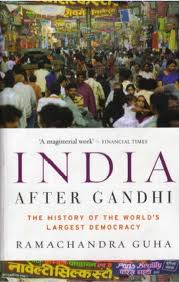
Sumit Sarkar on Ramachandra Guha’s “India After Gandhi”


Sumit Sarkar wrote a review of Guha’s India after Gandhi for New Left Review (56, March-April 2009), which he ends with an interesting comment:

“Welcome as India after Gandhi is for its initiation of a new field of contemporary historiography, one is left half-yearning for the book Guha did not write”.

I think Sarkar has sufficiently shown, despite his non-polemic sympathetic tone for a fellow historian, that Guha can never write “the book”. Sarkar does appreciate this “clear and comprehensive account of the course of events”. But

“Guha offers no overall theses as to how the India of 1947 became that of today. Instead he embarks on a narration of political events, deftly interwoven with socio-cultural and economic developments. Along the way he provides a set of individual political profiles, often interesting and amusingly drawn. One occasionally feels that he overuses this strategy, especially since, barring a few individuals—Nehru, Patel, Sheikh Abdullah, Indira Gandhi or Jayprakash Narayan—many were not as significant as the character-driven plot structure, weighted towards party leaders, makes them out to be. Other social forces and structures are inevitably downplayed”.

The narrative is “uncritical” based on “journalistic sources”.

“More broadly, what is missing in terms of Guha’s framing questions is any analysis of the tensions between national unity and democracy, and the ways in which the concerns of the former—military security, internal sovereignty—have not infrequently hollowed out the content of the latter”.

Sarkar finds many “large questions, which Guha does not address”. But why?

“This is not an incidental drawback, but flows from the liberal-Nehruvian nationalism that is the book’s chief ideological marker”.

HENCE, Ramachandra Guha’s book is more an exercise in story-telling – “a thoughtful survey of the period in fluent, lucid prose”.

Robbers and the State


Ramakrishna Paramhansa once told the following story to a gathering (don’t ask me to be exact!):

A man going through a forest was robbed by three robbers. After robbing him, one proposed to kill him. Another reasoned about the uselessness of killing the person, he proposed to tie him up and leave him in the forest. Ultimately, the robbers bound his hands and feet and left him. After sometime the third robber returned and freed the person saying, “I am very sorry, hope you are not hurt. Come, I will lead you to the highway from where you can go home”. When they came to the road the man expressed his gratitude towards the robber – “You have been very kind to me. Come with me to my house”. The robber, obviously, refused and went away, while the man kept on looking at him charmed by the goodness of the robber and asked god to keep him safe.

This world itself is the forest, where Sattva, Rajas and Tamas are the robbers robbing a man of the Knowledge of Truth (The Real), leaving him enchanted by Maya. Tamas wants to destroy him, Rajas binds him to the world, while Sattva rescues him from the clutches of the other two. Under the protection of Sattva, the man is rescued from anger, passion and other evil effects of Tamas. But then Sattva too is a robber who leaves him further off from the knowledge of Truth – of Moksha and Maya. Ultimately he is left mesmerised by Maya.

Isn’t this story an interpretation of the dialectic of coercion and consent (which is the basis of the State and its apparatuses) – translated in terms of the interplay of Tamas, Rajas and Sattva?

The Meaning of Anti-Casteism


Ambedkar clearly defined the meaning of the struggle against the caste system. For him it was not simply a petty bourgeois assertion of identity, a struggle for mere representation, as many exponents for and against the dalit movement have propounded. In his ILP days and again in “Who were the Shudras” (1946), Ambedkar essentially viewed the origin and function of caste (and therefore casteism) as conversion of “the scheme of division of work into a scheme of division of workers, into fixed and permanent occupational categories”. So the revolt against the caste system (or casteism in a capitalist society) is a revolt against the material and ideological division of workers, against the labour market segmentation, against the individualist-competitive ethic (a petty bourgeois tendency) among workers (which frequently takes identitarian forms). Only by questioning and destroying the whiteness of the “white” workers, a larger united working class movement could be posed in racist societies like the US. Similarly in a casteist society like India, only by attacking the “upper/middle-caste-ness” among workers, a working class alternative could be posed. A drastic reorientation of the dalit movement (and therefore of the working class movement) is needed if it has to pose a real challenge to the caste system and casteism, as Ambedkar understood them. Dalit Movement has to re-emerge as the vanguard of the working class movement.

Terrorism, Mass Hysteria and Hegemony in India


All incidents in India that have occurred recently, which go by a blanket name terrorist attacks, have been viewed as self-explanatory. A terrorist and his acts don’t need any explanation. A terrorist is like any other professional who is supposed to do what he is trained for. Why does he do that – is not a question to be asked. It is his own “free will” which clashes with others’ free will. Haven’t we been time and again accused of talking about the human rights of the “terrorists” while “ignoring” those of the soldiers and policemen who are “victims” of the terrorist attacks? Their opposite location with respect to the hegemonic centre does not mean anything.

I feel the post-modern capitalist celebration of relativism indicates towards an important aspect of the reconstruction of power, civil society and expression in the age of finance capital. The footlooseness of faceless finance capital characteristic of this age has intensified the process of solid melting into the air to an ever-increasing degree – every click on the keyboard makes, changes and destroys billions of lives every moment. This has led to a multiple crisscrossed entrenchment of every segment in the society trying to hold on to something solid – an identity or something… In the process, every ‘melting’ identity poses its own language which could not be understood beyond the space-time of its posing. This is what we can call a continuous process of subalternization, of manufacturing subalternities that cannot act, but simply react in the hegemonic paradigm. When useful things become commodities, their self-expression (through their own use-value) is incomprehensible in the market, they must express their worth through the hegemonic reactive monetary expression of exchange-value – a general form of value.

Thus, the resolution of “civilizational” conflicts (between various levels of subalternities) is possible in the within-the-system framework only through a generalized cutthroat competition or simply mutual annihilation – the well-armed and defiant robots clashing with each other – “the terrorists”, the security personnel etc. The only language that is mutually understandable is that of the guns and bombs… So the citizenry can’t empathize with the terrorists, they are always aliens. And so are the (counter)terrorists and their ‘innocent’ protégées for “them”. They are reduced to reactive agencies within the hegemonic game-plans. They can only react to each other’s moves.

Today’s terrorism is a desperate cry to make others’ listen to what subjects/terrorists are unable to express and what “others” either refuse to hear or are unable to understand. It is the failure and crisis of self-representation let out in the hegemonic language of coercion and terror. This seems absurd but this is as absurd as the absurdity of the conjuncture.

The whole arrogant security discourse that the media and security mafia in India pose is far more absurd than the defiant terrorist attacks. What can be more absurd than the astheticised victimhood of the “great” India that they sell while being slyly proud whenever a terrorist attack takes place in the country, as that makes them feel to be in the league of the greatest victims of global terrorism – the US, UK and Israel. So now we have our own 9/11. This is the level of discourse in the Indian media in the context of the Mumbai incidents.

The recent unabashed display of an elitist, confessedly, “anti-political” stress on security infrastructure and technology to resolve every conflict and the aim to put away politics on security matters are nothing but an insistent inability and a lack of will to understand conflicts. Nobody is asking for an everyday democratic control over every aspect of social life, rather what is being provoked by the panicky bourgeoisie and petty bourgeoisie in India is a hysteria in favour of a trans-political security and intelligence machinery – which can easily become a permanent coercive, of course, an efficient, bureaucracy which regulates the social life.

Terrorism in the present shape is not a threat for the system but like its counterpart is an opportunity for the hegemony to create consensus to (counter)terrorise (and subalternise) the alienated voices and stop them from becoming a meaningful and organised threat to the system by transcending their own subalternity. Anyway, as a prominent postmodernist, postcolonialist scholar categorically said, “Who the hell wants to protect subalternity? Only extremely reactionary, dubious anthropologistic museumizers. No activist wants to keep the subaltern in the space of difference… You don’t give the subaltern voice. You work for the bloody subaltern, you work against subalternity.” (“Interview With Gayatri Chakravorty Spivak”, Ariel: A Review of International English Literature (July 1992), 23(3):29-47)

Source of neoliberalization in India


“It was not the US, furthermore, that forced Margaret Thatcher to take the pioneering neoliberal path she took in 1979. Nor was it the US that forced China in 1978 to set out on a path of liberalization. The partial moves towards neoliberalization in India in the 1980s and Sweden in the early 1990s cannot easily be attributed to the imperial reach of US power. The uneven geographical development of neoliberalism on the world stage has evidently been a very complex process entailing multiple determinations and not a little chaos and confusion.”

(David Harvey – A Brief History of Neoliberalism, pp9)

The Economic Function of Terrorism?


And why not? At the time when a global recession is on its way, there is a need to increase public spending to revive the economy. And Baba Keynes himself told us once – “Pyramid-building, earthquakes, even wars may serve to increase wealth, if the education of our statesmen on the principles of the classical economics stands in the way of anything better”. What is better than a war on terrorism which never ends – it will lead to a constant militarisation, and an expansion of the security and armaments industries necessary for boosting effective demand.

Is this really a conspiracy theory?

Financial Meltdown – A Last Resort?


Finance Capital in general holds the whole economy and public saving to ransom, then why cannot its poor agents kidnap a child for ransom?

2 MBA students held for kidnapping teen
25 Nov 2008, 0341 hrs IST

NEW DELHI: In a shocking fallout of the financial meltdown, two part-time MBA students who had apparently lost heavily on investments in stocks and real estate decided to make good their losses by joining in a plot to kidnap a 15-year-old south Delhi boy. The operation went awry when the mastermind, a cousin of the victim, panicked and dumped him at Okhla from where a passerby brought him home.

Arjun Jhamb Verma, a Class IX student of Gyan Bharati School in Saket, was kidnapped on his way to school on the morning of November 20. By Sunday night, the south Delhi police had arrested the two MBA students along with four others, including the kingpin who is an electronics and real estate dealer. The others include an inter-state extortionist and his accomplice as well as a hair-stylist.

Both MBA students were pursuing their course through correspondence. Police said Piyush Jain (24) had enrolled in IMT Ghaziabad and also dabbled in shares. His close friend Rohit Chopra (24), who is doing an MBA from Ignou, is a property dealer in Gurgaon. He had apparently lost a lot of money due to the slump in prices of flats. Rohit had also invested in the stockmarket at Piyush’s insistence.

Rohit’s father is a general manager at a leading hotel in the capital while Piyush’s father is an established graphic designer with his own setup in Karol Bagh.

Courtesy: TOI

The Financial Crisis – The Crisis of Not Finding Barbarians?


There is so much anxiety everywhere. Till recently the neoliberal world prospered by spreading insecurity and inculcating the feeling of ‘what comes next’ among the working class. This fragmented the class consciousness and competition thrived. Didn’t our good old Marx and Engels taught us the following?

“In proportion as the bourgeoisie, i.e., capital, is developed, in the same proportion is the proletariat, the modern working class, developed — a class of labourers, who live only so long as they find work, and who find work only so long as their labour increases capital. These labourers, who must sell themselves piecemeal, are a commodity, like every other article of commerce, and are consequently exposed to all the vicissitudes of competition, to all the fluctuations of the market…[T]he “organisation of the proletarians into a class, and, consequently into a political party, is continually being upset again by the competition between the workers themselves… The essential conditions for the existence and for the sway of the bourgeois class is the formation and augmentation of capital; the condition for capital is wage-labour. Wage-labour rests exclusively on competition between the labourers.”

But Marx understood that competition among workers is essentially a representation of competition among capitalists. There is a theory of displacing crisis, anxiety etc, that gives a patient reason to survive. In economic theory it is called the theory of external markets. Capital and capitalists thrive only by externalising/selling/’exporting’ commodities, crisis etc, to labour and other nations (or capitalists)… Rosa Luxemburg stressed on this aspect in her understanding of imperialism. The crisis period is that period in the political economic life of capitalism, when this export meets with obstinate hurdles.

Economists tell us that the present crisis is due to an unrestrained financialisation that the neoliberal globalisation has triggered. But then, hasn’t this radical financialisation diminished every external space? As soon as externality is posed, we find it accommodated and submitted to the larger global structure. Then in the above perspective, this is the crisis and the reason for anxiety! For the time being, there is no place to ‘export’ crisis – this is the biggest crisis!

More than a hundred years ago, a prominent Greek poet C.P. Cavafy wrote the following which clearly presents what is happening today – a crisis of not finding barbarians!

– Why should this anxiety and confusion
suddenly begin. (How serious faces have become.)
Why have the streets and squares emptied so quickly,
and why has everyone returned home so pensive?

Because night’s fallen and the barbarians have not arrived.
And some came from the border
and they say the barbarians no longer exist.

Now what will become of us without barbarians?
Those people were some kind of solution.

(‘Waiting for the barbarians’ in The Collected Poems of C.P. Cavafy, Translated by Aliki Barnstone, WW Norton & Company (2006), p 29)