“A petition, without the backing of force, is useless”


“It is a fact beyond dispute that a petition, without the backing of force, is useless….A petition of an equal is a sign of courtesy; a petition from a slave is a symbol of his slavery. A petition backed by force is a petition from an equal and, when he transmits his demand in the form of a petition, it testifies to his nobility.”

Well, here, by force, Gandhi means, the capacity to say this: “If you do not concede our demand, we will be no longer your petitioners. You can govern us only so long as we remain the governed; we shall no longer have any dealings with you”.

I have myself signed tens of petitions in recent months, but do we have this “force” in us? And still we continue petitioning! YA BASTA!

Is the Maoist movement in India “pre-political”?


In a recent meeting our comrade, Saroj Giri called the recent Maoist upsurge “pre-political”, which makes both Maoists and those against them uncomfortable. Obviously, there can be an endless debate over the textual lineage and correctness of this usage, as some raised in the meeting, but that is not my concern. Before that in an article in EPW he said (more ironically):

“Today when the country is promoting itself as a modern global democracy, with technocratic, security-centric, good governance replacing populist, messy ways of governing the masses, the combination of Maoists, who are literally the adivasis (“old, obsolete ideology”) of left politics, with the adivasi masses, seems to give rise to not just an “undemocratic” force but something almost primordial, pre-political…”

I find this characterisation interesting. For me, the notion of “pre-political” as used for Maoist ‘politics’ has two definite connotations:

Firstly, it stresses on the organicity of this ‘politics’ – i.e., it is not something simply representative and thus external;

Secondly, this ‘politics’ is embedded in the subalternity of a particular section in the working class – which is subaltern in the sense, that it has not found its generalised political expression as that for the working class.

In this regard, one must remember that a political movement, in Marx’s understanding, is

“a movement of the class, with the object of achieving its interests in a general form, in a form possessing a general social force of compulsion.”

A ‘working-class’ movement is pre-political, if it is still jammed at an identitarian level, is sectional (“primordial”), i.e.,

“the working class is not yet far enough advanced in its organisation to undertake a decisive campaign against the collective power, i.e., the political power of the ruling classes”.

But these pre-political (“economic”) struggles are important because they train the various sections of the working class for that decisive campaign

“by continual agitation against and a hostile attitude towards the policy of the ruling classes”.

Whose puppet is the Nepal govt and what for?


Leave aside this talk about puppet, colonial, expansionist etc. They are mere rhetorics. India is clearly an imperialist country – a country which controls around 45 percent of FDI in Nepal has much on stake. You cannot appeal to India’s good conscience and put it on the ‘right’ track by sarcasm (just asking for “a paradigm shift in relations with India by recognizing the changed political context in Nepal”) . Only a popular unity of the working masses across boundaries can defeat this South Asian imperialism. However, this would require inculcating a Zimmerwaldian spirit among Indian comrades – and that is the most difficult task, indeed!!!

http://news.outlookindia.com/item.aspx?679967

Ahead of their planned massive show of strength against the “puppet” regime of Madhav Nepal on May 1, Nepalese Maoists have intensified their anti-India campaign by releasing posters and pamphlets against New Delhi.

The former rebels are planning a major rally on May 1 to demand the ouster of the 22-party coalition government headed by Madhav Kumar Nepal, calling it a “puppet” regime, coinciding with the International Labour Day.

Ten days before the rally, walls in capital Kathmandu adorn posters and paintings against India, which authorities feel would further fan anti-India sentiments in Nepal.

“Get rid of the puppet government”, “abrogate the Nepal India Peace and Friendship Treaty of 1950” and “Indian Army vacate Kalapani and Susta” are some of the slogans that have made way into the posters.

Some posters say the May one agitation is to protect “national independence and fight against colonial and expansionist forces.”

Maoists have been accusing India of interfering in Nepal’s internal affairs, but New Delhi has rejected it.

Last week, Indian Ambassador Rakesh Sood had met Maoist chief Prachanda to express concern that the rally would further fan anti-India sentiments in Nepal.

CPN-Maoist leader say the May 1 rally is to “fight against those forces which have been conspiring against the peace process and the process of drafting the constitution.”

The party has also appealed to labourers to participate in the rally.

Class Struggle, Development and Revolutionary Politics


1. What happened in China? Isn’t it capitalism that is being nurtured by the ‘Maoist’ party in China?

The course of development is determined by class struggle (at least the Chinese communists were emphatic about it, when they said that this class struggle goes on in their own ranks as well). The Chinese economy where it stands today too is not a result of any linear development; without deliberating on contradictions of the development process that revolutionary movements trigger, we generally tend to impute successes/failures of the revolutions or movements to the subjective choices of the leadership – their goodness and badness.

2. What is happening in Nepal? The Nepali Maoists are quite vocal about their aim to nurture capitalism in their country.

Even in the case of Nepal, we should try to understand the Maoists, by grounding their politics in the wider political economic processes which limit their ‘dream’ of an uninterrupted revolution, of ‘bypassing capitalism’. Their problem is at least partly our patriotism – like the anti-patriotic Zimmerwald Conference we should first of all decry and call for the defeat of the Indian state and capitalists who virtually hold half of the Nepali economy to ransom; then only can we see a proper anti-capitalist revolution emerging in landlocked Nepal. We should just go through news reports of the past five years, how threats from Indian capital and state (which Indians, including the leftists, generally understand as an expression of big brotherliness, rather than that of imperialism, because we ignore the economic basis of India-Nepal relationship) have regulated the Maoists’ radical initiatives.

3. What is the development strategy of the Maoists in India? Don’t they profess to compensate for lack of capitalism?

About our Maoists, I believe, our so-called movement people are waiting for their failure to be the proof of their wrong ideology, strategy, tactics or even ignorance about the development process. But that is not the way for the revolutionaries – they have to understand every struggle caught up in the particularisation of class struggle in various localities, first by affirming it to be part of the same movement. What will be the development strategy ultimately is determined by the articulation between various local (particular) struggles, and the class hegemony that directs that articulation.

4. How have non-Marxist socialists in India faired on this count?

The socialist movement (here I include many communist organisations too) in India today – because of their populist political base and vision (‘populism’ in a definite theoretical sense) is caught up in the cartesian binaries of big vs small, agriculture vs industry, village vs city, india vs bharat etc etc, in which the hierarchised composition – internal differentiation – of the preferred half (the ‘small’ or the agrarian community etc) are simply wished away, ultimately for the benefit of the well-to-do within this ‘small’/agrarian community (in practical terms increasing their bargaining power). (A parallel example in the urban areas could be the trade unionists protecting sectional interests or labour aristocracies by not taking account of labour segmentation). We have seen how socialists in rural areas have been reactive to any talk of class differentiation, and independent labour mobilisation, since they tend to divide, not unite the rural community.

5. But don’t you think every movement has to have a central focus that can broaden its base? A peasant movement will be homogeneous in this regard.

I think within the peasant movement, even before Independence, there were a few socialists who were quite clear about the complexity of the peasant question – how differentiation within peasantry determined the trajectory of even seemingly “homogenized” peasant struggles: to name some of them, Swami Sahajanand Saraswati (see his “Maharudra ka Mahatandav”) and Indulal Yagnik/Dinkar Mehta (in Gujarat) who understood the task of re-envisaging the rural struggles around rural labourers (which include those sections of the “landed” peasantry who simply reproduce their labour-power by engaging in farming). For a historical review of this aspect please read Jan Breman’s “Labour Bondage in West India”. The recent overstress on peasant homogeneity is phenomenon which is related with a definite rise of the kulak lobby (I am using this term in a purely objective sense).

6. At least the socialists have a clear vision about alternative development.

Yes, the socialists have a clearer vision about development alternatives, but much of that has to do with their dualistic conceptualisation; they can remain happy with utopian anti-capitalism, by choosing one pole in the binary. The problem with communists is that they try to develop a labour standpoint – and labour-capital relationship does not constitute a cartesian contradiction, they are opposites in a dialectical contradiction – “capital is labour”/”labour is capital”, as Braverman said, “working class is the animate part of capital”. The development strategy is constituted through this continuous contradiction, through a generalisation or a political systematisation of the alternatives emerging in the daily experiences of the working class. The question here is to go beyond capitalism, to overcome capital as accumulated labour dominating the living labour – to overcome the subsumption/ alienation/ accumulation of various forms of labour by capital (capitalism expands not just by wiping away the “vestigial” forms of production and exploitation, but also by resignifying them). We cannot have a predetermined development strategy in this struggle, except that which will sharpen the class struggle.

7. But class struggle between capital and labour too leaves aside many other conflicts.

Not exactly. The issue before us perhaps is to understand how ‘other’ struggles (struggle between classes, not just labor and capital but other classes also; struggle within classes; struggles against the State, caste and gender struggles) are related to capital-labour conflicts. Why cannot they be seen as particularisations of capital-labour conflict? Labour does not mean just wage labour. Labour-capital relationship resignify the whole stratification of the society, even castes and gender are posed as specifications of that relationship:

a) Ambedkar can be helpful in understanding the caste system in this regard, when he talked about caste as not just a division of labour, but a division of labourers. In this framework, anti-casteism becomes a working class struggle to create unity among labourers.

b) An Italian-American activist-scholar, Silvia Federici has succinctly put:
“If it is true that in capitalist society sexual identity became the carrier of specific work-functions, then gender should not be considered a purely cultural reality, but should be treated as a specification of class relations…In capitalist society “femininity” has been constituted as a work-function, masking the production of the work force under the cover of a biological destiny. If this is true then “women’s” history is “class history”.

8. So are you against community level struggles, as communities are generally composed of diverse class interests?

A “Community” is not simply an aggregation of horizontal interests; it arises out of an articulation (which includes hidden and open conflicts) between various levels of interests. Its critical edge is determined by the nature of interests that dominate that articulation. We are not even hostile towards the idea of rural community, but the point is to see how it is internally constituted, and which class interest dominates it.

(I thank comrades, interacting with whom I wrote much of the text.)

Historical stereotypes and disjunctures


[L]ate antiquity throws up a social formation combining aristocratic dominance with free labour on a model that conforms to none of the historical stereotypes distinguishing the classical from the medieval and modern worlds (aristocrats + slaves, aristocrats + serfs, capitalists + wage-labourers). These of course have always been extremely general formulations that seek to sum up the economic structure of different historical periods in terms of an essential or uniquely pervasive set of relations. But hired labourers were used on an extensive scale by the English estates of the thirteenth century; slaves were used by agrarian capitalists down to the late nineteenth century; and serfs, like slaves, could also be deployed in industrial production. These disjunctures complicate the issue of a scholarly understanding of the possible sophistication of ancient economic behaviour, because they rule out the simplistic idea that the dynamic which drives an economic system is given primarily in terms of the organization of labour, i.e. that the ‘forms of exploitation’ of labour determine the ‘relations of production’, and to form some assessment of the nature of aristocratic activity the issue of the nature of the labour force is thus largely irrelevant.”

Jairus Banaji, AGRARIAN CHANGE IN LATE ANTIQUITY, OUP, 2001, pp 217-218

Bondage, Vestiges and Capitalism


Following paragraphs are taken from a review that I wrote for Labour File in 2008:

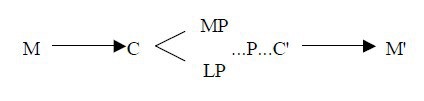
It is important to understand Marx’s conception of “wage slavery” here. The usage of this phrase was not at all allegorical or rhetorical, as many tend to believe. It conceptualised the unfreedom or coercion inherent in the dual freedom of labour (from physical compulsion and from the means of production). On one hand, this dual freedom creates an ambience that compels a labourer to sell his/her labour power. On the other hand, once labour power is sold for a period, the labourer has no control over its expenditure for that duration. It should be remembered though the custom is to pay the wages after labour-power is exercised, wages are, in fact, already advanced prior to the labour process not only for the purpose of records, but also as capital required for production – i.e., it constitutes variable capital that is required to buy labour-power and put it to work. In the circuit of capital given below, Money (M) is advanced to buy Means of Production (MP) and Labour Power (LP) before Production (P) can take place.

image

In fact, “whether money serves as a means of purchase or a means of payment, this does not alter the nature of the exchange of commodities”.(Karl Marx, Capital, Penguin, pp. 279) As “a means of purchase” money is advanced to the sellers of labour power prior to production, while as “a means of payment”, it remains as the worker’s “credit to the capitalist” until production is completed to be paid as wages afterwards. Functionally it hardly makes any difference – “this does not alter the nature of the exchange of commodities”. And both institutionalise labour vulnerabilities in their own way – advance (partial or whole) can easily be transformed into debt, creating liabilities that shape bondage, while wages can be delayed or even lost (when the capitalist goes bankrupt). In fact, the delay in receiving wages is a significant reason for indebtedness among workers. If in Marx’s England debt played a part in tying the worker more to a shop as a consumer, or to sustain the “truck system”, it can instigate other systems, too, to institute labour vulnerabilities. Ultimately the purpose is to increase these vulnerabilities and thus, reproduce the hegemony of capital over labour. The report remarkably succeeds in showing how this is done in various parts of India through debt bondage.

—————————————————————
Here are some more observations that I made during that time:

A. The process of proletarianisation to which the majority is subjugated, not the number of ‘ideal’ proletarians or wageworkers, defines capitalism. The actualisation of this process – and thus the degrees of proletarianisation or the “dual freedom of labour” differs according to the concrete contexts defined by the needs of capital and class struggle. More technically, this process is a long thread (not necessarily historical) between the formal subsumption to the actual subsumption of labour by capital – its two ends. At various junctures archaic unfreedom, like slavery, which generally characterised pre-capitalism is formally adopted (more aptly, exapted as explained in B) and transformed according to the conjunctural needs of capitalist accumulation. If we don’t recognise this processual aspect of capitalism, we will be lost in the miasma of overproduced forms and appearances in capitalism.

B. Stephen Jay Gould’s conception of exaptation, I believe, is very useful in understanding the dialectical internalisation of “vestiges” by new stages in evolution – both biological and social. Gould and Elisabeth S. Vrba in their 1982 paper defines exaptation as (i) “a character, previously shaped by natural selection for a particular function (an adaptation), is coopted for a new use”; and, (ii) “a character whose origin cannot be ascribed to the direct action of natural selection (a nonaptation), is coopted for a current use”. This concept allows us to comprehend the reproduction of “vestiges” as a process internal to the new stage in development, not as something hindering the ‘complete’ realisation of the new stage.

C. The “purist” idea that “vestiges” obstruct (not shape or contextualise) capitalist development has for a long time informed the theory and practice of Marxism in the so-called third world countries – engaging the revolutionaries in the fruitless exercise of fighting the “vestiges” before taking on the basic system, thus investing their revolutionary vigour in the reformist project of the capitalist development. It is interesting to note that this is not only true about the “Leninists” and “Maoists”, as some “anti-Leninists” allege. Many anti-Leninists and anti-Maoists present more vehement denial of the feasibility of any socialist project in “backward” countries. Their conceptualistion of revolution not only goes against the thesis of “revolution in permanence” – “the downfall of all the privileged classes, and the subjection of these classes to the dictatorship of the proletariat by maintaining the revolution in permanence until the realisation of Communism, which is the final form of organisation of human society” – but is also an unconscious reinforcement of the notion of “socialism in one country”, which they profess to hate.

Problems and prospect of the “Maoist” Strategy


Rural society and the market are so intertwined throughout India that you cannot squeeze the markets (or towns) off by abruptly cutting their connection with the villages (the logic of encirclement). In fact the opposite has occurred in most of the cases – in Bihar and many places in Jharkhand, ML groups couldn’t sustain their “zones” because the villages were squeezed off by the elongated disruption of their relationship with the market. They were successful and that too marvellously as long as people perceived “liberation” as “strikes”, i.e., as strategies for bargaining for prices – prices of labour and labour power (interestingly, Marx termed strikes as guerrilla attacks). When these “strikes” tend to create “liberated zones” – a semi-permanent rupture in the relationship between the larger market and local communities, the local support starts getting alienated and disgruntled.

At many places, the naxal movement has successfully opposed the oppressive “diku” intermediary system in Tendu-leaves type trades, but the impossibility of posing an alternative economic system in a piecemeal fashion within the isolated “liberated zones” (this is due to India’s political economy) helped reestablish the similar oppression, however, with a notable change that now we find locals (not dikus) for the role of mediating a more intense internalisation of capitalist relations – “mutually embedding” of the market (labour, capital and commodity) and communities. Hence, we see ex-comrades becoming part of the established political formations (as for instance during the last elections in Jharkhand) or as traders, contractors etc. It is this section, which was the immediate beneficiary of many local militant struggles and which became agencies of the status quo. The phenomenon of Salwa Judum can also be perhaps explained in this framework – it is constituted by those elements in the tribal communities who have benefited by the expulsion of diku intermediaries, and now they want an accommodation within the hegemonic establishment.

But all this demonstrates the success of the Naxal movement in developing right “tactics” for organising locally, but the problem comes when those tactics are institutionalised as strategies (when guerrilla battles are confused with the whole war). This is the problem of spatio-temporal overgeneralisation, of essentialising particular tactics beyond spatial and temporal contexts. This problem occurs due to a partial critique of India’s capitalist political economy – viewing particular/apparent forms that it takes in specific locations (according to which specific tactics are formulated) as the essence or the general reality. The lack of a comprehensive critique of India’s political economy in revolutionary practice (but “without revolutionary theory there can be no revolutionary practice”) has led to the cornering of “the political” and foregrounding of the voluntaristic military operations.

The ‘generalised’ guerrilla tactics that we saw in China (also in pre-republican Nepal) were conjunctural (based on the concrete analysis of concrete situations). If we go through Mao’s writings (not just those published officially), we can see self-organisation of the working population (even with their ‘unsophisticated’ consciousness) at the centre of his politics (see his Hunan report and intensive/extensive land investigations in which we find him engaging in throughout the revolutionary phases). In fact, the guerrilla tactics was organically grounded in this as a ‘specific’ vehicle to interconnect various locations of experiences. This specificity derived from a feudalised political economy that was present there (I am calling it thus, because the post-Qing Chinese state was virtually a network of local militarised (warlords) interests).

On Jairus Banaji’s response to Arundhati Roy


One point that interests me in Jairus Banaji’s post in Kafila and the subsequent debate on the post is his focus on labour as the centre of the movement. I think this focus is fundamental in order to ground various local/localised struggles in political economy (or rather in its critique) and to understand the underlying interconnections between them (whether the leadership of these struggles understand them in this manner is immaterial – did not Marx appreciate Paris Commune even when Blanquists were in hegemony?).

Marx’s conceptualisation of labour and of capital-labour relations is rich enough to provide tools for comprehending various struggles against capitalist accumulation (both primitive and normal). He understood subsumption of labour by capital as a process (not some particular fixed states), which starts from being formal to real – from a stage where labour is subsumed through non-capitalist “forms” of exploitation to the actual subsumption in “pure” wage-labour form. Between these two poles, subsumption can take a plethora of forms. Who knows better than Jairus that unwaged labour (reproductive or otherwise) is also part of the capitalist subsumption of labour.

So how do we understand tribals and “peasants” struggles against land and resource alienation within this framework? They are essentially fighting against capitalist efforts to alienate them from their resources, which create (or, better, reproduce) conditions for the subsumption of their labour by capital. Whether they will become wage labourers is not at all essential; if they are not employed, or even employable, they still remain labourers as part of the reserve army of proletarians or surplus population (stagnant, latent and floating) reproducing themselves on their small pieces of land, or by food gathering (in forests or trash cans). Their struggle, in a Marxist sense, can be understood as part of the anti-systemic working class struggle to control the conditions of production and, I stress, reproduction too.

Now coming to the forms of struggle (armed, unarmed, etc), I think we as Marxists (of all hues and colours) cannot act as idealists, by considering only those movements as working class movements or anti-capitalist movements, which are projected in our idioms, and are developing according to our framework of strategic-building. The working class can throw diverse forms of struggles according to its internal constituents or class composition. However, one must critique forms in order to show the limitations and problems of those forms, in order to avoid the problem of overgeneralisation of particular forms, and also in order to undertake the revolutionary task of generalisation seriously, which essentially means to see a revolutionary building up against capitalism within and through all forms of working-class struggles.

A general discomfort about Narayanpatna


1) The federal structure of India’s polity in the neoliberal phase has emerged as a unique mechanism to administer the internalisation and intensification of the general logic of capitalist accumulation at every location – with its great ability to subsume and network all forms of social relations under the command of this logic. The identitarian/territorial separations and exclusions are transformed into a differential inclusion within this logic forming the uneven terrain of the evolving capitalist geography in India. Commercialization and the subsumption of local social relations into this larger logic have recontextualised the social divisions through which the class struggle is refracted locally. So we find identity struggles… yet, they are class struggles!

2) The national club of Indian activists and intellectuals became aware of the movement at Narayanpatna only at the moment of its retreat. Even if they were aware of it, they hardly cared about it. There was nothing like another anti-land acquisition movement against the big “outside” of the corporates, which temporarily (if I may say so) almost seemed to homogenise the ‘affected’ village India against ‘non-Indian’ imperialism and its Indian agencies – a romantic India against the pragmatic world of capitalism (some name this, Bharat vs India) – a dream struggle for oneness with the pristine simplicity which capitalism wants to destroy.

3) However, at the time of its retreat, people inside and outside did try to paint the reality in Narayanpatna according to the images that sell today. But the truth is that Narayanpatna divides people – it represents that politics which emerges out of the divisions that constitute India, not just between the outside and the inside, the rural and the urban, not simply between the upper caste and the lower caste, but between the whole ‘glocal’ network of capital (which unites the global with the local, not just extensively, but intensively too) and the insistence of the indigenous section of the local labour to self-valorise, not to be subsumed by capital and its personified agencies.

4) The Narayanpatna movement was against both the asset-rich and the asset-poor who engaged in that grand network of capital. People were uncomfortable with this movement because it brought forth the fundamentals of the reality – of the deep divisions that constitute rural India. So in Narayanpatna all assumptions about rural movements went topsy-turvy – we saw intra-‘poor’ and community-level conflicts. This movement was against everybody that alienated and sought to alienate the forces of production and reproduction from the “tribals” – their labour, its means and its objects.

a fable


“Suppose a net has been cast into a lake to catch fish. Some fish are so clever that they are never caught in the net… But most of the fish are entangled in the net. Some of them try to free themselves from it…But not all the fish that struggle succeed. Then the fishermen shout, ‘Look! There goes a big one!’ But most of the fish caught in the net cannot escape, nor do they make any effort to get out. On the contrary, they burrow into the mud with the net in their mouths and lie there quietly, thinking, ‘We need not fear any more; we are quite safe here.’ But the poor things do not know that the fishermen will drag them out with the net.”