Earlier, when a migrant came to a metro, earned money as a labourer, went back to his village and bought land there, he was assumed to be a pauperised peasant with a nostalgic urge. Some took him to be insufficiently proletarianised, not fully attuned to the urban life, and also living in illusions – fighting his present to remain in the past. I always had my doubts. My experience of working with many such migrants, both in Delhi and Odisha, shows that this tendency of investing back is actually an existential mentality of any normal individual worker with or without a regular employment. It is a way to invest their savings smartly. For precarious labourers, it is a way of surviving or reproducing themselves and their families in the absence of social security and regular employment.
It is the peasant/petty bourgeois mentality of the left leadership and intellectuals that does not allow them to see such a simple fact. However, I will refrain from saying that they are under any illusion. It is their class outlook that really determines the conclusions that they make.
This is a note for a TU workshop in Odisha to be held in December (2014)
1. The mobility of capital and precarity of labour characterise the neoliberal transition of the economy. It is the fear of capital’s mobility that regiments governments to do everything in their capacity to make capital stay. Odisha’s government has similarly demonstrated its willingness to submit the tremendous natural wealth in the state to attract corporate capital, disregarding and even crushing every popular opposition.
2. In these more than two decades of implementing neoliberal policies, entailing a process of accumulation by dispossession has transformed the rural areas into an appendage to this developmental process. The dispossessed communities have been mobilised to support this process in the name of employment generation.
3. However, what we see today is a complete transition of rural areas into a vast reserve of “relative surplus population”, completely at the beck and call of corporate interests as cheap and dispensable workforce. This has changed the character of social and land relations in these areas. The integration in neoliberal capitalism has reinforced the subsistence character of agriculture. Instead of the productivistic and industrial character of capitalist agriculture, which can be found in restricted pockets, we find the function of the village economy being predominantly to sustain surplus population – to subsidise the cost of reproducing labour power of the floating and latent reserve army of labourers, thus ensuring an abundant supply of cheap labour force. This is statistically evidenced by the fact that Odisha is among a few states where the primary source of rural income is wage-labour, not profitability on agriculture.
4. It is this context in which the new social movement must be recognised and strengthened. The intensified process of proletarianisation that made various segments of population anxious in the 80s-90s and provided a ground for the rise of competitive identity struggles, is now rendering an opportunity for coordination and networking across identitarian and segmental divides.
5. The hegemonic institutions and ideologies continue to enforce divisions, of which Odisha has been a hotbed in recent years. But the prospect of countering this too has become stronger. Those who were working with tribals, dalits, forest dwellers and other marginal sections of the society, asserting their traditional exclusivist rights and livelihood are increasingly realising the re-signification of their work in the new context.
6. For instance, the institution of MGNREGA, whatever be its role in realpolitiks and in the management of migration, has made a drastic contribution in reenvisaging rural struggles. Wage and employment suddenly emerged at the core of rural struggles, and rural workers their vanguard. This fact has given new meanings to the activities that these workers do to sustain themselves – in forest, on land, in cooperatives, in SHGs, as migrants. A continuum can be easily visualised across reproductive and productive engagements of these workers that can provide an opportunity for recognising forms of struggles and organisations that can coordinate with one another. It is this critical awareness about workers’ struggles and organisations which needs to be strengthened and disseminated. This awareness is not something that can be reified and frozen, it needs to be transformed into a constant alertness and sensitivity towards the dynamism of class struggle.
7. Organisational forms are frameworks through which we try to grasp the daily struggles of the working class, which are waged at various levels of collectivity. When we talk about the “unorganised” nature of the working class today, it is essentially the crisis of existing organisational forms which are finding it difficult to comprehend the patterns in daily class struggle and in new forms of self-organisation and self-activity that evolve within these struggles. This crisis is productive in the sense that it gives an opportunity to the institutionalised labour movement to reground itself in the new conjuncture of class struggle characterised by informalisation, casualisation and contractualisation of the work process, which has drastically recomposed the working class.
8. As stated earlier, today in Odisha, too, we find a stable State totally committed to neoliberal development and industrialisation systematically transferring the infrastructure and natural resources for corporate profiteering. It is a tremendous task before the already marginalised labour movement here to organise itself to confront this sudden expansion of capitalist hegemony in every sector of economic activity. We find an intensification of primitive accumulation through old methods like land acquisition, deforestation, etc, coupled with new instruments of financialisation (chit funds etc.). This has intensified the process of proletarianisation, which along with an expansion of urban and semi-urban economies has drastically transformed the role of the village economy and agriculture – that of predominantly sustaining surplus population or footloose labour.
9. The increasing population of unemployed and underemployed youth being exploited as cheap and casual labour is an important element of the recomposed working class today. With no job security and an intensified competition for jobs of cheap, casual and contractual nature, today’s workers are vulnerable to all kinds of manipulations by state agencies (that includes political formations) which are reflected in sectarian conflicts on communal/caste lines, between ‘native’ and ‘outsiders’ etc. A recent significant case of such manipulation was visible in Talcher where the old contractor and the new contractor of loading/unloading activities in Talcher mines who were associated with main parliamentary political parties in Odisha used workers for violently settling their scores. It is in this lethal situation that the labour movement finds itself today, already mired by marginalisation and fragmentation on political lines. It poses the importance of autonomous workers’ organisations grounded in daily conflicts between labour and capital.
What is return anyway? Don’t we hit return on our keyboard to start a new paragraph?
Benjamin did not conceive revolution as an act to secure future, as redeemer of future generations, but as retribution – it avenges in the name of the downtrodden generations. The revolutionary class is “nourished by the image of enslaved ancestors rather than that of liberated grandchildren.”
In fact as Calvino points out future is actually a return – “forgetting the future” is “to forget the return” – forgetting “his home, his return voyage, the whole point of his journey.”
Calvino notes that folk tales are of two types. One is of the riches-rags-riches type and the other is the rags-to-riches type. In the first type “the idea of poverty” is connected to “the idea of rights that have been trampled on, of an injustice that must be avenged”. On the other hand, the second one reflects “a consolatory miracle or dream.” It is this that constitutes the “social conscience of the modern age” – the common sense that preserves the status quo. For Benjamin the social democratic historicist myth-making is of the second type – it makes “the working class forget both its hatred and its spirit of sacrifice.”
It is the first type that characterises revolutionary consciousness in capitalism, which is simply never to forget the primitivity of accumulation, the original fall. It is this that makes the struggle against capitalist accumulation revolutionary, or else it will be mere adherence to the historicist reformist conception of progress – the rags-to-riches type. It is not insignificant that every time capitalist accumulation takes a new turn and expands itself, the conception of primitivity of accumulation is enriched – the (hi)story of transition and primitive accumulation is retold. That is why there are many odysseys in the Odyssey.
Returning is reconquering. “In the collective unconscious the prince in pauper’s clothing is the proof that every pauper is in reality a prince whose throne has been usurped and who has to reconquer his kingdom.” Calvino further asserts,
“The return must be sought out and thought of and remembered: the danger is that it can be forgotten before it even happens.”
About a year back, we had written an editorial for Radical Notes about workers’ struggle in Maruti Suzuki’s Manesar plant. And other videos and commentaries were posted too, which critically analysed the dominant perception among pro-worker forces regarding the pre-and-post July 18 struggle of Maruti workers. A comrade associated with Bigul Mazdoor Dasta came heavily against our position, and wrote a 7500-word essay to rebut the dangerous anti-“Leninist” strand that seemed to emerge from our position. To demonstrate the need to combat “new philosophers”, he found anarcho-virus, that we were carrying, in other organisations and groups too, so presumably he saw some kind of ‘anarchist’/’libertarian’ consolidation (alas!) happening in India. The urgency of the polemic is furthermore emphasised by the conclusion that he makes:
“All the energies of the revolutionary intelligentsia today must be directed towards building … a revolutionary party.Lest, the moment of Socialism will pass, the “new philosophers” will continue to remain prisoners of their seductive philosophical ruminations, and our punishment will be fascism.”
What is most interesting about this piece is the ability of the author to spend so many words to assert one single point – that the “new philosophers” in their fling with Maruti workers are rejecting the role of the vanguard (and thus, Leninism), and how could they? And he is forcing his readers to refer to wikipedia back and forth, to know the influence of real devils behind such rejection – Rosa Luxemburg, Tronti, Negri, Holloway, Castoriadis, Operaismo, Autonome, Johnson-Forrest Tendency… Oh, I forgot to add, Paul Mattick and Pannekoek. Tch…I missed two more, Badiou and Zizek. This new trend that he finds is “a childish mixture” of all these and has eventually congealed into “one single tendency of anti-party revolutionism”. For the convenience of his readers (and to demonstrate that The Vanguard is already aware of all of them), he has put them in bold black letters. We are really grateful to him for providing us a reading list that will help us in understanding and articulating our own position well.
I
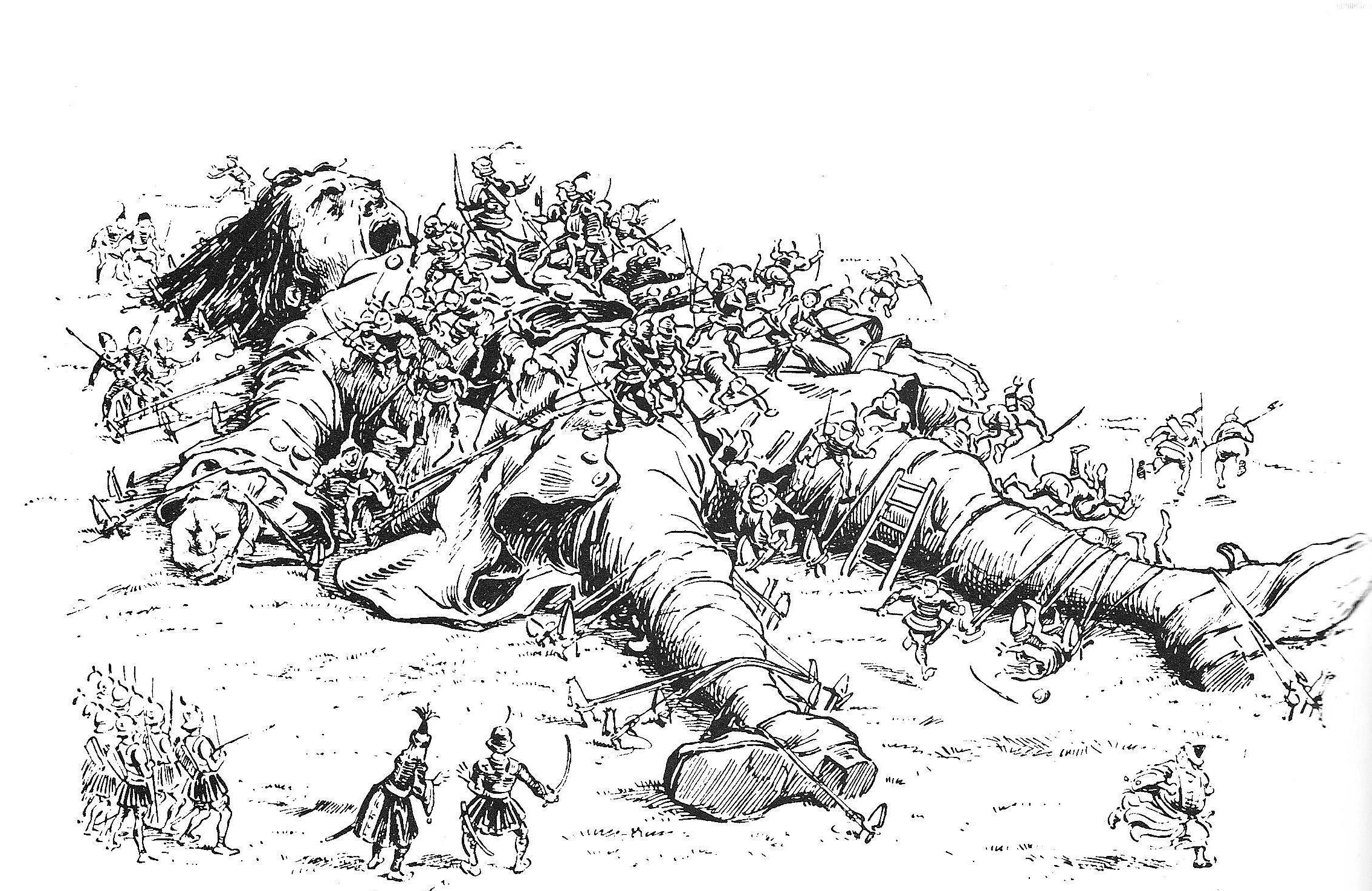
Well, comrade, we don’t reject the vanguards (anyway, do we really need to do that, and more importantly, who are we to do that?), we are simply saying that they must cease to behave like competing Lilliputians – daring to bind and pull the working class in spite of their own progressively constipated constitution, and doing all sorts of gymnastics to draw its attention towards them.
Gulliver and Lilliput Warriors
In your passion to exorcise the devils, you have forgotten that Lenin had spells and counter-spells too, depending on his immediate polemical and rhetorical needs. Some of these devils have understood that aspect of Lenin better than the Lilliputian Leninists. Let me start with an example that uses the words that you abhor:
“…it is a fact that the spontaneous awakening of the masses of the workers … has been taking place with astonishing rapidity during the past few years. The “material elements” of the movement have grown enormously…, but the conscious leaders … lag behind this growth.” (Lenin, “A talk with Defenders of Economism”, 1901, emphases added)
That great and very creative exponent of Leninism, whom we all admire, too has something for a devilish use. He has time and again warned against the Leninist tendency of making the party-form and vanguardism into “an immutable fetish”.
“For it is of the essence of history always to create thenew,which cannot be forecast by any infallible theory. It is through struggle that the new element must be recognized and consciously brought to light from its first embryonic appearance. In no sense is it the party’s role to impose any kind of abstract, cleverly devised tactics upon the masses. On the contrary, it must continuouslylearnfrom their struggle and their conduct of it. But it must remain active while it learns, preparing the next revolutionary undertaking. It must unite the spontaneous discoveries of the masses, which originate in their correct class instincts, with the totality of the revolutionary struggle, and bring them to consciousness. In Marx’s words, it must explain their own actions to the masses, so as not only to preserve the continuity of the proletariat’s revolutionary experiences, but also consciously and actively to contribute to their further development. The party organization must adapt itself to become an instrument both of this totality and of the actions which result from it. If it fails to do this it will sabotage developments which it has not understood and therefore not mastered. Therefore,all dogmatism in theory and all sclerosis in organization are disastrous for the party. For as Lenin said: ‘Every new form of struggle which brings new perils and sacrifices inevitably “disorganizes” an organization ill-prepared for the new form of struggle. It is the party’s task to pursue its necessary path openly and consciously – above all in relation to itself – so that it may transform itself before the danger of disorganization becomes acute, and by this transformation promote the transformation and advance of the masses.’” (Lukacs, Lenin: A Study on the Unity of his Thought, 1924)
We are simply pleading, nothing more and nothing less, that workers can and do discover something new through their class instincts, in both political and organisational terms. For both Lenin and Lukacs, more urgent was the “party’s” task of recognising the new, bringing it to light and preparing itself for “new perils and sacrifices”, so that it catches up with and does not “lag behind” the growth of the “material elements of the movement.”
II
We do understand Lenin’s conjunctural compulsion to use Kautsky’s quote in What is to be done? about the relevance of bourgeois intellectuals to point out that workers need to educate themselves, to understand capitalism and capitalist strategies, to understand their own potentiality, and not just react to their immediate experience (in fact, grasping the richness of this experience requires a science). But we are suspicious of the use of Kautsky’s quote by Lilliputian leftists to defend their own bourgeois outsidedness and the practice of sermonising the proletarians – reducing their experience to subalternity and confusing this revolutionary class to another sack of potatoes aggregated externally and waiting for deliverance. In fact, Lenin’s footnote to Kautsky’s quote transforms the recognition of the “outside” into the Brechtian process of distanciation whereby the revolutionary class can comprehend the capitalist totality and critique its everyday life that would help it in designing its self-activities beyond the evolutionary guerrilla battles – and in the process create its own theoreticians – Weitlings and Proudhons. As Lukacs says, “‘from the outside’, that is, theoretically” – that’s all.
Lenin makes himself furthermore clear, when he says (in the footnote that the Vanguard seemed to have memorised, without understanding its real import):
“it is necessary that the workers do not confine themselves to the artificially restricted limits of “literature for workers” but that they learn to an increasing degree to mastergeneral literature. It would be even truer to say “are not confined”, instead of “do not confine themselves”, because the workers themselves wish to read and do read all that is written for the intelligentsia, and only a few (bad) intellectuals believe that it is enough “for workers” to be told a few things about factory conditions and to have repeated to them over and over again what has long been known.” (emphasis added)
Yes, we are stressing exactly the same – instead of going on telling the workers that they “do not confine themselves” (and since we are your “outside”, we will tell you what to do), we have been telling our vanguards that the workers “are not confined”, and they must not dare to confine them to their consciousness-raising sermons and “cleverly designed tactics”.
III
The other related charge that our vanguard makes on us is that of celebrating spontaneity. We do agree with him that celebrating spontaneity is really bad, but we must add, denigrating it is worse. Celebration is bad because it reduces spontaneity to pristine purity and subalternity, making it incomprehensible, aborting the pregnant possibilities and squeezing away the radical political vigour inherent in it– its anti-systemic contentiousness. But its denigration is fascistic – since it takes away the agency of the working class and puts it in the hands of a few “comedians of the vanguard party”, as CLR James used to characterise his erstwhile Trotskyist comrades. In fact, celebration and denigration go together in fascism – it is like a bandar-madari game – the instinct of the monkeys and the duce‘s manipulation.
The issue for us is to understand spontaneity and its richness, its potentialities. They are, in the words of (y)our Lenin, the “material elements”. However, there is no pure spontaneity. In fact, as Gramsci would say, such spontaneity “does not exist in history”, and the difference between the spontaneous and the conscious “is a ‘quantitative’ difference of degree, not one of quality.” The recognition of spontaneity helps us in understanding the movement – its historical necessity. This recognition shields us against its disparagement as a cooked-up venture and against the charge of voluntarism, and establishes the matter-of-factness of the revolutionism of the working class.
IV
Lenin very aptly described word-chasing “comedians” in his own party (60-70% of the Bolsheviks).
“Comedians! They chase words, without thinking about how devilishly complicated and subtle life is, producing entirely new forms, which we only partly “catch on” to. People for the most part (99 per cent of the bourgeoisie, 98 per cent of the liquidators, about 60–70 per cent of the Bolsheviks) don’t know how to think, they only learn words by heart. They’ve learnt the word “underground”. Firmly. They can repeat it. They know it by heart. But how to change its forms in a new situation, how to learn and think anew for this purpose, this we do not understand.” (Lenin to Inessa Armand, 1913)
The same has happened with “vanguard”, “party”, “outside”, “spontaneity” etc., whose particular meanings or forms were removed from the contextual and conceptual matrices in which Lenin used them, and were then essentialised. Our neo-“Bolsheviks” have learnt them firmly, and keep on repeating them, without understanding that these words or concepts are pregnant with meanings or forms which could help in developing a language of revolutionary praxis in the changing dynamics of class struggle. They have reduced Leninism to a language which is a mere routinised expression of their organisational existentialism. It has become a vehicle to justify their own bureaucratic congealment – existential outsidedness, voluntarist symbolism and competitive sectarian stinginess.
However, Marx has already given us a mechanism to measure the worth of Lilliputian acrobatic contests vis-a-vis “the real workers’ movement”.
“The development of the system of Socialist sects and that of the real workers’ movement always stand in inverse ratio to each other. So long as the sects are (historically) justified, the working class is not yet ripe for an independent historic movement. As soon as it has attained this maturity all sects are essentially reactionary. Nevertheless what history has shown everywhere was repeated within the International. The antiquated makes an attempt to re-establish and maintain itself within the newly achieved form.” (Marx to Friedrich Bolte in New York, 1871)
Our “vanguards” should do some reality check, whether they are already in Marx’s list of “the antiquated”. It might be that they suffer from premature senility or some variety of progeria – hence, when they compare themselves with others, they find the world full of childishness and infantile disorder.
This text in Hindi has been written to introduce the Oriya translation of Marx’s “Wage Labour and Capital”. It mainly emphasises on the political reading of the text and of Marx’s other “economic” writings.
परिचय: श्रम और पूंजी के बीच सम्बन्ध – अर्थशास्त्र और राजनीति
(Introduction: The Labour-Capital Relationship – Economics and Politics)
मार्क्स की एक बात जिसे सबसे गलत ढंग से समझा गया है वह है उनका आर्थिक मूलाधार का सिद्धांत – कि तमाम मानवीय गतिविधियों का मूलाधार आर्थिक है. विरोधियों ने इस बात को पकड़ कर यह साबित करने की कोशिश की कि मार्क्स पूरे मानवीय सामाजिकता को आर्थिक संरचना का ऊपरी ढांचा मात्र मानते हैं. अतएव उनकी नज़र में मानवीय सोच और व्यवहार पूरी तरह से अर्थ-तंत्र द्वारा निर्धारित एवं परिभाषित हैं, उनकी अपनी कोई आन्तरिकता नहीं है, उनके विकास का अपना नियम नहीं है, उनकी स्वतःस्फूर्तता और अभिव्यक्ति पूर्णतः आर्थिक सन्दर्भ का नतीजा है.
दूसरी तरफ, मार्क्सवादियों ने मार्क्स के बचाव में कई तरह की व्याख्याएं दीं जिनका निचोड़ बस इतना है कि मार्क्स की समझ में आर्थिक मूलाधार होते हुए भी वह सब कुछ नहीं है. ग्रंथों पर ग्रन्थ लिखे गए मार्क्स के समझ की समृद्धि दिखाने के लिए – यह दर्शाने के लिए कि उनकी संस्कृति, साहित्य, राजनीति आदि की समझ कितनी समृद्ध थी. अवश्य ही इन सब से मार्क्सवाद और पैना हुआ तथा उसका अथाह विकास जो हम आज देख रहे हैं संभव हो सका.
परन्तु एक ज़रूरी चिंता जो इन तमाम बौद्धिकताओं के नीचे कहीं दब सी गयी – वह थी मार्क्स के चिंतन प्रक्रिया में आखिरकार आर्थिक मूलाधार का अर्थ क्या था. अधिकांश मार्क्सवादी पंडितों ने भी आर्थिक को अर्थ-शास्त्रीय चश्मे से ही देखा, जबकि मार्क्स का पूरा “सैद्धांतिक व्यवहार” अर्थ-शास्त्र की आलोचना पर टिका था. उन्होंने यह समझने की कोशिश की कि कैसे अर्थ-शास्त्रीय नियोजन मानवीय समाज की अस्तित्वपरकता को, उन मौलिक संघर्षों को, जिनके आधार पर पूरी सामाजिक आर्थिक संरचनाएं बनती और बिगड़ती हैं, ढांपता है. मार्क्स ने अपनी आलोचनाओं द्वारा उन शास्त्रीय और व्यवस्थापरक पर्दों को हटाकर पूंजीवादी सामाजिक-आर्थिक संरचना में गतिमान मानवीय श्रम – उसकी रचनात्मकता – पर आधिपत्य के लिए होते दैनिक संघर्षों के धरातल और नियमों को समझने की कोशिश की. उन्होंने पूंजीवादी व्यवस्था के तहत, उत्पादन के साधनों के ऊपर निजी और अपवर्जनात्मक अधिकारों से पैदा हुए मानवीय श्रम और उसकी रचनात्मकता के बीच अलगाव को समझा. उन्होंने दिखाया कि पूंजी वह सामाजिक सम्बन्ध है जिसके तहत जीवित श्रम को संचित श्रम की मूल्य रक्षा और वृद्धि के साधन मात्र में तब्दील कर दिया जाता है. पूरी सामाजिक संरचना – आर्थिक और राजनैतिक व्यवस्था – इसी सम्बन्ध को कायम रखने में मदद करती है.
मार्क्स की इस समझदारी ने अवश्य ही कई परिष्कृत सिद्धांतों को जन्म दिया, पर ये सिद्धांत कोई सैद्धांतिक अटखेलियों के लिए नहीं थे, बल्कि वे मार्क्स के राजनैतिक पहल का नतीजा थे. उनके लिए यथार्थ हमेशा सम्बन्धात्मक और गतिमान होता है, जिसमे अंतर्विरोधों की नियामक भूमिका होती है. यही वजह है पूंजी और श्रम के बीच के अंतर्विरोधात्मक परन्तु गतिशील सम्बन्ध की विशेषताओं के अध्ययन को वह आवश्यक समझते थे. जहां अर्थशास्त्री पूंजी-श्रम के सम्बन्ध को महज तकनीकी और प्रबंधकीय समझते हैं, वहां मार्क्स इस सम्बन्ध में अंतर्विरोधात्मकता को दिखाकर उसके राजनैतिक स्वरूप को उजागर करते हैं.
उन्नीसवीं सदी पूंजीवादी-औद्योगिक विकास के वैश्विक फैलाव और उसके बढ़ते अंतर्विरोधों का दौर था. कई तरह के सामाजिक विद्रोह पैदा हो रहे थे – अधिकांश तबकों का सर्वहाराकरण हो रहा था और मजदूर वर्ग सुसंगत शक्ति के रूप में ऐतिहासिक पटल पर पहली बार उभर रहा था. मार्क्स का दार्शनिक और राजनैतिक विकास इसी दौर में, यूरोप के क्रान्तिकारी मजदूरों के सरोकारों के बीच हुआ. इसी ने उनके वैचारिक चिंताओं को जन्म दिया.
“मजदूरी श्रम और पूंजी” मार्क्स के इसी राजनैतिक और सैद्धांतिक परिश्रम का आरंभिक नतीजा थी. उन्होंने पुस्तिका के आरम्भ में ही यह साफ़ कर दिया है कि किसी भी आन्दोलन का, “चाहे उसका लक्ष्य वर्ग-संघर्ष से कितना ही दूर क्यों न मालूम होता हो,” प्रगतिशील निष्कर्ष इस पर निर्धारित है कि उसमे मजदूर वर्ग की हिस्सेदारी किस प्रकार की है – वह कितनी निर्णायक है. मार्क्स की आर्थिक विवेचना इसी वर्ग-संघर्ष के मौलिक धरातल को समझने का, वर्गों के आपसी संरचनात्मक एवं विरोधात्मक सम्बंधों में परिवर्तनकारी संभावनाएं देखने का प्रयास है. यह विवेचना अर्थ-तंत्र की निष्पक्ष जाँच नहीं है, बल्कि ऐसी निष्पक्षता का दावा करते सामाजिक और आर्थिक “वैज्ञानिकों” का माखौल उड़ाती है. मार्क्स दिखाते हैं किस प्रकार आर्थिक तत्वों के तकनीकी पक्ष दिखाने के नाम पर इन पंडितों ने ज्यादा से ज्यादा सतही प्रक्रियाओं को ही दिखाया है – उन्होंने उनमे छिपे मानव सम्बंधों और संघर्षों को पूरी तरह से नज़रंदाज़ ही नहीं किया, वरन तकनीकी शब्दावलियों और विश्लेषणों के परत पर परत चढ़ाकर उनकी सच्चाई को ढांप दिया.
मार्क्स अपने विश्लेषणों द्वारा इन्ही संबंधों और संघर्षों की जांच करते हैं और उनकी मौलिकता को उजागर करते हैं. वह दिखाते हैं किस प्रकार से इन संबंधों और संघर्षों के तहत एक तरफ पूंजी मानवीय श्रम का अधिकाधिक जीन्सीकरण करने को उतारू (या कहें मजबूर) है, क्योंकि इस प्रक्रिया के फैलाव और गहनता में ही उसका जीवन है. इस प्रक्रिया के तहत श्रमिक श्रम-शक्ति देने वाला महज एक मशीन बन जाता है – श्रमिक के श्रम और उसकी रचनात्मकता को ही निचोड़ कर पूंजी को सतत नया जीवन मिलता है. परन्तु मार्क्स के लिए यह प्रक्रिया निश्चित नहीं है – वह संघर्ष है क्योंकि श्रमिक अपने मशीनीकरण, अर्थात श्रम-शक्ति से श्रम खींचने की प्रक्रिया, का लगातार चेतन-अवचेतन तौर पर विरोध करता है.
यह संघर्ष केवल उत्पादन प्रक्रिया में ही नहीं होता, बल्कि पूरे सामाजिक स्तर पर होता है. आखिरकार श्रमिक को श्रम बाजार में भी तो लाना होगा – जिसके लिए उसे मजबूर करना होगा. श्रमजीवियों का मजदूरीकरण अथवा सर्वहाराकरण ज़रूरी है. उसको भूमि और अन्य साधनों के बंधनों से मुक्त करना ज़रूरी है, तभी वह अपनी श्रम-शक्ति का व्यापार करने को मुक्त होगा. श्रम की यही “दोहरी मुक्ति” पूंजीवादी समाज व्यवस्था की नीव है. यही मुक्ति मजदूर-दासता की शुरुआत है. इस व्यवस्था के कायम रहने के लिए इस दोहरी मुक्ति को बनाए रखना आवश्यक है. श्रमिक के पास इतना हो कि वह अगले दिन काम के लिए तैयार हो पाए, और बस इतना ही हो कि वो काम के लिए तैयार रहने के लिए मजबूर हो. अतः उत्पादन प्रक्रिया की तैयारी में ही संघर्ष के तत्व मौजूद हैं, जो अपने दूसरे तेवर के साथ उस प्रक्रिया के अंतर्गत दिखाई देते है.
मुक्ति ही दासता है, सहमति ही जोर-जबरदस्ती है – पूंजीवाद की विशिष्टता उसके अंतर-द्वंद्व हैं, उसका दोहरापन है – पर यह द्वंद्व अथवा दोहरापन असल में पूंजी और श्रम के बीच हो रहे संघर्ष की सामरिक भाषा है. पूंजी के लिए मुक्ति, श्रम के लिए दासता है. मार्क्स इसी संघर्ष को पूंजीवादी समाज का आर्थिक मूलाधार मानते हैं – दूसरे शब्द में कहें, यही उनका आर्थिक मूलाधार का ‘राजनैतिक’ सिद्धांत है.
“मजदूरी-श्रम और पूंजी” एक ऐसी अनूठी पुस्तिका है जो कि मार्क्स की एक अधूरी कृति होते हुए भी पूंजीवादी विकास के भिन्न अवस्थाओं में नीहित श्रम-पूंजी संघर्ष की केन्द्रीयता को पहचानने में मदद करती है. भारत में अब कोई ऐसा कोना नहीं बचा जो पूंजीवाद से अछूता हो, और हम एहसास कर सकते हैं तमाम व्यक्तिगत और सामाजिक संघर्षों में पूंजीवादी अंतर्विरोधों को. मगर उन्हें पहचानने और इन संघर्षों के बीच सम्बन्ध स्थापित करने के लिए मार्क्स द्वारा विकसित सैद्धांतिक हथियारों की आज भी ज़रुरत है. “मजदूरी श्रम और पूंजी” भी कुछ ऐसे महत्वपूर्ण हथियार प्रदान करती है.
——-
नोट: हिंदी में इस पुस्तिका का अनुवाद “उजरती श्रम और पूंजी” के नाम से किया गया है.
An interesting and controversial fact-sheet on the present state of the Anti-Posco struggle composed by a comrade (himself a prominent civil liberties activist) was earlier circulated on Countercurrents, New Socialist Initiative’s website etc and later apparently taken down. It has definitely disturbed the ‘radical’ civil libertarians in Delhi. The text tends to muddy the pristine domain of civil liberties and rights discourse by talking politics (whatever be its level). My criticism of the article is that ‘this’ politics is not enough.
In fact, what is happening with all major struggles in India is that various class and political currents in them are being ‘subalternised’, and their sanitised (of politics) translation done by the civil libertarians are publicised everywhere. It is high time we understand the pitfalls of putting civil liberties/rights discourse above politics. This discourse has radical possibilities only when they are under the command of revolutionary politics. What has actually happened is the opposite – ‘civil libertisation’ (ngoisation) of radical (armed/unarmed) politics, thus reducing the latter to militant reformism.
This note was prepared for a workshop of workers’ organisations in Orissa (June 26 – 28, 2013)
1. Meaning of संगठनor organisation. When we talk about workers’ organisation what does it mean? It essentially means workers coming together against capital. But this togetherness is always in making, in the everydayness of workers’ lives. This संगठन or organisation can only be recognised, and strengthened or weakened, they can’t be formed in the sense that our Lilliputian vanguards generally mean – as if they are “mighty to save” and workers are waiting for deliverance by their hands.
2. When we take labour-capital relationship as forming the basis of the present socio-economic formation, it is essential to understand that this relationship is nothing but conflictual, where the victory of capital signifies the continuation of this asymmetric relationship, while the victory of labour or proletarians would signify the collapse of this relationship – and thus the negation of the class system itself. Once we understand this, we can easily comprehend the permanence of this conflict under capitalism – absolute is its existence, relative is its rhythm. The success and failure of the two ‘parties’ depend on which party is more organised – united and able to comprehend and check the designs of the other. However, in the case of workers, unity must not be understood as any aggregation of demands and interests (एकता ), as neo-Chartists envisage, rather it should be seen as how much different sections of the class relate with one another in their self-activities and in their struggle against capital (तारतम्यता/तालमेल).
3. Hence, the inversion of the politico-organisational formula that is traditionally posed.
a) Classically, issues/agenda <=> organisation => struggle; under this framework issues are recognised and posed, organisations are developed to suit the agenda and then struggles are waged. It is the model based on the manufacturing of organisations as apparatuses to organise and wage struggles. Even when self-activity is recognised in this framework, as spontaneity etc, the task highlighted is to (counter)hegemonise it so that it links with the agenda of the organisation;
b) The perspective that we defend is – Struggle…Organisation… Issues/agenda; here struggle itself is an organisation, whose “agenda” is evident in its very nature – a continuation or end of the class system. Here, the short-term agenda (Marx’s “guerrilla fights”) is to intensify the struggle or conflict.
Under a), a delivery system has to be developed – demands are what workers/people help in constructing, and an efficient organisation is that which is able to read, aggregate and average those demands and negotiate for them.
Under a) the elements of the chain are discrete, and it finishes with the struggle. Then a new segment starts. The continuity of organisation only shows that an apparatus or a machine has been objectified and is flexible – then garbage in and garbage out. Of course, this machine has to be maintained, oiled and put to use. On the other hand, an inseparation of the organisation and struggle, and its perpetuity under b) liberates the organisational question from formalism, grounds it in the dynamic of the conflict itself. Forms are formed and dissolved in the struggle itself.
4. Under b) the role of organisers is not diminished, but becomes crucial. Their integration in class struggle and organisation allocates them the role of net-workers – connectors between the diverse locations of class struggle – the role of the messenger. Of course, they are refused the role of a herdsman. A ‘Leninist’ lesson in this regard is crucial – they must become Jambavanta (जाम्बवंत) to Hanuman(हनुमान), but if they try to drag him by the tail – their Swarna-Lankas (स्वर्ण लंका) will be reduced to ashes.
*मारूति-सुजूकी मजदूरों का आंदोलन – सीमाएं और संभावनाएं*
मारूति के बर्खास्त और कैद मजदूरों के संघर्ष की क्षमता और निरंतरता उनके पिछले सालों में शौप्फ्लोर पर हुए मैनेजमेंट के साथ दैनिक टकराव का नतीजा है. उनका तेवर बस एक औद्योगिक-राजनैतिक सत्य से पैदा होता है, जो मजदूर अपने दैनिक जीवन में जल्दी ही समझ जाता है कि “एक की हानि, सबकी हानि है”. पर इस सत्य का आधार अगर हम छोड़ देते हैं – यानि हम मौलिक वर्गीय संबंधों (पूंजी-श्रम के संबंधों) के धरातल से अगर इस सत्य को अलग कर दें तो यह महज़ नारे के कुछ नहीं रह जाता. मारूति आंदोलन के समर्थकों ने अपने तथाकथित राजनीति के झांसे में मजदूरों को तकरीबन ले लिया है – उनकी सुनवाई की राजनीति ने इस आंदोलन को अपने ज़मीन से लगभग अलग कर दिया है – मजदूरों के दैनिक वर्गीय अनुभवों से आन्दोलन को बहुत हद तक हटा दिया है. रोहतक, बम्बई, कर्नाटक, दिल्ली जा जा कर सरकार, मीडिया और ‘नागरिकों’ को अपनी बेगुनाही का विश्वास दिलाने के वैधानिक उदारवादी चक्र में उनको डाल दिया है.
अगर हम राजनैतिक असर की ही बात करें तो मारूति के मजदूरों की शौप्फ्लोर पर औद्योगिक हरकतों से जो असर पड़ा था उससे पूरी व्यवस्था असमंजस में पड़ गयी थी. एक तरफ अगर सरकार और पूंजीपतियों के गठजोड़ ने मजदूरों पर दमन कर उन्हें पीछे धकेला, तो दूसरी तरफ तथाकथित मजदूर हितैषी संगठनों को पहली बार कई वर्षों के अंतराल में लड़ाकू मजदूरों पर हावी होकर उड़ने का अवसर मिल गया. इन संगठनों की पूरी राजनीति मजदूरों के बेचारेपन पर टिकी है. इसी वजह से १८ जुलाई की परिघटना को पूर्ण रूप से साजिश बताना और उसे वर्ग द्वंद्व का यानि मजदूरों के पूंजी और उसके एजेंटों के खिलाफ लड़ाई का नतीजा नहीं मानना उनके राजनीति के लिए आवश्यक है. मजदूरों की नैसर्गिक और सामूहिक आक्रामकता की रक्षा और उसके सामाजिक-औद्योगिक स्तर पर फैलाव में मदद करना, उसमे व्यवस्था परिवर्तन की संभावना देखना उनके राजनैतिक दायरे के बाहर है – क्योंकि ये कार्य सांगठनिक महन्त्शाही को पूरी तरह से चुनौती देते हैं – इससे आप मजदूरों के शिक्षक से ज्यादा उनके स्व-गतिविधियों में सहकर्मी की भूमिका में ही ‘सीमित’ हो जाते हैं. तब ढोरों की तरह आप उनको हाँक कर किसी केंद्रीय स्थल पर जमा करने, भाषण पिलाने और मीडिया में फोटो छपवाने की इच्छा नहीं रख सकते. जितना आप उन्हें सिखाएंगे, उससे ज्यादा आपको उनसे और उनके अनुभवों से सीखना होगा.
यह सोचने वाली बात है कि तथाकथित राजनैतिक उड़ान के नाम पर मारूति के निकाले गए मजदूरों के समर्थन में सामजिक-औद्योगिक एक्शन कम, दरबारी गुहार लगाने की कार्रवाई पर ही ज्यादा जोर दिया जा रहा है. १८ जुलाई २०१२ के बाद मारूति में अभी कार्यरत मजदूरों और अन्य मजदूरों के साथ सम्बन्ध बनाने का टास्क ज्ञापनों की राजनीति में कहीं खो गया है. ९ दिसम्बर २०१२ को ऑटो कन्वेंशन की परिकल्पना यह दर्शाता है कि मजदूर अपने स्तर पर इस तरह के सम्बन्ध की अपेक्षा रख रहे थे, परन्तु नेताओं और हिरावलवादी संगठनों ने उनके इस प्रयास को सांगठनिक प्रतिस्पर्धा में तब्दील कर दिया. फिर ५ फरवरी २०१३ के लिए मारूति के बर्खास्त मजदूरों ने देशव्यापी धरना प्रदर्शन करने का आह्वान किया, जिसमे फिर से फैलाव में ही बचाव का सिद्धांत ही प्रमुख प्रेरणा थी. परन्तु इस कार्यक्रम के प्रबंधन के लिए स्थापित संगठनों का ही नेटवर्क सामने था, जिसने देश भर के मजदूरों के बीच कैम्पेन के जगह पर पूरे कार्यक्रम को सांकेतिक तमाशे में बदल दिया – मजदूरों के बेचारेपन और सरलता की बात मीडिया और ‘नागरिकों’ तक पहुंचाई गयी ताकि वे समझ पाएँ कि मारूति मजदूर आक्रामक तो हो ही नहीं सकते. कहीं भी यह कोशिश नज़र नहीं आई इस बात को समझने और समझाने की कि हिंसा वर्ग-सम्बन्ध और औद्योगिक व्यवस्था का मूलाधार है (जिसको शास्त्रीय भाषा में आदिम संचय कहते हैं), और सर्वहारा-आक्रामकता वर्गीय टकराव तीव्र होने का द्योतक भी हो सकता है.
(परिवर्तन की दिशा, वर्ष १ अंक २, १५ फरवरी २०१३, नागपुर)
The following text was translated in Hindi and published by our comrades in Nagpur, for the first issue of “Parivartan ki Disha” (January 2013):
Maruti Workers organised a whole day convention of automobile workers on December 9 to oppose continuing contractualisation and casualisation of the workforce and to press for the workers’ rights to organise and to get decent wages. They showed their commitment to the struggle that they have been waging for the last two years despite intimidation and repression. The continuous attempts to alienate their representatives from them, either by buying them off or by accusing them of criminal offences and incarcerating them have failed to deter their resistance. Of course, the process of open victimisation that has started after the July 18 incident has embroiled a major section of the workforce in the legalese, which has put the workers on defensive. However, this call for a convention demonstrated their political astuteness, since only such moves can rebuild their strength and can renew their struggle to a wider scale.
It is difficult to assess the immediate impact of organising symbolic events like a convention – but it is a marvelous example of how workers themselves develop their political agencies and institutions within their own experiences. Of course, the proceedings of the convention were not unique and fell into the line of the usual spectacles which workers are forced fed, where leaders of various trade unions and workers organisations competed to sell diverse shades of representative languages and tactics. But as said earlier what matters is workers’ resolution to test and taste all forms of institutions available to them and go ahead searching for newer ones until they find ones that can really resonate with the levels of their everyday struggle and consciousness.
The Maruti Suzuki workers’ struggle is different from earlier struggles in the automobile sector in the sense that in this struggle there has been a continuous destruction of the various forms of segmentation that capital imposes on workers to break their unity. Earlier, the forms of workers organisation and struggles were determined by these segmentations, thus they remained largely within the limits of law and capital’s control. But Maruti workers have openly subverted the industrial order, reducing even the legal forms of organisation to mere instrumentality (i.e., even when the official union is that of the permanent workers, the non-legal form of workers unity across industrial divides is primary, thus reducing the union to a mere tool to negotiate and issue statements).
After the July 18 incident, the police repression was meant to subdue the workers, and alienate them from their arrested comrades. Of course, it put them on defensive, but the bond among workers forged during their long struggle was never broken. In fact, it strengthened more and more, and workers came out openly in support of their comrades both within the factory premises and outside. Whenever the management tries to appease the workers (like, by proposing to form a grievance committee), workers refuse to negotiate until their comrades are in jail.
Another aspect of the post-July 18 developments has been a wide support among the regional working class for the Maruti workers. The official and mainstream unions have been forced by their rank-and-file to rally in support of Maruti workers. Even the company union of Maruti’s Gurgaon plant had to extend their support. A general perception of Maruti (Manesar) workers has been that of a self-sacrificing youth committed against the contract labour system, wage disparities and oppressive working conditions. All this has put them in the leadership of the regional working class and its struggle. And this convention too showed their determination to take up this responsibility.
In one of the discussions that we had with workers in other industrial regions about the Maruti ‘violence’, a worker expressed how they work for the fear of the daily hunger and for feeding their family. Otherwise who would like to work under iron discipline and invisible eyes constantly watching over you, reprimanding you for every small mistake? Workers continuously look for every small opportunity that would enable them to dodge and abuse this system of surveillance.
The (more-or-less) open violence of primitive accumulation that joins the fate of labour to capital readies it for the inherent violence in the active imposition of work that capital as social power with its various apparatuses seeks to ensure. There is nothing reactive about workers’ actions to break out of this panoptic circuit which is now expanded throughout the society. The diverse immediate forms that these actions take are meant to surprise capital.
It is not the question of defeat or success of these forms or agitations that should concern us. In fact, our every success makes our actions predictable, increasing the reproductive resilience of the hegemonic system. Who knew this fact better than Karl Marx? He stressed on the need to watch out for opportunities to stage sudden radical leaps away from the guerrilla forms of daily resistance against the encroachments of capital, or else workers will be evermore entrenched within the system of wage slavery despite – and because of – frequent achievements in their everyday negotiations with capital. Those radicals suffer from the same Second International reformism and co-option politics, of which they accuse everybody, when they visualise class maturation as a linear succession of successes and achievements, not in the increased activity of the working class to catch capital off-guard by its volatile, yet collective thrust.
Today, the dynamism of this workers politics poses a crisis not just for capitalist strategies but also for itself as it constantly outmodes its own forms. The significance of the Maruti struggle and the July 18th incident lies in this process – they demonstrate the increasing inability of the legal regulatory mechanisms and existing political forms to ensure “industrial peace”.